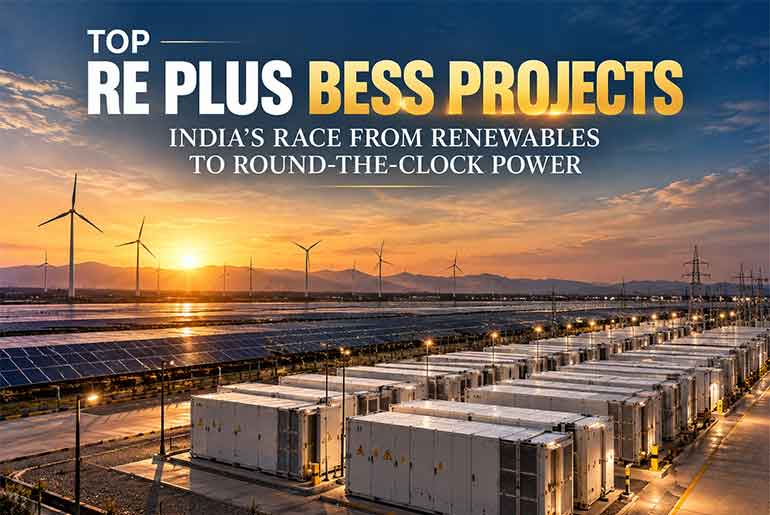
A new chapter in India’s renewable energy story is opening. For years, the emphasis was primarily on how quickly the country could ramp up solar and wind capacity. Today, the question is becoming more important: how much of that renewable power is there when it’s actually needed? That’s where RE plus BESS Projects are changing the conversations.
Developers are increasingly combining renewable generation and energy storage rather than treating them as separate pieces of the power system. Solar plants are now being coupled with batteries. Hybrid solar wind with storage projects are coming together. Large renewable parks are becoming more like flexible power stations than collections of generation assets.
That change can be witnessed in some of India’s biggest projects.
RE-plus-BESS Projects are emerging as a critical part of India’s next wave of power-sector growth, from the massive renewable expansion at Khavda to large storage-linked projects in Rajasthan, Andhra Pradesh, Haryana and other states.
The scale is huge. The Ministry of Power in its projections for BESS in the National Electricity Plan expects India to need 8.68 GW/34.72 GWh BESS by 2026-27 and 47.24 GW/236.22 GWh by 2031-32. Pumped storage will grow in tandem with batteries, demonstrating that storage is transitioning from a supporting technology to an integral part of the electricity system.
Against this backdrop, the following Top RE plus BESS Projects give a useful glimpse into where India’s storage-led renewables market is headed.
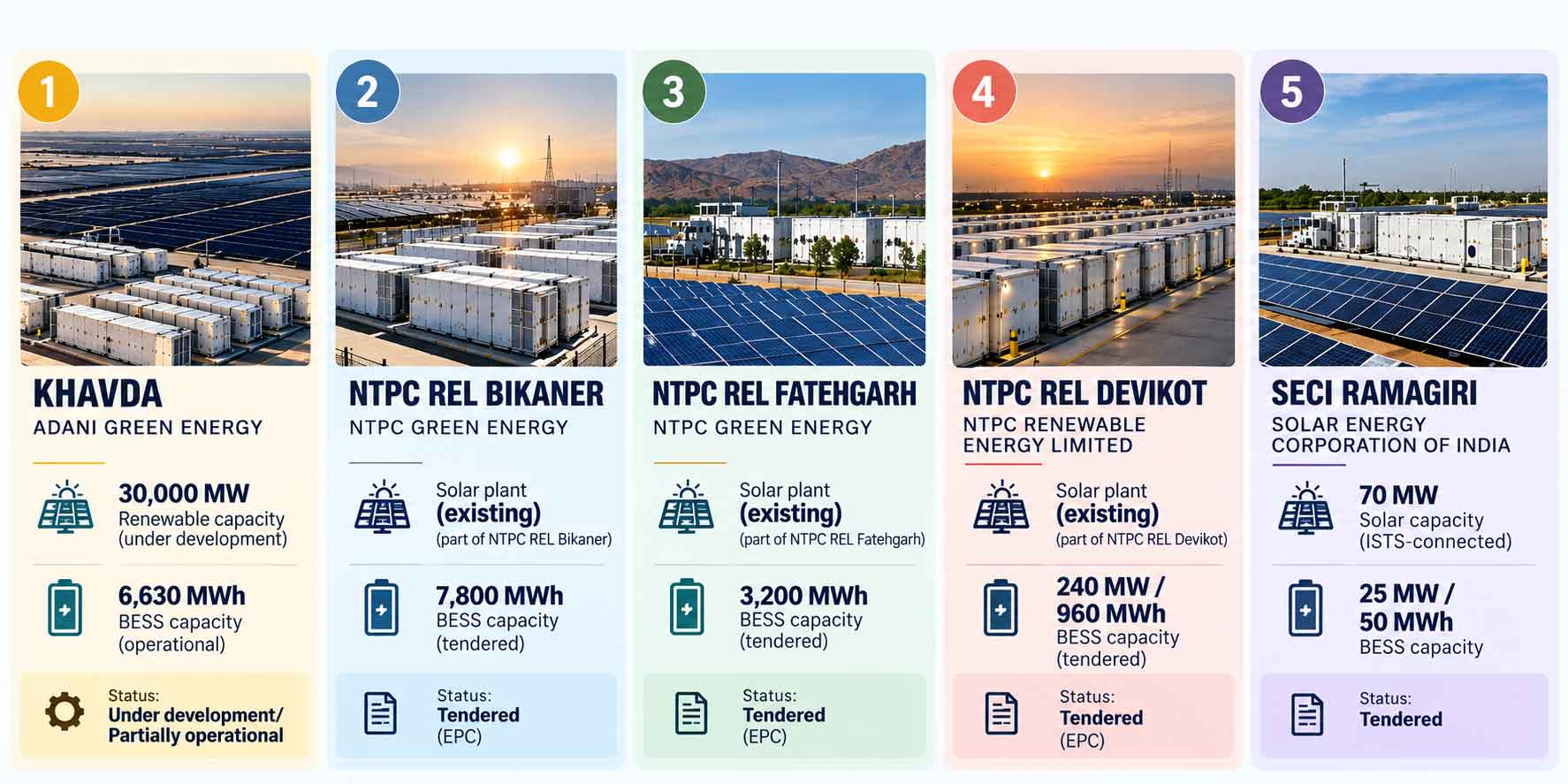
Khavda: Where Scale of Renewables meets Scale of Batteries
India’s renewable ambition is best showcased nowhere better than at the Khavda renewable energy development in Gujarat.
Adani Green Energy is building a 30 GW renewable energy plant at Khavda over 538 sq km. Now the project has gained another defining feature – a very large installation for battery storage.
Adani Green Energy said in October its operational BESS capacity at Khavda has increased to 6.63 GWh from 3.55 GWh as of June. The company said the installation was the largest operational BESS at a single site in the world.
The importance goes beyond the headline figure.
“This battery is being built alongside a huge renewable generation base. It builds the sort of infrastructure India increasingly needs: renewable power that can be moved closer to when it’s needed.
Hence Khavda is top of mind when considering conversation around RE plus BESS Projects as it demonstrates what can happen when renewable generation and storage is planned at very large scale.
The project also shows another significant trend. Storage is not being seen as an emergency backup anymore. At larger renewable parks, BESS can be incorporated into the commercial and operating architecture of the project itself.
NTPC REL Khavda: A Storage Push by the Public Sector
Khavda is not just an Adani story.
NTPC Green Energy Limited has also been working on developing storage capacity at its renewable assets in the region. In May 2026, NGEL floated an EPC tender for developing 3,300 MWh of BESS capacity at NTPC REL Khavda Solar Plant.
Why is this important? It demonstrates how public-sector renewables developers are starting to develop storage on top of existing solar infrastructure.
The model will develop storage alongside large renewable generation assets, rather than designing BESS in isolation.
This is a major step forward for RE plus BESS Projects. Existing renewable parks can provide the generation backbone and BESS adds flexibility and allows developers to build a more dispatchable power product.
NTPC REL Bikaner: Making Solar Parks Storage Hubs
Rajasthan is another major hub for India’s renewable-storage build-out.
In May 2026, NTPC Green Energy Limited issued an EPC tender for 7,800 MWh of BESS capacity at the NTPC REL Bikaner Solar Plant.
That number matters because it shows just how quickly the need for storage can balloon as renewable farms move beyond just generation.
Bikaner has emerged as a significant renewable energy hub due to Rajasthan’s abundant solar resource and large transmission-linked projects. The addition of BESS to this ecosystem changes the role of the park.
During the day, the solar plant can generate lots of electricity, and storage can help get some of that to the evening and peak-demand hours.
This is the basic idea behind the next generation of RE plus BESS Projects, ie, build generation and flexibility instead of solving the two problems separately.
NTPC REL Fatehgarh: Storage Near Existing Solar Infrastructure
NTPC is also developing another big storage project at NTPC REL Fatehgarh Solar Plant. In May 2026, NGEL issued an EPC tender for 3,200 MWh of BESS capacity at the project. The project is not important only because of the size of its storage, but because it is part of a bigger strategy. India already has large renewable generation assets across Rajasthan and other high resource states. The next challenge is to better use that generation.
Storage can help reduce the mismatch between when renewable electricity is generated and when it is consumed.
That makes projects like Fatehgarh particularly relevant to the future of RE plus BESS Projects. The model is slowly shifting from “build renewable capacity” to “build renewable capacity that can serve the grid more intelligently.”
NTPC REL Devikot: 240 MW/960 MWh Battery System
Another example of this transition is the Devikot Solar Plant in Rajasthan. NTPC Renewable Energy Limited (NTPC REL) has issued an EPC tender for 240 MW/960 MWh ISTS-connected BESS at NTPC REL Devikot Solar Plant.
The four-hour configuration is particularly striking.
Theoretically, a 240 MW/960 MWh system could run at rated power for four hours. This longer duration matters because India’s storage need is increasingly going beyond short-duration balancing.
For grids with a lot of renewables, BESS with longer durations can help to push solar generation later into the evening when solar output drops off but electricity demand can be high.
So the Devikot project is another step in the evolution of RE plus BESS Projects from simple capacity addition to time-shifting renewable electricity.
SECI Ramagiri: A Small Project with a Big Message
Not all significant storage projects need to be measured in gigawatt-hours. For example, the Ramagiri project of the Solar Energy Corporation of India in Andhra Pradesh. SECI has invited bids for a 70 MW solar PV project with 25 MW/50 MWh BESS at Ramagiri in Sri Sathya Sai district connected to the ISTS. The numbers might look small compared to multi-GWh projects. But the project is important because it is a direct solar plus-storage configuration being developed by a central renewable-energy agency.
The project indicates that RE plus BESS Projects are starting to emerge at various scales.
It also offers a useful model for future projects where storage is incorporated into the project design from the start rather than added later.
SJVN’s 1.2 GW Solar + 600 MW/2.4 GWh Storage Portfolio
This is another big development, SJVN’s procurement of Solar-plus-storage.
The company has chosen developers to set up 1,200 MW of ISTS-connected solar PV projects with 600 MW/2,400 MWh of energy storage systems anywhere in India.
The selected developers are SAEL Industries, Jindal India Renewable Energy, Sembcorp Green Infra, JBM Renewables, Fastnote Biofuels and Reliance Nu Energies.
The importance of the project structure is the connection of a large renewable generation capacity with a defined storage requirement.
That’s different from designing a solar project and then determining whether to add storage. Here storage is an element of the procurement architecture. That approach could become more common as buyers seek firm, more predictable renewable power.
So, for the burgeoning universe of RE plus BESS projects, SJVN’s procurement model is worth close observation.
Haryana 265 MW/530 MWh BESS Acquisition
SJVN is also pursuing a standalone BESS deployment in Haryana for which it has floated a tender for 265 MW/530 MWh of BESS under the Viability Gap Funding mechanism
Strictly speaking, this is not a RE-plus-BESS project as the tender is for standalone storage.
But it does matter in the larger story.
“Why?”
Because the future renewable-storage market won’t consist entirely of batteries next to solar panels. Some will be co-located with renewable generation, others will operate independently, supporting the grid.
For the assessment of RE plus BESS Projects, this distinction is important.
The larger market is heading for a portfolio of storage models, not a technology or project structure.
Rajasthan Hybrid and FDRE Projects of ACME
Another big player in India’s transition to firm renewable power is ACME Solar. The company has been developing renewable generation combined with BESS in hybrid and storage-linked projects in Rajasthan.
One recently commissioned project includes 53.63 MW/300 MWh of BESS as part of a larger 300 MW/1,581 MWh FDRE project with a PPA with SJVN. The project shows how battery storage can be incorporated into a larger firm and a dispatchable renewable-energy framework. The aim is not only to produce solar power when the sun is shining. That is to create a renewable-energy product that fits a buyer’s demand profile better.
This is one of the most significant changes across RE plus BESS Projects.
“The industry is gradually shifting away from capacity thinking to output thinking.”
The question is no longer, “How many megawatts of solar are you building?
“How much reliable renewable electricity can you deliver and when?” is the increasingly
ACME Bikaner Hybrid Project
ACME is also working on a bigger hybrid renewable project in Bikaner with 300 MW of solar and 100 MW of wind. The company has already commissioned a part of the solar capacity and the project is backed by a PPA with NTPC. The storage element of this project is to be assessed separately from other BESS-linked developments at ACME but its significance is in the direction of travel.
Solar and wind generation are complementary to a certain degree. Add storage to such a combination and the project can move further toward a more balanced renewable supply profile.
This is why Bikaner has become an important geography for India’s emerging RE + BESS Projects ecosystem.
Rajnandgaon: Grid & Solar Intelligence, BESS
Another interesting project from Chhattisgarh. SECI has allocated a 100 MW solar PV project with BESS of 40 MW/120 MWh at Rajnandgaon. The project also includes the procurement of a Phasor Measurement Unit, so the story is not only about generation and storage. It’s about grid visibility and control too.
With more renewables on the system, grid operators require better visibility of voltage, frequency and system behaviour. Storage can react quickly, but the grid needs the right monitoring and control infrastructure to take full advantage of that flexibility.
Projects like Rajnandgaon are a glimpse of the future, where RE plus BESS Projects are getting increasingly integrated with advanced grid-management systems.
The Larger Context: From Individual Projects to a New Power Architecture
What’s most interesting about India’s storage story is that these projects are no longer isolated experiments.
They’re starting to see a pattern. Khavda is huge scale renewables and batteries. NTPC’s Bikaner, Fatehgarh, Devikot and Khavda projects are examples of pairing large public sector renewable assets with storage.
The Ramagiri and Rajnandgaon projects of SECI have demonstrated the development of solar-plus-BESS configurations through central procurement.
SJVN’s 1,200 MW solar-plus-storage procurement is a sign of the coming of storage-backed renewable supply as a procurement category.
The FDRE projects at ACME demonstrate that batteries can help bring renewable power closer to a firm, dispatchable product.
It’s the combination of these projects that makes RE plus BESS Projects worthy of attention beyond their individual MW and MWh.
The Real Shift Is From Ability to Capacity
India has already demonstrated it can build renewable generation at scale. The next challenge is much more complicated. Solar output increases considerably during the day. Wind generation is dependent upon weather conditions. Demand does not always fit either pattern.
Storage is the glue that holds these three realities together.
That’s why the RE plus BESS Projects growth is not just a chapter in the battery industry. It is part of a restructuring of the power system itself.
The economics will still be important. Battery costs, financing, land, grid availability, degradation, augmentation and revenue models will all be factors in determining which projects succeed.
But the direction is becoming clearer.
India is starting to construct renewable projects not just for the energy they can produce, but for the services they can offer to the grid.
“The biggest projects will not necessarily be the ones with the biggest solar number on the tender documents.” Increasingly, the winning projects will be those that can package generation, storage, transmission access and dispatchability together into one commercially viable package.
That is the real story behind the Top RE plus BESS Projects coming up across India.
The country is transitioning from a renewable-energy model centred on generation capacity to one focused on usable, flexible and increasingly dispatchable clean power.
As more gigawatt-scale renewable parks add batteries, the line between a solar project and a power plant will keep blurring.
The next generation of clean-energy infrastructure in India will do more than generate electricity.
It will decide when that electricity matters most.
 Electrify your feed! Click here to join our Whatsapp group and to get the latest updates, expert insights, and innovations driving India’s energy storage revolution.