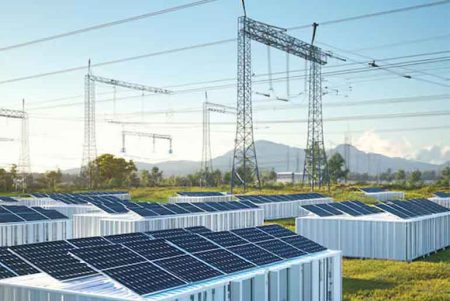
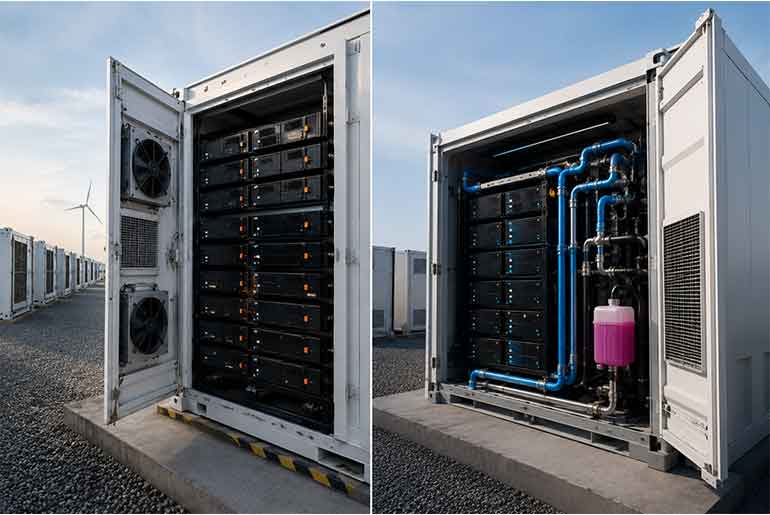
Across the endless deserts of Rajasthan and the sprawling solar parks of Gujarat, thousands of photovoltaic panels spend the day harvesting sunlight that did not exist on India’s grid a decade ago. Yet as the sun disappears beyond the horizon and electricity demand across the country begins to spike, another technology quietly takes center stage—Battery Energy Storage Systems (BESS). But inside every single one of those heavy steel enclosures, an invisible battle is taking place. It is not a battle over power generation or market share. It is a battle against heat. Every battery energy storage asset is designed with a specific lifespan on paper. Financial models are built around it, revenue projections depend on it, and utilities plan their grid stability based on those numbers. The real question, however, is whether the hardware can physically survive the subcontinent’s climate long enough to achieve it. This is why implementing sophisticated Thermal Management Systems for BESS in India has shifted from a minor engineering line item into the single most critical factor determining whether a multi-crore grid asset delivers on its technical promises or degrades into an uninsurable liability.
In simple terms, batteries store energy. Power Conversion Systems (PCS) manage the energy flow. But it is the thermal management architecture that preserves the asset itself. This reality is taking center stage as India’s energy storage market rapidly transitions from small pilot projects to massive, utility-scale deployments. Consequently, the Leading BESS Manufacturers in India are increasingly differentiating themselves not merely through cell chemistry, but through highly advanced thermal control setups engineered specifically to survive the country’s brutal climatic baselines.
Why Thermal Management Systems for BESS in India Have Become a Strategic Necessity
Temperature may appear to be a simple operating parameter, but inside a commercial battery enclosure, it acts as the primary driver of project economics. A lithium-ion battery functions through highly controlled electrochemical reactions that are hyper-sensitive to external and internal temperature fluctuations.
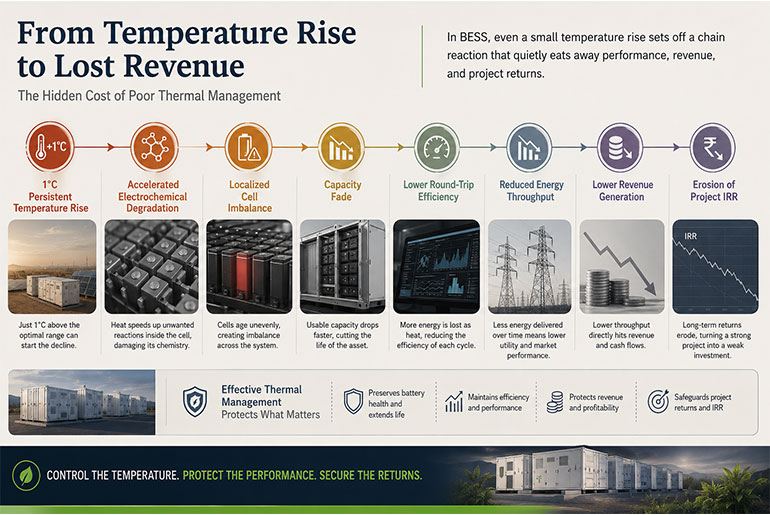
When a battery system charges or discharges at a megawatt scale, internal resistance naturally generates thermal energy. If that heat isn’t rapidly removed, it triggers a destructive operational chain reaction:
1°C Persistent Temperature Rise
↓
Accelerated Electrochemical Degradation
↓
Localized Cell Imbalance
↓
Accelerated Capacity Fade
↓
Reduced Energy Throughput and Efficiency
↓
Lower Project Revenue
↓
Erosion of Project IRR
For BESS EPC Companies in India bidding on highly competitive government tenders with razor-thin margins, this degradation chain is a financial disaster. A utility-scale developer rarely loses money because of a single, sudden system failure; they lose money because a 20-year asset degrades so rapidly under the harsh Indian sun that it becomes a 12-year asset. The entire investment model collapses simply because the internal climate control failed. This economic reality is exactly why modern Thermal Management Systems for BESS in India have evolved from basic auxiliary ventilation into a core strategic requirement to safeguard project returns.
The Battery’s Goldilocks Zone: Neither Too Hot Nor Too Cold
To understand how a thermal management system protects a project’s bottom line, you have to look at the sensitive electrochemistry happening inside the cells. The dominant chemistry utilized across utility-scale Indian storage projects is Lithium Iron Phosphate (LFP), praised for its long cycle life and thermal stability. Yet, even LFP cells demand a surprisingly strict temperature window to perform as promised—a thermal “Goldilocks Zone” strictly between 15°C and 25°C.
When temperatures climb past 35°C, the protective Solid Electrolyte Interphase (SEI) layer inside the cell begins to break down. This causes the cell to consume its active lithium at an accelerated rate, permanently reducing the system’s storage capacity.
Conversely, if a system drops below 10°C, the internal resistance spikes, slowing down chemical reactions and forcing a phenomenon called lithium plating during fast charging cycles, which can cause internal short circuits.
This electrochemical fragility meets a brutal adversary in India’s unique geographic landscape, demanding a dynamic system that handles severe regional extremes:
| Region / Location | Peak Ambient Temperatures | Real-World Operational Impact on BESS |
|---|---|---|
| Rajasthan Deserts | 50°C to 55°C | Extreme ambient heat load; significantly increases the risk of accelerated battery degradation and capacity fade without continuous active cooling. |
| Gujarat Solar Parks | 45°C to 50°C | Intense heat combined with high dust exposure; demands sealed battery enclosures and robust thermal management systems. |
| Delhi NCR / Northern Plains | 45°C+ (Summer) | Severe seasonal temperature fluctuations; requires aggressive cooling during peak summer and controlled heating during winter months. |
| Ladakh / High-Altitude Regions | Sub-zero winters | Elevated internal battery resistance and reduced charging efficiency; necessitates battery pre-heating before high-rate charging operations. |
Operating a mega-scale battery farm across these environments means the role of Thermal Management Systems for BESS in India is not simply cooling. It is comprehensive thermal control—maintaining batteries within their optimal operating zone regardless of external environmental conditions.
Understanding How Heat Is Generated Inside a BESS
Batteries are often incorrectly viewed by project stakeholders as being a secondary source of heat, with the misunderstanding that the only place for heat to originate from is external environmental conditions. However, this is incorrect. Every time a battery goes through a charge and discharge cycle, it generates thermal energy through internal resistance and electrochemical activity. Current flowing through the cells of a battery will generate wasted energy as heat.
Heat generation increases significantly during fast charging, high-power discharge events, frequent cycling, and peak demand support operations. As storage systems scale into larger utility-scale deployments, thousands of cells are packed tightly together within enclosed containers. Without effective heat dissipation, localized hotspots develop.
The issue of temperature is much more than just the reduction of that temperature; the actual challenge is also to keep temperature within strict limits. Temperature differentials of 2-3 degrees Celsius between cells will lead to different aging rates of the various batteries. As one cell degrades much faster than another, the cell that has aged more quickly will have a lower voltage than that of the other cells. The result is that the overall voltage capacity of the entire assembly will be reduced, hence the reason why modern thermal engineering emphasizes maintaining uniform temperatures as much as maximum thermal capacity.
Air Cooling vs. Liquid Cooling: The Engineering Debate Reshaping Utility-Scale Storage
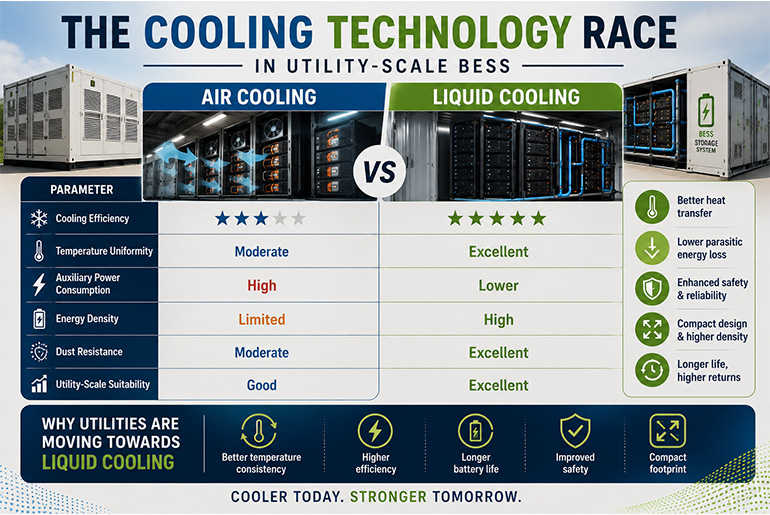
As storage projects become larger and more energy-dense, the industry is transitioning away from traditional air-cooling approaches toward advanced liquid-cooling architectures. While air cooling features a lower initial equipment cost and a simpler mechanical design, it is fundamentally struggling to keep pace with the high-voltage, high-density 1500V architectures dominating modern utility applications.
Air is a poor conductor of heat. When rows of high-density battery racks are packed tightly together, air cooling naturally creates localized hotspots. The cells closest to the HVAC vents stay cool, while the cells deeper in the rack suffocate in trapped heat. This limitation is why the procurement layout for Thermal Management Systems for BESS in India is shifting heavily toward closed-loop liquid cooling, which utilizes a water-glycol coolant mixture running through ultra-thin aluminum cold plates directly touching the individual cells.
Comparative Analysis of Cooling Technologies
| Engineering Parameter | Traditional Forced Air Cooling (HVAC) | Modern Closed-Loop Liquid Cooling |
|---|---|---|
| Cooling Efficiency | Moderate; temperature variations across racks are common. | High; excellent temperature uniformity (less than 2°C variance). |
| Auxiliary Power Consumption | Higher fan and HVAC energy requirements drain system efficiency. | Lower overall thermal management energy demand; can reduce parasitic load by 20–30%. |
| Spatial Footprint | Larger due to mandatory airflow corridors and bulky ductwork. | More compact design architecture; can save up to 40% of installation space. |
| Maintenance Complexity | Simpler maintenance but high dust and filter exposure in arid regions. | More sophisticated but highly controlled, with a completely sealed cooling loop. |
For many BESS EPC Companies in India, liquid cooling is becoming the standard requirement in major government procurement tenders. The reduction in parasitic power draw alone—meaning less electricity is wasted running the cooling equipment itself—directly boosts the project’s Round-Trip Efficiency (RTE), making the asset significantly more profitable on the open power market.
Why Thermal Management Systems for BESS in India Are Moving Towards Intelligence
The next major evolution of thermal management is not happening in the hardware domain; it is being driven by software. Historically, cooling systems operated on a reactive control loop: a battery heated up, sensors detected the increase, and the cooling equipment responded.
Modern Thermal Management Systems for BESS in India are becoming completely predictive. Advanced Battery Management Systems (BMS) now communicate continuously with thermal management platforms. By analyzing charging behavior, discharge patterns, current flow from the grid, and operating conditions, the system can anticipate thermal spikes before they even occur. Instead of reacting to heat, it prevents heat from developing in the first place.
Battery thermal management is evolving to become a ‘live’ system due to advances in artificial intelligence, predictive analysis and digital twin technology. Virtual replicas of physical battery containers are stored in the cloud to enable users to predict when thermal anomalies may occur and make real-time adjustments to their cooling systems, balance temperatures between individual battery compartments and adjust their cooling energy consumption based on weather forecasts. As the size and worth of storage facilities continue to increase, predictive thermal knowledge will probably be what differentiates bankable projects from those that are not.
How the Leading BESS Manufacturers in India Are Turning Thermal Management Into a Competitive Advantage
The market for energy storage is maturing rapidly. As battery cells become increasingly standardized globally, competitive differentiation is shifting away from basic cell procurement and toward advanced system integration, safety engineering, and thermal performance.
For the leading BESS Manufacturers in India there is acknowledgement that building integrated, climate hardy storage systems that meet the subcontinent’s operating environment will be key to long-term commercial success. Leading Indian manufacturers are following the same best practices created by global innovators like Tesla, Fluence, CATL and Sungrow, and as a result, these manufacturers are investing significant amounts of money into creating integrated cooling architectures.:
- GoodEnough Energy: With their massive 7 GWh dedicated BESS manufacturing facility in Greater Noida, they focus heavily on creating highly integrated, rugged thermal setups engineered to handle sudden, massive industrial load steps and replace heavy diesel backup setups without thermal tripping.
- Exide Energy & Amara Raja: As India’s traditional battery titans establish massive gigafactories for localized cell production, they are designing their upcoming storage packs with customized internal spacing and integrated liquid-cooling channels to optimize the physical thermal contact area right at the factory level.
- Tata AutoComp Gotion: A major force in utility-scale integration, they have pioneered high-density, liquid-cooled pack manufacturing. Supplying massive standalone grid-support installations across the country, their engineering focus links localized liquid chillers directly to the main BMS for cell-level balancing.
The commitment of these Leading BESS Manufacturers in India reflects a broader industry trend: thermal management is no longer being treated as an added accessory. It has become the core design philosophy.
The Container, The PCS, and The Thermal Loop: An Engineering Partnership
A common misconception is that thermal management exists independently from the rest of the storage system. In reality, thermal performance depends on the successful integration of multiple engineering disciplines, demanding an absolute technical handshake across hardware layers.
The Role of the Battery Container
For every Battery Container Manufacturer in India, thermal design has become just as important as structural engineering. Modern BESS containers must do far more than house batteries; they must act as a high-performance thermal shield. The enclosure walls must integrate advanced insulation layers to prevent blinding external desert heat from radiating into the battery compartments.
In addition, since liquid-cooled systems use cold liquids inside hot spaces; a well-designed container will have adequate condensation management systems and separate plumbing for the fluids. This allows any microscopic weeps of cold fluid or droplets of condensation to be collected and drained without having any contact with the energized high voltage electrical terminals.
The Influence of the PCS Layer
The engineering challenge becomes even more complex when power electronics enter the thermodynamic equation. The inverter and conversion equipment selected by the chosen PCS Supplier for BESS in India generate substantial heat during operation due to the rapid switching actions of high-power transistors converting megawatts of power from AC to DC.
Thermal Runaway: The Failure Every Developer Wants to Avoid
No discussion about thermal management is complete without addressing thermal runaway. Thermal runaway occurs when a cell is driven past its safe thermal threshold by an internal defect, mechanical damage, or extreme external heat, triggering an uncontrollable, self-sustaining chemical reaction. The cell begins generating heat faster than it can dissipate it, creating a dangerous cascading effect:
Cell Overheating → Internal Heat Generation → Gas Venting → Thermal Propagation → Fire Event
While full-scale container incidents remain rare, their financial and safety consequences are severe. This is exactly why advanced Thermal Management Systems for BESS in India serve as the absolute first line of defense. By maintaining a constant, high-velocity flow of thermal fluid directly against the cell faces via liquid cold plates, the system acts as a massive heat sink. If a single cell suffers an internal short circuit, the cooling loop rapidly absorbs and dissipates that localized surge of heat, preventing neighboring cells from hitting their critical ignition point.
Industry standards such as IEC 62619, UL 1973, and UL 9540A are increasingly shaping how developers, manufacturers, and regulators evaluate system safety. For project developers working under the Central Electricity Authority (CEA) grid connectivity guidelines, preventing thermal runaway propagation is not simply a safety objective—it is a baseline bankability requirement.
Real-World Grid Deployment: The Indian Climate Case Study
The practical value of integrating climate-hardened thermal platforms is clearly demonstrated by real-world deployments running on India’s power network today. A prime operational example is the landmark utility-scale storage system commissioned by BSES Rajdhani Power Limited (BRPL) in Delhi—a 20 MW / 40 MWh grid-connected battery facility.
Operating directly inside the intense urban heat island of the Delhi NCR region, this large-scale facility faces the ultimate environmental test. During peak summer months, ambient temperatures across the capital regularly hover above 45°C, right when power demand for air conditioning spikes across the city’s distribution network.
The storage asset’s core job is grid stabilization—absorbing excess renewable power when available and discharging it rapidly during evening peak hours to prevent transformer overloads.
Because the system relies on high-density LFP cells, a standard air-cooled setup would have required massive auxiliary power to combat Delhi’s intense summer climate, severely lowering the project’s overall efficiency. By utilizing an integrated, liquid-cooled thermal management loop tied directly to real-time grid response software, the facility successfully maintains uniform cell temperatures even under maximum charge and discharge cycles during peak summer heatwaves. This deployment stands as a definitive blueprint for how smart thermal engineering can secure long-term asset bankability in the harshest environments.
Conclusion
Battery Energy Storage Systems are often discussed in terms of megawatt-hours, round-trip efficiency, and cell chemistry. Yet beneath these macro metrics lies a simpler truth: every battery naturally generates heat, and how you manage that heat dictates your project’s financial survival.
Batteries hold the raw energy, the PCS translates it, and the container protects it. But it is the thermal management system that preserves it over its promised 20-year lifespan.
As India moves toward a future defined by large-scale renewable integration and expanding storage infrastructure, Thermal Management Systems for BESS in India will remain central to project success. For utilities, developers, investors, and the Leading BESS Manufacturers in India, thermal engineering is no longer an afterthought or a supporting function—it is the invisible guardian of grid reliability, operational safety, and long-term asset bankability. In the energy transition, temperature may be the quietest variable in the room, but it is undoubtedly the most important.
 Electrify your feed! Click here to join our Whatsapp group and to get the latest updates, expert insights, and innovations driving India’s energy storage revolution.