



As Battery Energy Storage Systems move from standalone assets to active participants in increasingly complex power markets, the question is no longer simply how much energy a battery can store, but how intelligently it can operate. For The Battery Magazine, Shweta Kumari, Sub-Editor, The Battery Magazine, engaged in a thought-provoking discussion with Dr. Kumar M or Muvva, Founder & CEO, Smartgrid Analytics, exploring how intelligent Energy Management Systems are reshaping the way BESS assets are controlled, optimised and validated.
The conversation moves beyond conventional monitoring into real-time decision-making, battery constraints, market signals, degradation economics, grid-code compliance and AI-enabled optimisation. Smartgrid Analytics draws on experience across more than 9 GWh of storage in 21 countries, offering insights into what changes when an EMS moves from a design specification to a live-grid environment.
The discussion also examines why AI should propose while deterministic systems retain control over critical grid decisions, and what India must build in its digital energy infrastructure to unlock the full value of storage.
Smartgrid Analytics has moved beyond monitoring towards EMS, optimisation and autonomous decision-making. As BESS becomes an active grid asset, what decisions must an intelligent EMS make in real time that conventional SCADA systems cannot?
In my experience, SCADA answers what is happening. An EMS answers what should happen in the next interval, and what am I giving up to do it. That is a different class of problem. We have seen firsthand that determining how much power a battery can actually deliver at any moment is a much more complex challenge than most realise. The first real-time decision is how much power this battery can actually deliver right now, which is rarely the nameplate. It is the minimum of a dozen independent ceilings: state of health, C-rate, state-of-charge headroom and taper, cell-voltage proximity to limits, temperature derating, cell imbalance, the weakest rack in the string, and data quality. Those ceilings move every few seconds. Conventional SCADA has no model that produces that number.
Another challenge I frequently encounter is arbitration between conflicting signals. A market schedule says discharge. A frequency excursion says respond within 200 milliseconds. A grid code says ride through and do not trip. A contract says charge only from the co-located solar. Those instructions conflict several times a day, and something must rank them deterministically without a human in the loop. Across twenty-one country grid codes, we have learned that the decision logic stays constant while the envelope around it does not. CAISO, India’s CEA and the Gulf codes each demand different behaviour from the same battery in the same second. An EMS carries that envelope. SCADA has no concept of one.
Your Solvyn platform has been deployed across utility-scale renewable and storage projects, including a 40 MW/120 MWh BESS project in Rajnandgaon. What have real-world deployments taught you about the gap between designing an EMS on paper and operating one reliably on a live grid?
Three things, none of which appear in a specification. These are patterns drawn from more than 9 GWh of storage across twenty-one countries, not lessons from a single site. First, trust me when I say: the data will lie. I’ve personally seen a battery management system report a perfect 100% state of health, frozen there after 69 equivalent full cycles. We have encountered current registers stuck with a 1,440 amp offset. Sorting out sign conventions, register offsets, and dropouts often takes longer than writing the control logic itself.
Second, your own models will drift, and you’ll only catch it if you build active checks. Our digital twin once uncovered a flaw where our scheduling software accounted for all round-trip losses on the discharge side. On the plant, predicted state of charge drifted more than thirteen percentage points a day and the schedule over-subscribed charging by 14 to 20 megawatt-hours daily. Nothing alarmed. It quietly cost energy.
Third, the binding constraint is rarely the one you designed for. Rajnandgaon was India’s first EMS deployment for us, and the hard requirement was not market performance but that the battery charge only from co-located solar while meeting CEA norms. Since then, across projects as large as 300 MW and 1,400 MWh, I’ve seen over and over that contract terms often bind the operation before physical limitations do.
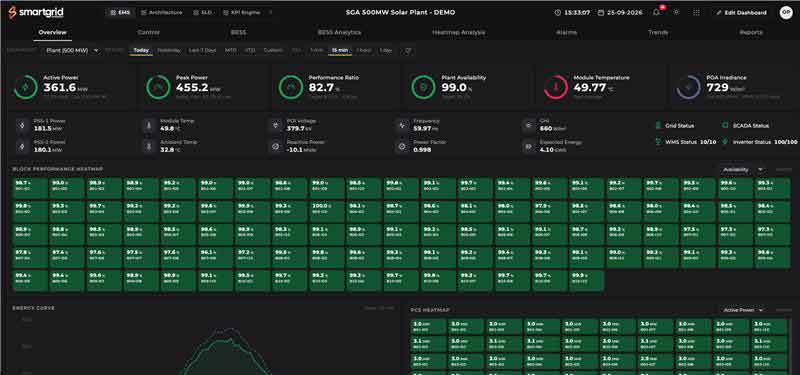
BESS economics are increasingly linked to multiple revenue streams—energy arbitrage, ancillary services, renewable optimisation and potentially power-market participation. How should software balance battery degradation, market prices, forecasts, grid constraints and contractual commitments when deciding when and how a battery should operate?
Degradation should be priced, not avoided. Every cycle carries a marginal cost in lost life. If the market pays more than that cost, the cycle is correct. Without a number, operators default to caution and leave revenue unearned. Computing it requires real physics. We run online rainflow cycle counting to identify closed cycles, then apply a depth-of-discharge exponent with a throughput term, an Arrhenius temperature factor, and a C-rate factor above a threshold. Calendar ageing runs in parallel on a square-root-of-time law with a state-of-charge stress factor. That parallel path overturns a common intuition. A battery parked at high state of charge through a hot afternoon often degrades faster than one cycling moderately at mid state of charge. Refusing to cycle is not the conservative choice operators assume it is.
At plant scale, this compounds. A 200 megawatt-hour installation is dozens of containers, and they do not age at the same rate. The optimiser must decide continuously whether to derate the whole plant to its weakest rack or drop that rack out, a choice with both revenue and warranty consequences. Everything else is hierarchy. Grid-code and contractual obligations are constraints, not optimisation terms. You do not trade a frequency response obligation for arbitrage margin at any price. Inside that boundary, the optimiser minimises delivered cost plus weighted carbon gap plus weighted deviation risk, less a reliability margin. The weights differ by market. Operating across twenty-one grid codes means twenty-one different revenue stacks and penalty regimes, and in India the deviation settlement mechanism turns forecast error directly into cash. Forecast accuracy is not an input to the revenue model. It is a revenue stream.
Smartgrid Analytics is increasingly combining AI, digital twins and energy-market intelligence. Where can AI genuinely improve BESS operations today, and where should critical grid decisions remain deterministic, explainable and under human control?
A: We have found AI earns its place wherever the problem is statistical, and the error is measurable and tolerable. Generation, load and price forecasting. Degradation estimation, particularly where the BMS cannot be trusted. Pattern recognition across a fleet, where one plant’s anomaly becomes another’s early warning, which is only possible at portfolio scale. And search across large schedule and bid spaces where combinatorics defeat a human planner. It must not decide anything inside the protection or compliance envelope. Ride-through, frequency response, ramp-rate limits, point-of-interconnection compliance. FERC Order 909 and PRC-029-1 do not accept “the model inferred it.” Neither does an Indian load despatch centre, and neither do the other nineteen regulators we answer to.
Our working rule is that AI proposes and the deterministic layer disposes. The optimiser may request anything. The limits engine then composes every ceiling explicitly, returns what is permitted, and names the binding constraint, not a score, but the actual reason: temperature derate, voltage proximity, weakest rack.
That naming is not a nicety. It is how you settle a dispute with a grid operator six months after an event, in whichever jurisdiction the plant sits. Explainability has to be designed in, not added afterwards.
Looking towards 2030, what will become the real competitive differentiator for utility-scale BESS: better batteries, better PCS, or better operational intelligence—and what does India need to build in its digital energy infrastructure for storage to deliver its full grid and economic value?
Cells and power conversion will converge. Chemistry gains diffuse across the industry within a cycle or two, and every serious PCS already meets grid code. Hardware advantage has a short half-life. What does not converge is the operating record. Every settlement interval teaches the model something about that plant, that climate, that code. A platform that has commissioned 107 GW of renewable assets across more than 500 projects, including over 9 GWh of storage in twenty-one countries, has met failure modes a new entrant cannot buy its way to. That record is the moat, and unlike a cell chemistry, it cannot be licensed. So the differentiator in 2030 will be operational intelligence, and it compounds rather than depreciating.
For India to capture the full value of storage, four things need building.
Data access as a right. Asset owners cannot optimise what they cannot see. BMS and PCS data should be exportable by default, not negotiated project by project.
Market granularity matched to the asset. Fifteen-minute blocks are a floor. Storage responds in milliseconds and should be able to sell that.
Settlement transparency, so a battery can prove what it actually delivered, interval by interval.
Cybersecurity specified at tender, with IEC 62443 in procurement rather than retrofitted after commissioning.
India is running the hardest version of this problem anywhere in the world. Software that works here works everywhere, and that is the export opportunity hiding inside the energy transition.
 Electrify your feed! Click here to join our Whatsapp group and to get the latest updates, expert insights, and innovations driving India’s energy storage revolution.