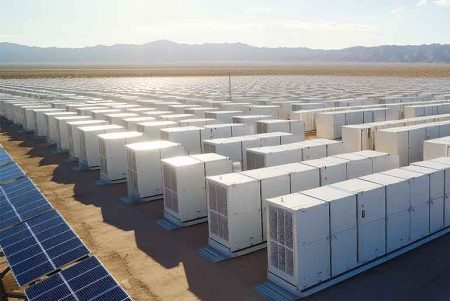

Right now India is entering its hottest days of the Year and it feels like you are stepping outside in Rajasthan during peak summer. The roads shimmer. Metal burns to the touch. Air conditioners groan under pressure (Indirectly leading to more heat in the Environment) Even the wind feels hot. Now imagine placing thousands of battery cells inside giant storage containers under this same 48°C sun and expecting them to power India’s future reliably for the next 15 to 20 years.
That is the real India Energy Challenge.
For years, the global energy conversation was mainly about adding more solar panels, wind turbines and hydro. India did that rapidly. According to the Ministry of New and Renewable Energy (MNRE), India has already crossed 154 GW of installed solar capacity, making it one of the world’s fastest-growing renewable energy markets. But now the country is entering a far more difficult phase of the clean energy transition — making renewable energy stable, reliable, and available even after sunset.
This is where battery energy storage systems, or BESS, enter the picture. But unlike Europe or parts of China, India’s battery storage journey is not unfolding in mild temperatures. It is unfolding in deserts, industrial belts, humid coastal regions, and heatwave-prone cities. And this India Energy Challenge is changing how batteries are being designed from the ground up.
The biggest enemy inside a battery system is not always poor charging or overuse. Sometimes, it is simply heat.
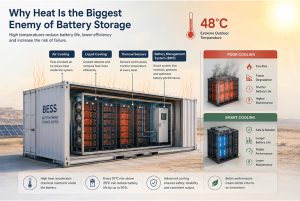
While we are outside, we can feel our Cell Phones heating up and same goes for battery cells, it naturally generate heat while charging and discharging. Under normal temperatures, this can be managed. But when outside temperatures climb above 45°C, the stress multiplies rapidly. Inside a utility-scale battery container, temperatures can rise even further because of solar radiation and continuous cycling. This affects battery efficiency, charging speed, lifespan, and safety.
In simple words, a battery that performs perfectly in Germany may struggle badly in Gujarat or Rajasthan.
This is why thermal management is suddenly becoming one of the most important conversations in India’s energy sector. Earlier, the industry mostly focused on battery chemistry and energy density. Today, engineers are equally focused on cooling systems, airflow design, heat dissipation, and fire safety architecture.
The India Energy Challenge is no longer only about storing electricity. It is about keeping that stored energy stable under brutal environmental conditions.
Across the industry, companies are now shifting from basic air-cooled systems toward advanced liquid-cooled battery technologies. Air cooling may work in moderate climates, but India’s summers are pushing many developers toward more aggressive cooling methods that can maintain uniform temperatures inside battery packs.
Some companies are also exploring immersion cooling technologies, where battery cells are submerged in special cooling fluids to control thermal stress more efficiently. While these systems are still evolving commercially, they reflect how seriously the heat problem is being taken.
And the timing could not be more critical.
India’s renewable energy expansion is happening mainly in some of its hottest regions. Massive solar parks are rising across Rajasthan, Gujarat, and other dry zones where temperatures regularly cross 45°C. Ironically, the places generating the most clean energy are also the harshest for battery storage infrastructure.
At the same time, India’s electricity demand patterns are changing rapidly.
Heatwaves are increasing cooling demand across cities and industries. Air conditioners continue running late into the evening, exactly when solar generation drops to zero. This creates a dangerous imbalance between demand and supply, commonly known in the power sector as the “duck curve.”
Without storage, solar power disappears precisely when India needs electricity the most.
This is why the India Energy Challenge is directly linked to battery storage growth. According to market estimates from the India Energy Storage Alliance (IESA), India’s battery storage market could exceed 160 GWh by 2030 as utilities, industries, and renewable developers increasingly invest in large-scale storage infrastructure.
Government agencies are already accelerating this shift. SECI, NTPC, NHPC, and other public sector organizations are issuing massive battery storage tenders linked with renewable energy projects. Recently, NTPC Green Energy floated an 800 MW/3200 MWh battery energy storage EPC tender at Khavda in Gujarat, highlighting the scale at which India is preparing for the storage era.
But another important question is emerging quietly in the background: which battery chemistry can truly survive India’s climate?
The simplest and oldest method is air cooling. In this system, large industrial fans circulate cool air inside battery containers to remove excess heat. Many early battery energy storage systems globally relied on air cooling because it was cheaper and easier to install. Air cooling still works reasonably well in moderate climates where temperatures remain stable for most of the year.
But India’s climate is forcing the industry to rethink this approach.
During extreme Indian summers, hot outside air itself becomes a problem. If the ambient temperature is already 46°C, simply pushing more hot air through a container does not cool batteries efficiently. In many cases, air cooling struggles to maintain uniform temperatures across all battery cells, creating dangerous hotspots inside the pack. Over time, these hotspots reduce battery life, lower efficiency, and increase fire risks.
This is why liquid cooling is rapidly becoming the preferred solution for large-scale Indian battery storage projects.
In liquid-cooled systems, special cooling fluids move through pipes or cooling plates placed around battery cells. Liquids absorb heat much faster than air, making temperature control far more stable and efficient. Even when outside temperatures rise sharply, liquid cooling can maintain balanced internal temperatures across the battery pack.
Many global research studies now show that liquid-cooled systems can significantly improve battery lifespan and reduce thermal degradation in high-temperature environments. According to several energy storage market reports, liquid cooling is expected to dominate next-generation utility-scale BESS deployments, especially in countries with extreme weather conditions like India and the Middle East.
Another advanced technology slowly entering industry discussions is immersion cooling.
This method sounds futuristic because batteries are directly submerged inside special non-conductive cooling fluids. Instead of cooling batteries indirectly, the fluid absorbs heat immediately from every surface of the cell. Immersion cooling offers extremely fast and uniform thermal management, making it attractive for high-density battery applications.
Although still expensive for large-scale commercial deployment, researchers believe immersion cooling could become highly important for future ultra-fast charging systems, data centers, and long-duration battery storage projects where heat loads become extremely intense.
Hybrid cooling systems are also emerging as a middle path. These systems combine air cooling and liquid cooling together to improve efficiency while controlling costs. Some developers are designing systems where liquid cooling handles the battery pack directly while air cooling manages the overall container environment.
But cooling technology today is no longer only about hardware. The most interesting transformation is happening quietly through software.
Modern battery systems are becoming intelligent. Advanced Battery Management Systems (BMS) can now monitor temperature patterns, predict thermal behavior, identify weak cells, and optimize charging cycles in real time. Artificial intelligence and predictive analytics are slowly entering the storage sector, turning batteries from passive storage boxes into smart energy systems.
The future battery may not just store power. It may think, adapt, and protect itself.
When people speak about India’s clean energy future, they often focus on gigawatts of solar and wind capacity. But the real success of renewable energy will depend on whether India can store that energy safely and efficiently during its most extreme weather conditions.
Because in the end, the India Energy Challenge is not simply about producing renewable power. It is about engineering energy systems strong enough to survive India itself — its scorching summers, rising electricity demand, fragile grids, and ambitious net-zero goals.
And the companies that solve this heat problem may ultimately shape the future of India’s entire energy transition.
 Electrify your feed! Click here to join our Whatsapp group and to get the latest updates, expert insights, and innovations driving India’s energy storage revolution.