
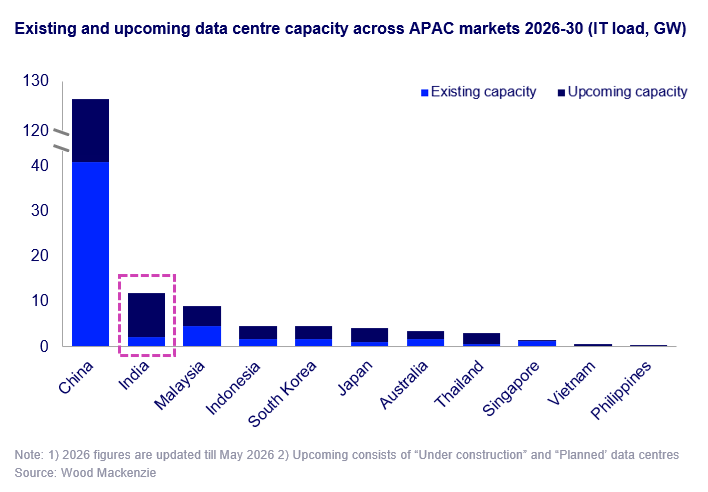
India’s data centre industry is entering a major structural growth phase, with operational capacity projected to rise from 2.2 GW in 2025 to 12 GW by 2030, according to a new report by Wood Mackenzie. The expansion is being driven by rapid digitalisation, artificial intelligence (AI), hyperscale cloud adoption and increasing demand for high-performance computing infrastructure.
The report, titled India’s Data Centre Landscape: Powering the Digital Economy, estimates that the market will grow at a compound annual growth rate (CAGR) of approximately 40% through 2030. AI-focused data centre capacity is expected to witness even faster growth, expanding nearly 24-fold from 275 MW in 2025 to 6,546 MW by 2030.
Wood Mackenzie Research Associate Souhardya Pal said the convergence of hyperscale investment, rising AI workloads and sustained policy support has positioned India as a major data centre investment opportunity in the Asia-Pacific region.
India’s rapidly expanding digital economy is emerging as a key driver of infrastructure demand. The country’s digital economy was valued at INR 32 trillion in 2025 and accounted for around 12% of GDP. With more than 1.03 billion active internet users and approximately 22 billion UPI transactions processed every month, the demand for digital infrastructure is expected to continue rising. Meanwhile, India’s domestic AI market is projected to reach INR 11.7 trillion by 2032.
The growth of data centres is also expected to significantly increase electricity consumption. Wood Mackenzie forecasts data centre electricity demand to rise 20-fold from 10 TWh in 2025 by 2040, potentially accounting for 7% of India’s total electricity demand.
Maharashtra and Tamil Nadu currently account for around 65% of the country’s installed IT load. However, the next phase of development is expected to broaden across Andhra Pradesh, Telangana, Uttar Pradesh and Karnataka. These markets are attracting investments and commitments from global technology companies, including Amazon Web Services and Google, as well as domestic operators such as AdaniConnex, which has announced a 2.6 GW development pipeline.
Power availability is emerging as the most critical factor shaping data centre locations. According to Wood Mackenzie, reliable and cost-competitive power has overtaken land and capital as the industry’s primary constraint. Developers are increasingly turning to captive generation and long-term renewable power purchase agreements (PPAs) to secure electricity, control operating costs and meet decarbonisation targets.
States offering liberalised open-access frameworks and competitive intra-state transmission charges could gain an advantage in attracting future data centre investments. Wood Mackenzie Vice President of Research Dr. Rashika Gupta said access to firm, round-the-clock power at the node level will increasingly determine site selection and project delivery timelines.
At the same time, water availability is emerging as another strategic risk. Rising AI workloads and higher rack densities are increasing cooling requirements, placing additional pressure on water resources, particularly in water-stressed regions such as Tamil Nadu and Karnataka. Developers are therefore exploring closed-loop cooling and zero liquid discharge technologies to reduce freshwater consumption.
With strong digital demand, expanding renewable energy availability, supportive policies and rapid AI adoption, India is poised to become one of the world’s fastest-growing data centre markets. However, securing reliable power, managing water resources and choosing locations with resilient infrastructure will be crucial for sustaining the sector’s long-term expansion.
 Electrify your feed! Click here to join our Whatsapp group and to get the latest updates, expert insights, and innovations driving India’s energy storage revolution.