India’s electric mobility transition is gathering pace, with 29 of the country’s 36 States and Union Territories now having notified electric vehicle (EV) policies, NITI Aayog officials said at a workshop on state EV policies.
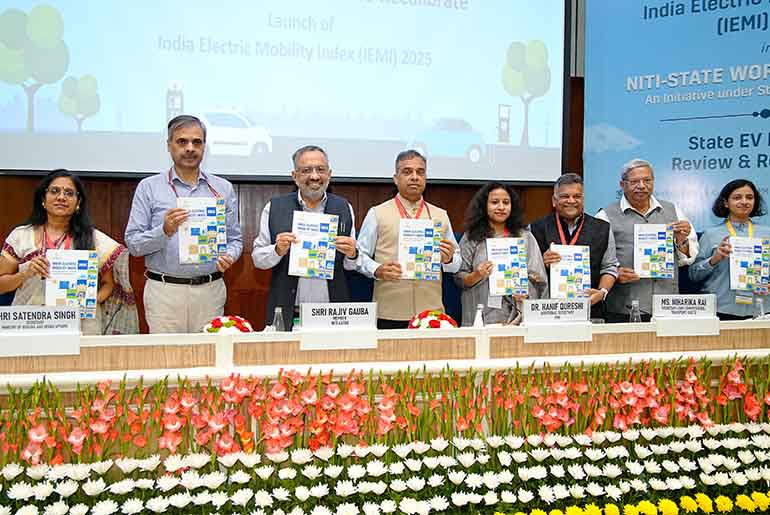
Speaking at the NITI Aayog Workshop on State EV Policies, Rajiv Gauba highlighted the accelerating global shift towards electric mobility and called the transition an economic, environmental and strategic priority for India’s Viksit Bharat 2047 vision. The event also saw the launch of the second edition of the India Electric Mobility Index (IEMI) report.
Gauba pointed to the rapid growth of EV adoption globally. In 2025, electric cars accounted for around one-tenth of new car sales in the US, more than a quarter in the European Union and over half in China. He said these shares are expected to increase substantially in the coming years.
He also referred to the recent West Asia crisis as a potential inflection point for electric mobility, drawing a parallel with the oil crises of the 1970s, which contributed to a stronger global focus on fuel efficiency.
EVs Linked to Energy Security and Economic Growth
Gauba stressed that accelerating EV adoption is particularly important for India because of its heavy dependence on imported crude oil. India currently imports nearly 89% of its crude oil requirements, and rising vehicle ownership could further increase oil demand unless the transition to electric mobility accelerates.
The automotive sector accounts for approximately 7.1% of India’s GDP and supports nearly 1.9 crore jobs, making its alignment with the global shift towards electric vehicles strategically significant.
He also highlighted the public health implications of transport emissions, particularly in major urban centres such as Delhi, where vehicular pollution contributes to significant health and economic costs.
Government Support Exceeds ₹92,000 Crore
The government has already committed more than ₹92,000 crore in support for electric mobility and related manufacturing, Gauba said.
The support includes initiatives such as FAME, PM E-DRIVE and PM E-bus Sewa, along with production-linked incentive schemes covering automobiles and auto components and advanced chemistry cell battery storage.
At the same time, India’s EV charging network is expanding, with oil marketing companies and private-sector players investing in charging infrastructure. The newly launched Unified Bharat e-Charge app is expected to improve access to charging stations and make charging more convenient for EV users.
State EV Policies Show Broad-Based Improvement
The second edition of the India Electric Mobility Index indicates continued progress among States and Union Territories. The highest State score increased from 77 to 84, while the median score rose from 36 to 40 over the past year.
The Index is intended to provide States with a data-driven framework for tracking EV adoption and evaluating the effectiveness of their policies. It can also help policymakers identify areas requiring additional intervention and develop evidence-based strategies.
Gauba noted that differences in the pace and nature of EV adoption across States reflect variations in industrial capacity, fiscal resources, geography and policy priorities. Rather than viewing these differences as a challenge, he said States can benefit by learning from one another and adapting successful approaches to their own circumstances.
Focus on Public Transport and Charging Infrastructure
Gauba urged States to focus on electrifying public transport, particularly in selected cities where EV adoption can deliver significant mobility and environmental benefits.
He also called for charging infrastructure to be well distributed geographically and reliable, while encouraging greater investment in research, development and innovation.
The emphasis on state-level action comes as India seeks to expand electric mobility while simultaneously addressing energy security, urban air pollution, industrial competitiveness and the broader decarbonisation of the transport sector.
 Electrify your feed! Click here to join our Whatsapp group and to get the latest updates, expert insights, and innovations driving India’s energy storage revolution.