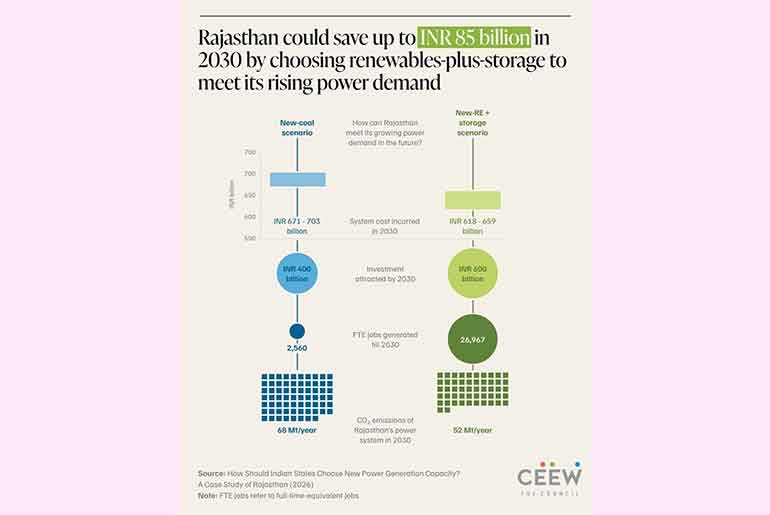
Rajasthan could meet its rising electricity demand more economically through a mix of solar, wind and battery energy storage systems (BESS) rather than contracting 3,200 MW of new coal capacity, according to a new analysis by the Council on Energy, Environment and Water (CEEW).
The assessment modelled Rajasthan’s power system at 15-minute intervals through 2030 to examine whether the proposed coal capacity would be the least-cost option for maintaining reliable electricity supply. The study projects that the state could face an electricity shortfall of around 5.5 billion units (BU) in 2030.
Importantly, nearly 90% of this projected shortfall is expected during non-solar hours, when solar power is unavailable. This increases the importance of flexible resources that can respond quickly to changes in electricity demand, including battery storage.
CEEW’s modelling suggests that an alternative portfolio combining solar, wind and battery storage could meet the same reliability requirement as the proposed new coal capacity. The renewable-plus-storage route could also offer significant financial benefits to Rajasthan’s distribution companies (discoms).
By 2030, the alternative mix could cost up to ₹85 billion (₹8,500 crore) less to procure compared with new coal capacity. In addition, Rajasthan’s discoms could earn around ₹35 billion (₹3,500 crore) more by selling surplus electricity on power exchanges.
The findings highlight the growing role of battery energy storage systems in managing renewable intermittency and meeting peak or non-solar-hour demand. Unlike conventional generation, batteries can store excess renewable electricity and discharge it when demand rises or solar generation falls.
The analysis also examines the wider implications of the two pathways, including their potential impact on employment, investment and emissions. The findings suggest that Rajasthan’s future power planning could increasingly benefit from combining large-scale renewable generation with flexible storage capacity rather than relying primarily on additional coal-fired generation.
With Rajasthan already emerging as a major renewable energy hub, the study underscores the need to evaluate new generation capacity not only on reliability but also on long-term costs, flexibility, emissions and the ability to integrate growing renewable power.
 Electrify your feed! Click here to join our Whatsapp group and to get the latest updates, expert insights, and innovations driving India’s energy storage revolution.