The Delhi Electricity Regulatory Commission (DERC) has approved the tariff and Battery Energy Storage System Agreement (BESSA) for a pioneering 12.5 MW/25 MWh grid-forming Battery Energy Storage System (BESS) at the 33/11 kV Shivalik Grid substation, marking what is being described as India’s first distribution-level, grid-forming BESS demonstration project. The project has been developed by BSES Rajdhani Power Limited (BRPL) with The Energy and Resources Institute (TERI) as Bid Manager, in partnership with IIT-Bombay and GIZ.
In its order dated 9 September 2026, the Commission approved a levelised tariff of Rs 35.91 lakh per MW per year — discovered through a transparent, competitive e-Reverse Auction process managed by TERI — for the BESS to be developed and operated by REConnect Energy Solutions Limited on a Build-Own-Operate-Transfer basis.
Why this matters
Unlike conventional battery storage deployed largely for energy arbitrage, the Shivalik project is designed to operate in grid-forming mode, allowing the battery system to function as a virtual power source capable of independently energising sections of Delhi’s dense urban distribution network. This gives it the ability to:
- Support critical loads through islanding during upstream grid disturbances or outages
- Enable faster grid restoration, including black-start capability
- Manage summer peak demand and defer costly network augmentation
- Absorb and balance rising rooftop solar penetration on the network
- Participate in ancillary services (AGC/SRAS) through integration with NRLDC
Officials note that the tariff discovered — nearly 38% lower than the tariff for BRPL’s earlier Kilokari BESS project (2024) — reflects the maturing battery storage market in India and the effectiveness of a well-structured, competitively bid tender process.
A replicable model for urban India
TERI, as the technical bid manager, structured the tender in line with the Ministry of Power’s Guidelines for Procurement and Utilization of BESS. The project is being positioned as a proof-of-concept for grid-forming, distribution-level storage that other urban utilities across India can replicate — particularly in space-constrained cities facing rising peak demand and growing renewable integration challenges.
Project timeline highlights:
- In-principle regulatory approval: November 2025
- Competitive tender floated: December 2025
- L1 bidder selected via e-Reverse Auction: January 2026
- DERC tariff and BESSA approval: September 2026
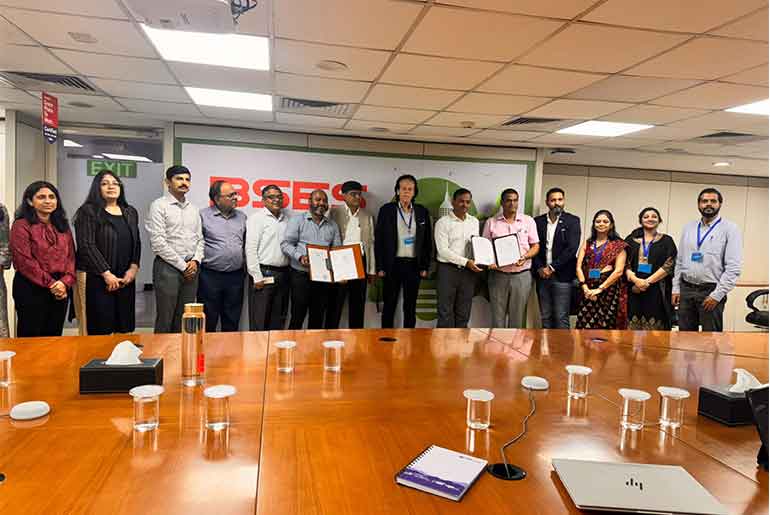
- BESPA signing between developer and BRPL: 16 September 2026
- Commissioning: within 7 months of BESPA signing
The Energy and Resources Institute (TERI), based in India, is an independent, multi-dimensional research organization with capabilities in policy research, technology development, and implementation. An innovator and agent of change in the energy, environment, climate change and sustainability space, TERI has pioneered conversations and action in these areas for over five decades. Headquartered in New Delhi, it has centres in six Indian cities and is supported by a multidisciplinary team of scientists, sociologists, economists, engineers, administrative professionals, and state-of-the-art infrastructure.
 Electrify your feed! Click here to join our Whatsapp group and to get the latest updates, expert insights, and innovations driving India’s energy storage revolution.