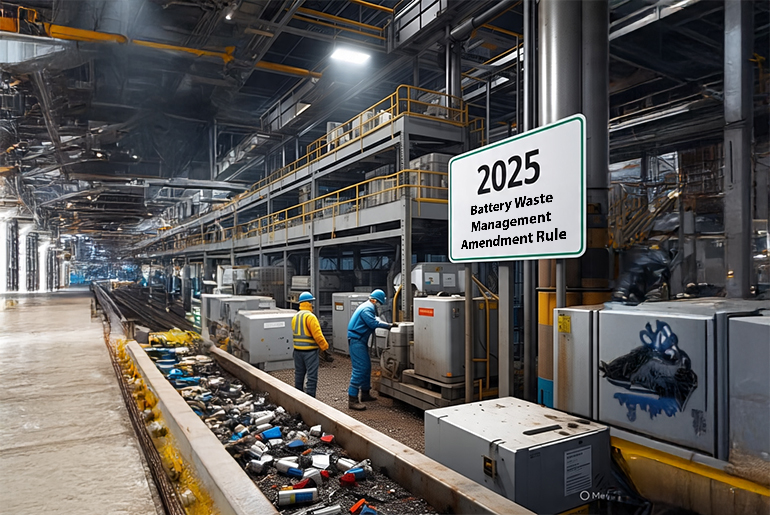
The Ministry of Environment, Forest, and Climate Change (MoEFCC) has released the Battery Waste Management Amendment Rules 2025, which are effective from February 24, 2025. The direction is towards the environmental goals and streamlining the rules. Rather than modest tweaking of the 2022 scheme, the rules augment the Battery Waste Management Rules 2022 policies. The changes are aimed at strengthening the Extended Producer Responsibility system, simplifying the labeling rules, and following global practices.
Key Amendments and Their uses
The new 2025 amendments introduce several changes that are progressive and designed to foster greater efficiency, transparency, and accountability:
1. Digital Labeling: Adopting Technological Upgrades
Realizing the necessity for effective compliance measures, the amendment allows producers to adopt the digital labeling practices. Producers may now print barcodes or QR codes with their EPR registration numbers on:
- Batteries or battery packs
- Equipment with batteries
- Battery or equipment packaging
- Bulk packaging, which is not suitable for retail sale
- Product information pamphlets
This move toward digital labeling considerably reduces the logistics complexity that was otherwise involved with battery waste handling for manufacturers and increases traceability throughout the life of the battery.
2. Packaging Exemptions: Simplifying Compliance
Identifying regulatory areas for improvement, the amendment allows exemptions for certain types of packaging from certain labeling obligations. Packaging that falls under Rule 26 of the Legal Metrology (Packaged Commodities) Rules, 2011, such as small quantities and certain commodities, is exempt from certain labeling requirements of the rules on battery waste.
3. Relaxation in Hazardous Substance Marking
In alignment with international standards, the amendment relaxes the requirement for mandatory marking of chemical symbols for cadmium (Cd) and lead (Pb) on batteries. This exemption applies when the concentration of cadmium remains at or below 0.002% (20 ppm) and lead at or below 0.004% (40 ppm) by weight; the marking of ‘Cd’ or ‘Pb’ is no longer mandatory.
Centralized Compliance Monitoring
To enhance transparency and bring responsibility to the battery value chain, the Central Pollution Control Board (CPCB) will have an online platform. This dynamic portal will have an updated quarterly list of manufacturers with digital labels. It will make monitoring and checking compliance easier, assisting in building a clearer system that facilitates better enforcement.
Extended Producer Responsibility (EPR): The Unwavering Pillar
The amendments reaffirm the EPR system, imposing an irrefutable obligation on producers to take full responsibility for waste battery collection, recycling, or refurbishment. The important features are:
- Ambitious Recovery Targets: Industries are now subject to increasingly stringent recovery targets for various battery chemistries and uses. For example, the recovery target for electric vehicle and portable batteries is 70% for the 2024–25 financial year, rising to 90% by 2026–27. These rising targets reflect India’s emphasis on maximizing resource recovery and reducing environmental impacts.
- EPR Certificates: The CPCB will issue EPR certificates depending upon the amount of recycled or refurbished batteries. Such certificates can be exchanged among producers and recyclers by means of a centralized online portal, providing a transparent and seamless compliance framework.
- Environmental Compensation: The framework imposes strict requirements for environmental compensation on any producers that fail to deliver their EPR targets. This will be drawn in by environmental compensation, determined by the shortfall in recovery target achievement. This money collected will be used for collection and recycling of non-recycled and uncollected waste batteries.
Industry Impact and Strategic Considerations
The Battery Waste Amendment Rules, 2025, represent a double-edged sword, presenting both opportunities and challenges for stakeholders in the battery industry:
- Improved Traceability: Digital labeling heralds improved tracking of the batteries along their entire life cycle, which supports waste management and monitoring of compliance.
- Regulatory Alignment: The easing of hazardous substance marking brings India’s regulations into line with international standards, facilitating international manufacturing and trade.
- Operational Efficiency: Strategic exemptions for some packaging types provide a concrete mitigation of the compliance burden for manufacturers, enabling smoother operations.
- Compliance Obligations: The stringent recovery targets and the innovative EPR certificate trading mechanism necessitate substantial investment from producers.
A Progressive Step Towards Sustainable Battery Management
The Battery Waste Management Amendment Rules, 2025, signify India’s unwavering dedication and commitment to sustainable development and environmental protection. By combining new technology, meeting global standards, and strengthening the EPR system, these changes seek to build a strong and effective system to handle battery waste. People involved in the battery sector need to adjust , follow the rules, and support a sustainable economy.
 Electrify your feed! Click here to join our Whatsapp group and to get the latest updates, expert insights, and innovations driving India’s energy storage revolution.