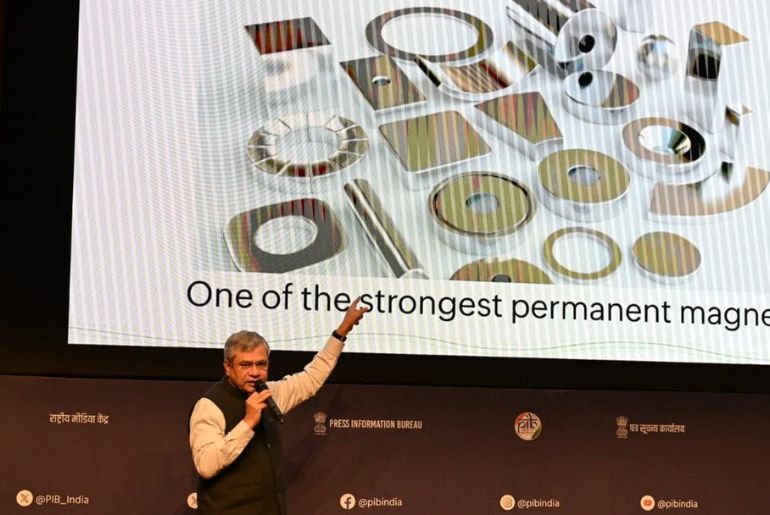
India has entered a new era of industrial transformation with the Union Cabinet approving the ₹7,280-crore Scheme to Promote Manufacturing of Sintered Rare Earth Permanent Magnets (REPM). The Magnet Mission is India’s first dedicated, large-scale scheme to establish an integrated domestic manufacturing ecosystem for Sintered Rare Earth Permanent Magnets (REPMs). While the scheme covers strategic sectors like electric mobility, aerospace, defence, and electronics, its biggest and most powerful impact will be on the renewable energy sector.
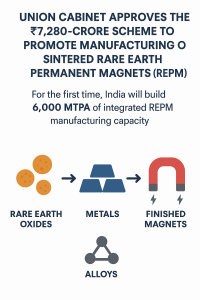
For the first time, India will build 6,000 MTPA of integrated REPM manufacturing capacity, turning rare earth oxides into metals, alloys, and finished high-performance magnets within the country. This marks a turning point for India’s manufacturing ambitions—and a major push toward self-reliance.
A key component of the scheme is to fill a major gap in India’s clean energy development to date; that is, the absence of domestic sources of permanent magnets that are necessary for wind turbines, solar tracking systems and a variety of energy storage and inverter technologies. By creating India’s first ‘Renewable Energy Permanent Magnet Ecosystem,’ the Government is also directly supporting the foundation of the renewable energy sector in India.
The article outlines how this program will enhance India’s clean energy landscape and why this initiative is both a timely opportunity and a strategic milestone.
Creating a Secure Magnet Supply Chain for Wind Turbines
Wind power is one of the most important pillars of the renewable energy sector. Modern wind turbines, particularly those featuring permanent magnet synchronous generator technology (PMSG), are reliant primarily on rare-earth permanent magnets to provide:
- High torque
- Efficiency of energy conversion
- Low maintenance
- Improved reliability
- Increased power output at low wind speeds
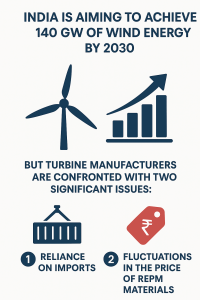
India is aiming to achieve 140 GW of wind energy by 2030, but turbine manufacturers are confronted with two significant issues: (1) reliance on imports, and (2) fluctuations in the price of REPM materials
At the present time, almost all magnets used in wind turbines in India are sourced from China. Prices fluctuate unpredictably, supply can get disrupted, and long delivery timelines often delay projects.
The new scheme directly solves this problem.
By enabling domestic production of REPMs, India will:
- Secure the wind-power supply chain
- Reduce the cost of generator manufacturing
- Lower the overall cost per MW of wind projects
- Support OEMs like Suzlon, Adani Wind, Inox, and Siemens Gamesa
This strengthens India’s wind industry and improves competitiveness in the global renewable energy sector.
Cutting Costs for Solar Manufacturing and Tracking Systems
What many people don’t know is that REPMs play an important role in advanced solar technologies too. They are used in:
- Solar sun-tracking motors
- High-precision actuators
- Robotics used in solar panel assembly lines
- Solar cleaning machines
- Inverter cooling systems
India is scaling solar production at record speed, targeting over 300+ GW of solar capacity by 2030. A large part of future solar installations will use smart trackers that follow the sun’s movement to increase electricity generation by 15–20%.
These trackers depend on small but powerful magnets for:
- Precise directional movement
- Energy-efficient tracking
- Long-term reliability
Until now, nearly every magnet inside a solar tracker motor was imported. The new REPM scheme will make trackers more affordable and improve the economics of solar parks across the country.
This is a massive win for the renewable energy sector because falling equipment costs directly accelerate project deployment.
Boosting Manufacturing of High-Efficiency Inverters and Storage Systems
As renewable energy installations increase, India needs millions of inverters, converters, cooling motors, robotics units, and battery energy storage systems (BESS). The technologies previously identified in this section rely on high speed drives (HSD) and REPM powered motors for cooling fans, compressor units, high frequency power electronics, precision automation and motion control of Giga factories.
Domestic production of REPMs will enable Indian manufacturers of inverters/energy storage and similar products, as well as reduce their reliance on foreign suppliers.
The overall result is the further development of the Renewable Energy Sector by decreasing equipment purchase price for EPC Contractors in the Solar and Wind Sectors; providing a higher degree of supply chain reliability to Battery Storage Manufacturers; and increasing the efficiency of Power Electronics Manufacturer’s production lines.
As BESS Plants and Green Hydrogen Facilities continue to be developed, the demand for REPMs will continue to grow exponentially. The proposed scheme will help provide the necessary support for the materials aspect of this demand.
Making India a Global Manufacturing Hub for Clean Energy Equipment
The lack of domestic REPM producers has been one of the largest barriers in preventing India from becoming a Global Export Hub for Renewable Technology. Countries like China, Japan, and Germany dominate the magnet industry, and India has been a buyer rather than a maker.
This scheme reverses that long-standing trend.
By creating 6,000 MTPA of REPM capacity through five globally selected beneficiaries, India can:
- Export magnets
- Export wind and solar components
- Reduce import bills
- Attract global clean-tech companies
- Build a fully localised manufacturing ecosystem
This positions India as a long-term player in the international renewable energy sector, with the capability to supply to Southeast Asia, Africa, and the Middle East.
Lowering Renewable Energy Costs and Improving Competitiveness
Magnets are a surprisingly expensive component in wind turbines, solar tracker motors, and inverter systems. Since India imports almost all magnets today, the cost of renewable energy equipment is directly affected by global market fluctuations.
This is how locally manufactured products address these challenges:
- Delivery times have been reduced, resulting in fewer project delays
- Prices remain the same; therefore, it will be easier to plan financially for these projects
- Import tariffs decrease the cost of purchasing solar and wind turbines
- Having stiff competition in India will encourage many innovators
- The manufacturers of these wind turbines have more control over quality.
When all these factors come together, they lower the LCOE (Levelized Cost of Electricity) for wind and solar projects. Since the cost of energy generating assets decreases, it ultimately has a positive impact across the entire renewable energy sector.
Achieving 500 GW of renewable capacity by 2030 is no longer just an ambitious goal for India. It is becoming more feasible, quicker, and easier to achieve daily.
Supporting India’s Net Zero 2070 Commitments
The REPM scheme also ties into India’s long-term climate goals. To achieve a sustainable expansion of the renewable energy industry, we must produce key technologies (magnets, inverters, turbine components) domestically within our country.
Through domestic production of REPM, we benefit in several ways toward achieving Net Zero:
- Reduce the carbon footprint of imported magnets
- Creating a high-efficiency wind and solar infrastructure
- Allowing for greater electrification of different industrial sectors
- Creating new industries around green manufacturing
- Increasing India’s energy independence
This policy supports India’s implementation of Viksit Bharat 2047, with the renewable energy industry expected to provide a substantial contribution towards jobs in the Green Economy, create clean energy, and advance technological self-reliance.
A Strong Push for Atmanirbhar Bharat in Clean Energy
The scheme’s structure—₹6,450 crore in sales-linked incentives and ₹750 crore in capital subsidies—encourages large players to invest in cutting-edge magnet manufacturing. It also ensures that the ecosystem grows in a sustainable and competitive way.
With India’s magnet consumption expected to double by 2030, the timing of this policy is perfect. It empowers the renewable energy sector by ensuring:
- Stable supply
- Local value addition
- Higher domestic employment
- Stronger manufacturing ecosystems
This is exactly what the clean energy industry needs to scale without bottlenecks.
Conclusion: A Game-Changer for India’s Renewable Future
The ₹7,280-crore REPM scheme is not just an industrial program—it is a national strategy that strengthens the country’s clean-energy backbone. By establishing India’s first integrated permanent magnet manufacturing ecosystem, the government has directly empowered the renewable energy sector.
Wind, solar, storage, inverters, robotics, and automation will all benefit. Costs will fall, supply chains will stabilise, local industries will grow, and India will move faster toward its Net Zero 2070 pledge.
In short, the scheme lays the foundation for a self-reliant, globally competitive, and future-ready renewable energy sector—one that will drive India’s growth over the next two decades.
 Electrify your feed! Click here to join our Whatsapp group and to get the latest updates, expert insights, and innovations driving India’s energy storage revolution.