
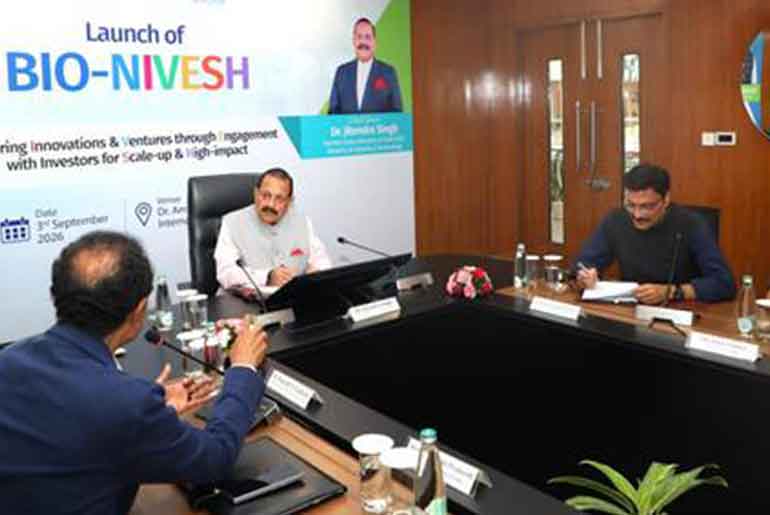
The Indian government has launched BIO-NIVESH, a new platform designed to connect biotechnology and deep-tech startups with investors and accelerate the commercialisation and scale-up of innovative technologies.
Union Minister of State for Science & Technology Dr. Jitendra Singh launched the initiative on September 3 during a roundtable bringing together startups and investors. The platform aims to strengthen links between innovators, industry and private capital, with a focus on moving technologies from research and development to commercial-scale manufacturing.
Dr. Singh said innovation cannot be sustained without investment, while investment itself depends on a strong pipeline of innovation. He stressed that closer collaboration between startups, investors, industry and the government will be critical to India’s next phase of technology-led industrial growth.
The first edition of BIO-NIVESH brought together 20 high-potential biotechnology and deep-tech startups and around 50 investors. Unlike conventional investor-pitching platforms, the initiative is intended to give startups greater insight into investor expectations while helping investors understand the technological, regulatory and development challenges associated with deep-tech ventures.
For India’s emerging advanced-technology sectors, the initiative highlights the government’s increasing focus on patient capital, technology translation and innovation-led manufacturing. These factors are particularly important for capital-intensive technologies that require substantial investment and longer development cycles before reaching commercial scale.
Dr. Singh also pointed to the ₹1 lakh crore Research, Development and Innovation (RDI) Fund, under which the Biotechnology Industry Research Assistance Council (BIRAC) has been designated as a Second-Level Fund Manager for biotechnology and allied sectors. The framework is expected to provide long-term capital to technology developers, startups and companies working in strategic technology areas, particularly those approaching technology translation, scale-up and innovation-led manufacturing.
The Minister said government funding should play a catalytic role by reducing early-stage risks and demonstrating technological potential, while private capital would be essential to take successful technologies through scale-up and commercialisation.
He also proposed that the biotechnology ecosystem consider a “Big Five in Five Years” approach, aimed at creating a small number of large anchor companies capable of strengthening the wider startup ecosystem. According to the Minister, lessons and models emerging from one technology sector could potentially be applied to others where relevant.
Dr. Singh said biotechnology could be a major driver of the next industrial revolution and that India should avoid being a late entrant to emerging technology opportunities. He pointed to the expansion of private participation in sectors such as space and nuclear energy as examples of how policy changes can encourage investment and entrepreneurship.
BIO-NIVESH is planned as a recurring platform, with future editions proposed across different cities to connect regional innovation ecosystems with investors. The government said the initiative’s success will ultimately be measured by partnerships created, capital mobilised, technologies scaled and products brought to market.
For India’s wider deep-tech ecosystem, the initiative could help address one of the key challenges facing capital-intensive technologies: bridging the gap between laboratory-stage innovation, commercialisation and large-scale manufacturing.
 Electrify your feed! Click here to join our Whatsapp group and to get the latest updates, expert insights, and innovations driving India’s energy storage revolution.