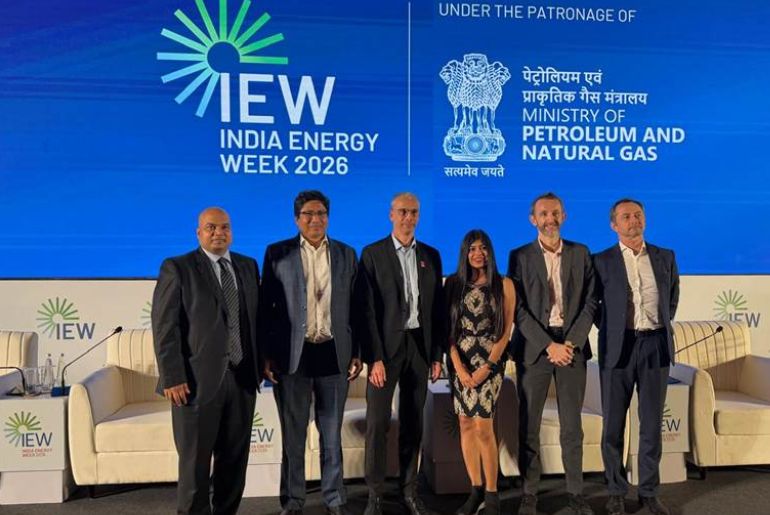
Shri Pradip Kumar Das, Chairman and Managing Director of Indian Renewable Energy Development Agency Ltd. (IREDA), participated in two high-level panel discussions at India Energy Week (IEW) 2026 in Goa, underlining the critical role of data, finance and institutional support in India’s clean energy transition.
Addressing the panel discussion on “Empowering Economic Policy with Energy Data: Steering India’s Growth towards Viksit Bharat,” Shri Das stressed that India’s long-term development goals must be anchored in evidence-based policymaking. He remarked that “Viksit Bharat will be built not on slogans, but on reliable data, realistic policy and patient capital.” He emphasised that energy data today goes far beyond technical use and has become a strategic economic tool that influences investment decisions, energy pricing and national policy direction.
Explaining IREDA’s role in this journey, Shri Das said the institution focuses on ensuring that capital reaches not only large-scale renewable infrastructure projects but also decentralised and community-based solutions. This approach, he noted, helps make the energy transition inclusive, resilient and sustainable.
He added that “Institutions like IREDA translate India’s energy vision into bankable reality by aligning growth, sustainability and affordability.”
In the second panel, “Startup Climate Technology Innovations: From R&D Margins to Market Mainstream,” Shri Das spoke about IREDA’s contribution to strengthening India’s clean energy financing ecosystem. He said IREDA was established not merely as a lending institution, but as a sector-focused financial entity with a mandate to deepen clean energy markets and lower the cost of capital.
He highlighted that through long-tenor loans, sector-specific appraisal frameworks and co-lending arrangements with banks, IREDA has supported the large-scale deployment of mainstream renewable energy projects such as solar, wind and hydropower. At the same time, the agency has enabled the growth of distributed energy segments, including rooftop solar and the PM-KUSUM scheme, using an aggregator-based financing model.
Shri Das also added that IREDA has diversified its financing activities beyond the more mature technologies. The organization has shown early interest in pumped storage hydropower projects and has designed structured financing models for new sectors such as green hydrogen and green ammonia. These sectors, according to Shri Das, have been supported by phased commissioning models and offtake model evolution, thus filling the gap between innovation and commercialization in the clean energy sector in India.
 Electrify your feed! Click here to join our Whatsapp group and to get the latest updates, expert insights, and innovations driving India’s energy storage revolution.