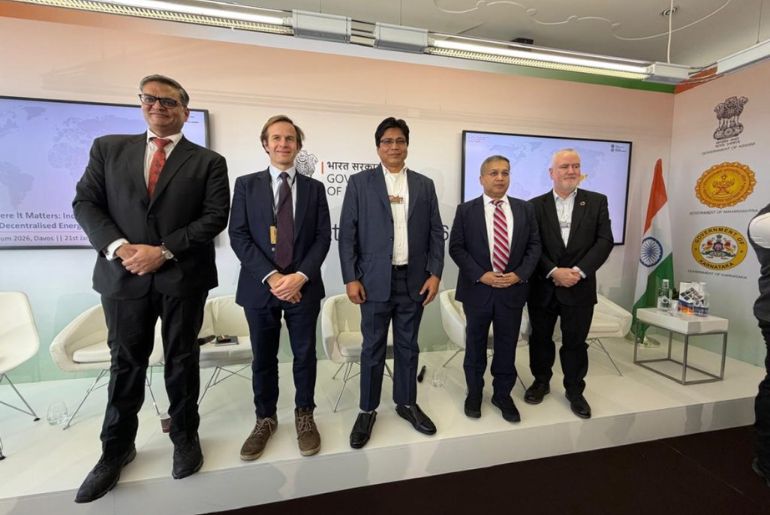
Shri Pradip Kumar Das, Chairman and Managing Director of the Indian Renewable Energy Development Agency Ltd. (IREDA), participated in a high-level panel discussion at the World Economic Forum (WEF) Annual Meeting 2026 in Davos on Tuesday. The session, titled “Scaling Solar Where It Matters: India’s Lessons on Rooftop, Agriculture and Decentralized Energy for the Global South,” focused on India’s experience in expanding distributed solar solutions and their relevance for emerging economies.
Earlier in the day, Shri Pralhad Joshi, Hon’ble Union Minister for New and Renewable Energy, delivered the keynote address at the forum, outlining India’s progress and leadership in advancing solar energy for inclusive and sustainable development.
During the discussion, Shri Das emphasised that decentralised renewable energy plays a crucial role in improving system efficiency. He noted that wider adoption of such models can help reduce government subsidies and aggregate technical and commercial (AT&C) losses, ultimately lowering costs and ensuring greater affordability for consumers.
Addressing concerns around the perceived risks of emerging renewable energy segments, Shri Das said these challenges can be effectively managed through robust project structuring and prudent risk assessment. He highlighted IREDA’s strong track record as evidence, pointing out that the institution has recorded a cumulative write-off of only ₹149 crore over more than 38 years of operations, despite financing projects worth approximately ₹1.81 lakh crore since its inception. This performance, he said, reflects IREDA’s rigorous appraisal processes and strong monitoring mechanisms.
Shri Das also highlighted IREDA’s role in accelerating clean energy access in rural India. He noted that the agency typically finances 70–80 per cent of project costs under the Rooftop Solar and PM-KUSUM schemes through the aggregator model, enabling faster and wider deployment of solar solutions, particularly in the agricultural sector.
He expressed gratitude to Union Minister Shri Pralhad Joshi for providing IREDA with the opportunity to participate at the World Economic Forum and present India’s renewable energy journey on a global platform. According to Shri Das, India’s achievements have been driven by a mature and well-developed renewable energy ecosystem.
The forum, he added, also offered an opportunity to underline IREDA’s pivotal role in steering India’s renewable energy transition, with the country’s institutional frameworks and policy experience serving as valuable reference points for other nations. Referring to Maharashtra’s progress in agricultural solarisation, Shri Das stressed the importance of building an enabling ecosystem that reduces sectoral risks and attracts long-term global capital to support sustainable growth.
 Electrify your feed! Click here to join our Whatsapp group and to get the latest updates, expert insights, and innovations driving India’s energy storage revolution.