
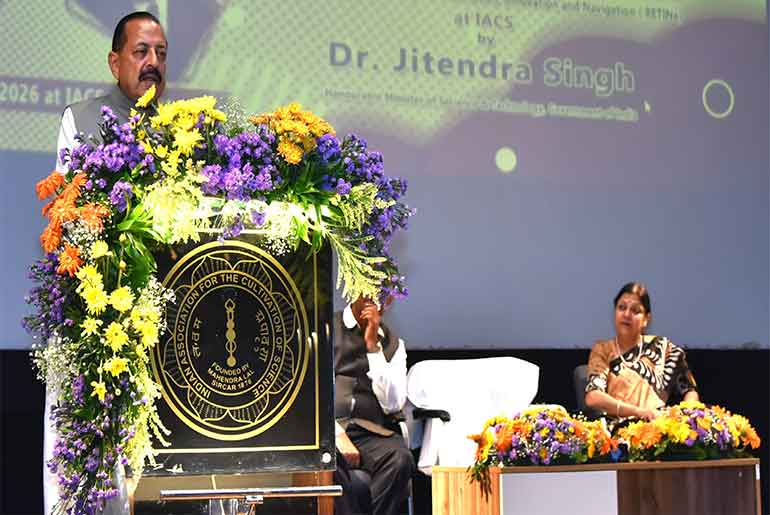
Union Minister Jitendra Singh inaugurated an indigenous solar cell fabrication facility at the Indian Association for the Cultivation of Science (IACS) in Kolkata, marking a significant step in India’s push toward self-reliant renewable energy technologies.
The indigenous solar cell fabrication facility includes a Plasma Enhanced Chemical Vapour Deposition (PECVD) system developed for the fabrication of India’s first amorphous silicon solar cell. Speaking at the event, Singh said the indigenous solar cell fabrication facility reflects the country’s growing focus on scientific self-reliance and advanced clean energy research under the Atmanirbhar Bharat initiative.
IACS celebrated its 150th anniversary during the event. Founded in 1876 by Mahendralal Sircar, the institute is regarded as India’s first research institution established by Indians for modern scientific research. The institute is globally known as the birthplace of the Raman Effect discovery by Nobel laureate C. V. Raman.
According to Singh, the indigenous solar cell fabrication facility represents an important advancement for India’s renewable energy ecosystem and strengthens the country’s capabilities in indigenous solar technology development. The facility is expected to support research activities related to next-generation photovoltaic materials and thin-film solar technologies.
Addressing the gathering at Mahendra Lal Sircar Hall, Dr. Jitendra Singh said IACS occupies a unique place in India’s scientific history as the first research institution in Asia established by Indians for the cultivation of modern science through original research. He recalled that Dr. Mahendralal Sircar had envisioned scientific capacity-building and modern scientific education for Indians at a time when scientific infrastructure in the country was virtually absent. The Minister also referred to the institute’s unique historical association with Sri Ramakrishna Paramahamsa through Dr. Sircar, who served as his personal physician.
Dr. Jitendra Singh said the discovery of the Raman Effect at IACS remains one of the defining milestones in India’s scientific history and continues to inspire generations of Indian scientists. He said that the institution continued producing globally respected scientific contributions even after Independence and evolved into a leading centre for frontier research across physical sciences, biological sciences, materials science, computational science and interdisciplinary technologies.
Alongside the launch of the indigenous solar cell fabrication facility, the Minister also inaugurated RETINA — Research Entrepreneurship for Translation, Innovation and Navigation — an incubation centre aimed at promoting innovation, startup development and commercialisation of scientific research.
Singh said Indian scientific institutions are increasingly moving beyond laboratory research and focusing on industrial collaboration, entrepreneurship and scalable technologies that can support sectors such as clean energy, healthcare and sustainable development.
Highlighting the institute’s scientific legacy, the Minister said IACS has contributed significantly to India’s research ecosystem by nurturing several prominent scientists, including Satyendra Nath Bose. He added that the institute continues to conduct globally recognised research in physical sciences, biological sciences, materials science and interdisciplinary technologies.
The Minister also highlighted ongoing research work at IACS in emerging technology areas including:
- Quantum materials
- Nanotechnology
- Artificial intelligence
- Battery materials
- Cancer biology
- Environmental technologies
The launch of the indigenous solar cell fabrication facility by IACS comes at a time when India is aggressively expanding domestic manufacturing capabilities across the renewable energy and clean technology sectors. The development is also expected to support the country’s broader goals of reducing import dependence and strengthening indigenous research-led innovation.
 Electrify your feed! Click here to join our Whatsapp group and to get the latest updates, expert insights, and innovations driving India’s energy storage revolution.