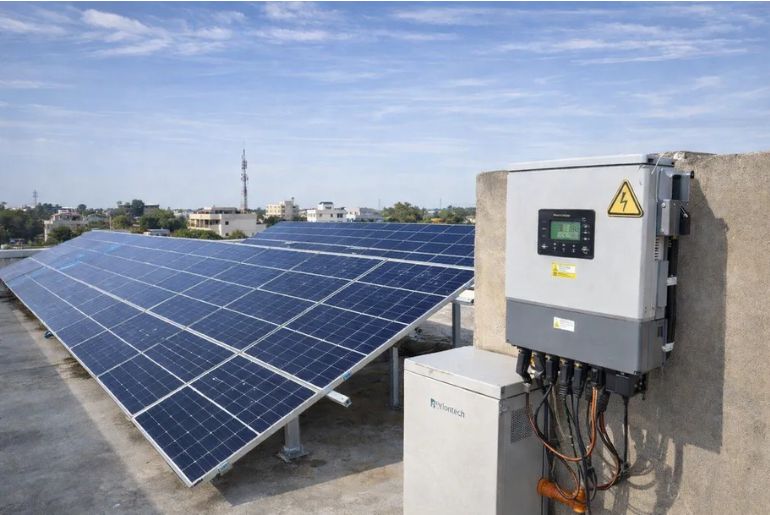
Jaipur Vidyut Vitran Nigam Limited (JVVNL) has issued an order allowing the use of hybrid inverters for Rooftop Solar (RTS) systems across Rajasthan. The directive was released by the Office of the Superintending Engineer on February 20, 2026. The decision is expected to benefit both residential and commercial consumers installing rooftop solar systems.
JVVNL stated that the move comes as renewable energy capacity is growing rapidly in the state. As more solar power is added to the grid, it has become more important to keep the grid stable, handle peak demand, and make sure the power is of good quality. The utility is encouraging the use of Battery Energy Storage Systems (BESS) by allowing hybrid inverters. These systems let users store extra solar energy generated during the day and use it during peak demand hours or power outages. This helps with the fact that solar power isn’t always available.
Alignment with MNRE Guidelines and RERC Regulations
The order follows guidelines issued by the Ministry of New and Renewable Energy (MNRE), which allow rooftop solar systems to include additional technologies such as battery storage, small wind hybrids, and solar tracker systems. However, JVVNL clarified that “Central Financial Assistance (CFA) will continue to be calculated only on the installed solar module capacity and not on battery storage.”
The Rajasthan Electricity Regulatory Commission (RERC) has added BESS to the list of Renewable Energy Generating Systems in its RERC (Grid Interactive Distributed Renewable Energy Generating Systems) (Third Amendment) Regulations, 2025. This makes the policy framework even stronger. RERC has suggested that people who want to install hybrid inverters with their renewable energy plants under Net Metering, Gross Net Metering (GNM), or Virtual Net Metering (VNM) should be able to do so.
State’s Broader Push for Solar-Plus-Storage
On behalf of the state government, Rajasthan Renewable Energy Corporation Ltd (RRECL) put out one of India’s biggest solar-plus-storage tenders earlier this year. The tender asked for 2,450 MW of solar power and 1,600 MW / 6,400 MWh of energy storage systems. This shows how strongly Rajasthan is pushing for integrated renewable development.
JVVNL emphasized that all hybrid installations must comply with existing technical and safety standards. The latest notice is expected to strengthen grid stability, improve demand management, and promote smarter, future-ready energy solutions. Hybrid inverters will enable better management of solar generation, battery storage, and grid interaction, ensuring higher self-consumption and improved backup reliability for consumers across Jaipur and nearby areas.
 Electrify your feed! Click here to join our Whatsapp group and to get the latest updates, expert insights, and innovations driving India’s energy storage revolution.