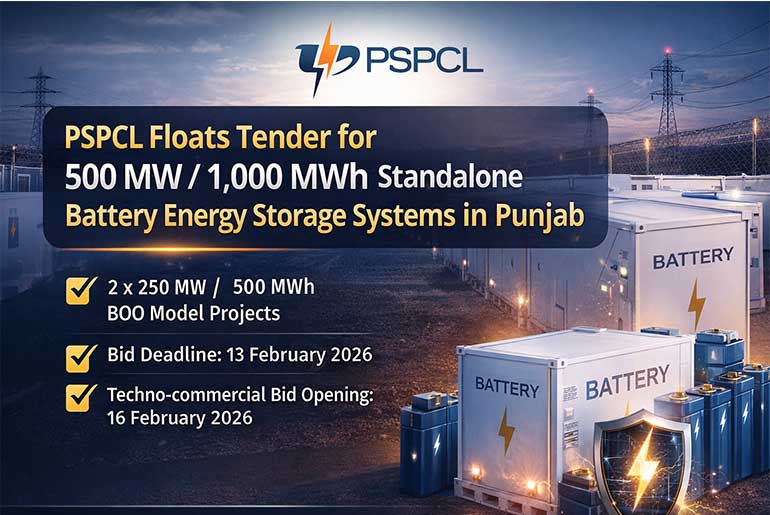
Punjab State Power Corporation Limited (PSPCL) has issued a tender inviting bids for the development of 500 MW / 1,000 MWh standalone Battery Energy Storage Systems (BESS) to strengthen grid reliability and manage peak demand across the state.
The projects will be implemented under a Build-Own-Operate (BOO) model, with storage assets deployed at two identified substations in Punjab.
Key Tender Details
- Procuring Entity: Punjab State Power Corporation Limited (PSPCL)
- Project Type: Standalone Battery Energy Storage Systems (BESS)
- Total Capacity: 500 MW / 1,000 MWh
Project Locations & Capacity Split
Ablowal Substation, Patiala:
250 MW / 500 MWh
Laltonkalan Substation, Ludhiana:
250 MW / 500 MWh
Tender Model & Scope
- Development Model: Build-Own-Operate (BOO)
- Contract Structure: Long-term Battery Energy Storage Purchase Agreement (BESPA)
- Grid Connection: State Transmission Utility (STU) network
- Dispatch Control: PSPCL will control charging and discharging operations based on grid requirements
Technical Requirements
- Minimum System Availability: 95%
- Operational Cycles: Up to two cycles per day
- Battery Cells: Only new battery cells permitted; refurbished or second-life cells are not allowed
- Energy Management System (EMS): India-developed EMS software mandatory
- Noise Limits: Compliance with prescribed noise standards (<80 dB)
- Land: To be provided on lease / right-to-use basis
Bid Size & Participation Criteria
- Minimum Bid Size: 100 MWh
- Incremental Capacity: 50 MW blocks
Multiple bids permitted subject to tender conditions
Financial Requirements
- Bid Document Fee: ~₹59,000
- Bid Processing Fee: ₹3 lakh + GST
- Earnest Money Deposit (EMD): ~₹4.71 lakh per MW
- Performance Bank Guarantee (PBG): ~₹11.775 lakh per MW (as applicable before BESPA signing)
Important Dates
- Bid Submission Deadline: 13 February 2026
- Techno-Commercial Bid Opening: 16 February 2026
Why This Tender Is Significant
- One of the largest standalone BESS tenders floated by a state discom
- Supports peak load management, frequency regulation, and renewable integration
- Aligns with India’s broader push to scale grid-level energy storage infrastructure
- Strengthens Punjab’s grid flexibility ahead of rising renewable penetration
 Electrify your feed! Click here to join our Whatsapp group and to get the latest updates, expert insights, and innovations driving India’s energy storage revolution.