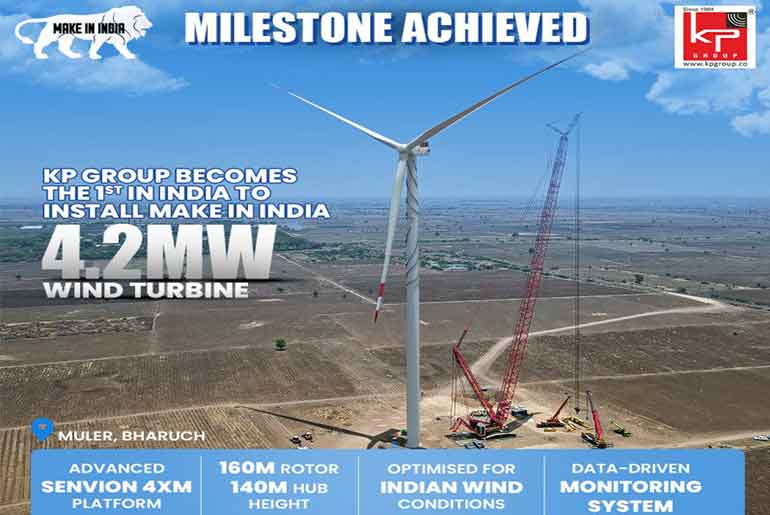
KP Group has recently announced that it has commissioned India’s First “Make in India” 4.2MW Wind Turbine in Gujarat achieving a significant milestone for the Country’s Renewable Energy landscape. The 4.2M160 turbine has made by Senvion India is a great example of advanced engineering made with a goal to push the limits of domestic manufacturing. By successfully installing this next-generation technology, KP Group has transitioned from a participant in the green energy sector to a pioneer of large-scale, localized wind solutions.
Technical Specifications of the 4.2M160
- 4.2M160 is specifically made to meet the challenges of the Extreme Indian Climate
- The Wind turbine has a large rotor diameter of 160 meters and stands at a hub height of 140 meters and is built on the tested 4XM platform
- The large dimensions of the rotor allows to absorb wind more effectively at higher altitudesresulting in increasing the energy yield and operational effiency as compared to the older and smaller models.
This new installation sets an example that India is now ready to deploy top-notch, future ready infrastructure that matches with the International standards.
Beyond the hardware, this project is a major victory for the ‘Make in India’ initiative. The turbine is built with over 85% localization, ensuring that the economic benefits of the energy transition stay within the country. Furthermore, its inclusion in the Revised List of Models and Manufacturers (RLMM/ALMM) as of December 2025 provides the regulatory green light for its widespread adoption across future projects.
For KP Group, this milestone of comissioning of the India’s First “Make in India” 4.2MW Wind Turbine in Gujarat reinforces their commitment to sustainable growth and technical excellence. By integrating such advanced, high-capacity turbines into their portfolio, they are not only improving the reliability of the power grid but also lowering the long-term cost of clean energy. This project serves as a blueprint for the industry, proving that localized engineering is the key to achieving India’s ambitious net-zero targets.
 Electrify your feed! Click here to join our Whatsapp group and to get the latest updates, expert insights, and innovations driving India’s energy storage revolution.