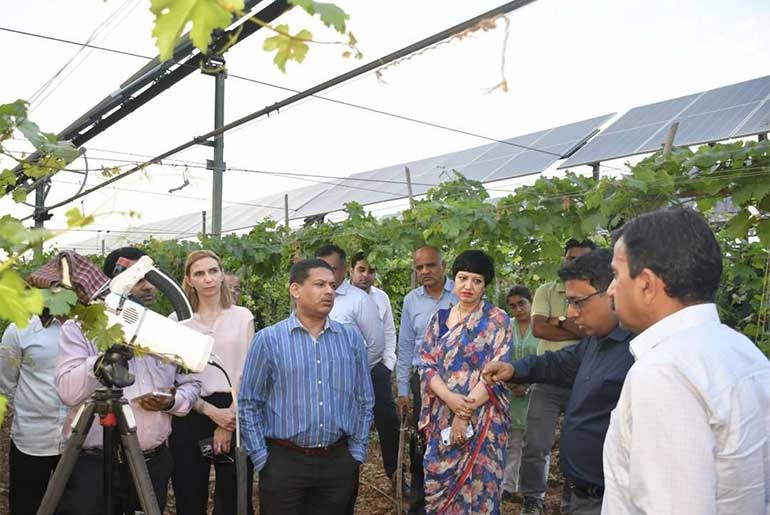
The secretary of the Ministry of New and Renewable Energy visited the pioneering agrovoltaic installations at Sahyadri Farms in Nashik, Maharashtra — a powerful glimpse into the future of Indian agriculture and clean energy.
As India’s largest Farmer Producer Organisation (FPO), Sahyadri Farms represents the collective strength of thousands of farmers who have transformed agricultural value chains through aggregation, technology, processing, exports, and market integration. Today, their foray into agrivoltaics signals something even bigger — the convergence of solar technology with crop science.
Agrovoltaics is not merely about placing solar panels above farms. It is about reimagining land as a multi-generational productive asset – capable of generating clean energy, supporting climate-resilient agriculture, improving water efficiency, stabilising farmer incomes, and creating new rural enterprise opportunities simultaneously.
At Sahyadri Farms, this vision is deeply inspiring because the model is truly end-to-end and circular: Farmers produce high-value crops. Solar infrastructure generates clean electricity. Efficient farming practices optimise water and land use. Processing, storage, and exports create value addition. Farmers become energy producers and entrepreneurs, not just cultivators
This is the direction in which the future is moving — where agriculture and energy are no longer separate sectors, but integrated ecosystems.
Maharashtra has once again demonstrated why it remains one of India’s most progressive states in agricultural innovation, farmer collectivisation, and renewable energy adoption. From cooperatives to FPO movements, from water conservation to decentralised clean energy, the state has repeatedly shown how rural transformation can be scaled through institutional innovation and community participation.
The agrovoltaic model emerging from Maharashtra is not just a state success story – it is a template for the entire country. It shows how India can simultaneously address farmer incomes, energy security, climate resilience, and sustainable rural development through integrated solutions.
India’s clean energy transition will be strongest when it is rooted in rural prosperity. Agrovoltaics has the potential to become a transformative pathway for farmer empowerment, decentralised energy generation, climate adaptation, and sustainable growth.
The visit also highlighted the immense potential of FPO-led agrovoltaic deployment models, where collective institutions can aggregate land, technology, financing, and market access to make advanced solutions accessible even to small and marginal farmers.
The future of farming may not just grow crops. It may also generate power, resilience, prosperity, and hope.
 Electrify your feed! Click here to join our Whatsapp group and to get the latest updates, expert insights, and innovations driving India’s energy storage revolution.