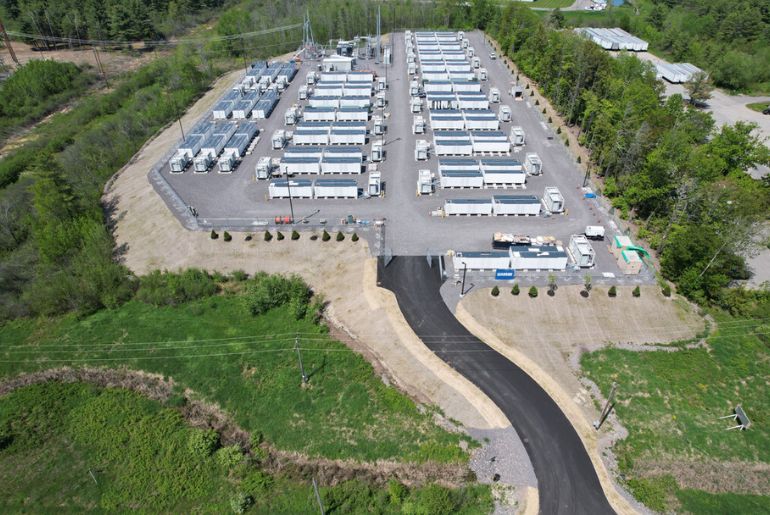
New England’s largest standalone energy storage facility has officially begun operations in Gorham, Maine. The project, known as Cross Town, is owned by Plus Power and is already helping improve grid reliability and stabilize electricity prices across the region.
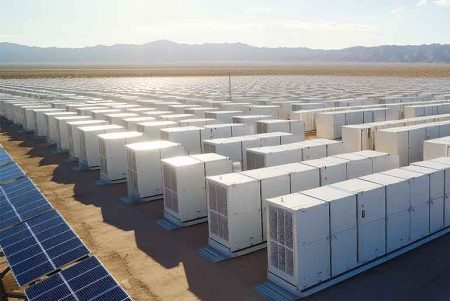
Located in Gorham’s industrial park, the site includes more than 150 battery units with the capacity to store up to 175 megawatts of electricity. Christina Hoffman, Senior Director of Planning at Plus Power, shared details during the ribbon-cutting ceremony on Wednesday.
The facility stores electricity from the grid when consumer demand is low and releases it during periods of high demand.
“In so doing it provides the same fully dispatchable services as a conventional power plant but with no water, no emissions and low lighting and noise,” Christina Hoffman, Senior Director of Planning at Plus Power said.
Supporting Maine’s Energy Storage Goals
With the addition of the Cross Town project, Maine has now crossed the halfway mark toward its goal of installing 400 megawatts of energy storage capacity by 2030, according to the Department of Energy Resources.
Plus Power, Asset Manager, Mike Rall explained that at full capacity, the battery system can deliver continuous electricity for approximately two and a half hours, enough to power around 19,000 homes. However, the facility can also operate at lower output levels to help balance electric currents and maintain grid stability.
Storing Excess Renewable Energy
Although Cross Town is not directly connected to renewable energy plants, it plays an important role in managing surplus clean energy. Rall noted that the times when the facility stores electricity often coincide with periods when wind and solar generation exceed demand on the regional grid.
“It has nowhere else to go,” Plus Power, Asset Manager, Mike Rall said. “So during those times we would store it and when it is later in the evening, or sometimes winter in the morning, when there is peak demand that’s when we release it to the grid.”
The project represents a significant step forward in strengthening regional energy resilience while supporting the integration of renewable power.
 Electrify your feed! Click here to join our Whatsapp group and to get the latest updates, expert insights, and innovations driving India’s energy storage revolution.