As the global energy transition accelerates, the spotlight has shifted towards energy storage system design and engineering—a cornerstone for enabling reliable, renewable-powered grids and widespread electrification. From stabilizing intermittent solar and wind energy to powering electric mobility and ensuring grid resilience, modern energy storage systems (ESS) sit at the heart of the world’s net-zero ambitions.
Yet, developing scalable ESS is not simply about packing batteries into containers. Engineers and designers face a threefold challenge: ensuring safety, maximizing performance, and lowering costs. Each of these dimensions interacts with the other, demanding innovation at the materials, cell, pack, and system levels.
This article explores the cutting edge of next-gen energy storage system design and engineering, the trade-offs involved, and how global and Indian initiatives are reshaping the storage ecosystem.
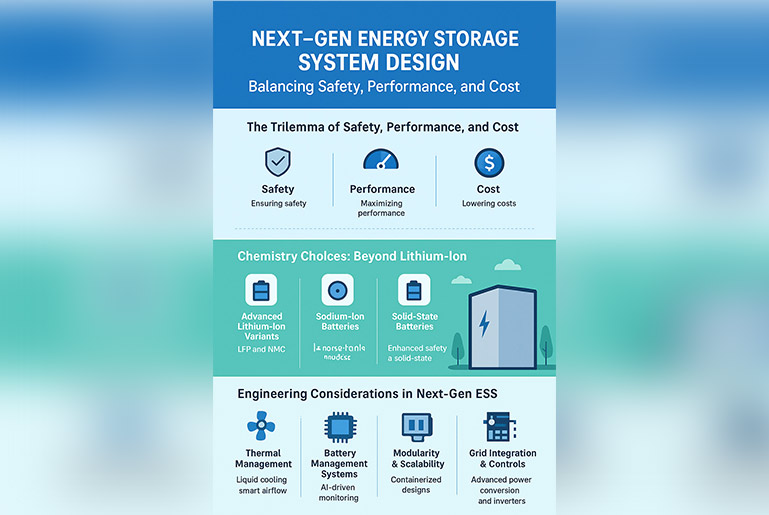
The Trilemma of Safety, Performance, and Cost
Designing an ESS is a balancing act. Compromising too heavily on one parameter risks undermining the system’s viability.
- Safety – Lithium-ion fires have already raised concerns about large-scale ESS deployments. Thermal runaway, faulty BMS algorithms, and poor thermal management are risks engineers must address. Safety mechanisms—such as advanced fire suppression systems, non-flammable electrolytes, and AI-powered monitoring—are becoming central to design.
- Performance – Energy density, cycle life, efficiency, and response time are all attributes that define overall performance of an Energy Storage System. For example, Lithium Iron Phosphate (LFP) batteries have great safety characteristics and life, but Nickel Manganese Cobalt (NMC) batteries have better energy density, where space is a constraint.
- Cost – Ultimately cost will drive and dictate the adoption. BloombergNEF (2024) reports the average lithium-ion battery pack price plunged to $139/kWh, which is a record low, but to outweigh uptake to mass grid parity, costs need to go lower than $100/kWh.
The interaction between these three distinguishers make energy storage system design and engineering a challenging but rewarding experience.
Chemistry Choices: Beyond Lithium-Ion
1. Advanced Lithium-Ion Variants
- LFP is already dominant in stationary ESS applications based on their safety and cycle life.
- NMC is still a solid option for ESS linked to EVs and for compatibility with high density and compactness.
2. Sodium-Ion Batteries
Sodium-ion batteries are emerging as an affordable alternative, especially relevant in India where raw material security is a concern. Companies like Reliance New Energy are investing in sodium-ion research and development for grid scale applications.
3. Flow Batteries
For vanadium redox flow batteries, their almost infinite cycling and long-duration (often referred to as days) energy storage capability captures imagination and is worth exploring. Moreover, their modular properties are appealing at the scale of industrial microgrids.
4. Solid State Batteries
With solid-state batteries still at the pilot scale, they will enhance safety through the replacement of flammable electrolytes. Both Toyota and QuantumScape are accelerating commercialization time frames, targeting 2027–2030.
Key Takeaway: Roadmapping diverse chemistry pathways is critical. No one battery can address all applications; design must be based on the use case.
Engineering Factors in Next-Gen ESS
1. Thermal Management
Heat dissipation is critical in design to mitigate runaway. In terms of novel designs, liquid cooling systems, phase-change materials, or smarter guidance methods through air flow to effectively dissipate heat are changing this landscape.
2. Battery Management Systems (BMS)
Advancements in AI-driven battery management systems are changing from monitoring past failures to predicting failures before they occur. Panasonic Energy, for instance, is currently incorporating machine learning features into their BMS to generate better (state of charge) SOC and (state of health) SOH predictions.
3. Modularity and Customizability
Containerized energy storage systems designed as modular units are easy to move, quick to deploy, and connected to an electric grid. For example, Tesla’s Megapack (also modular) and Exide Industries containerized systems in India.
4. Grid Integration and Control Technologies
Recent developments in power conversion systems (PCS) technology and inverter technology are allowing energy storage systems to offer frequency regulation, peak shaving, and black start (restart an offline grid) features.
Case Study: Global Benchmarks
Moss Landing energy storage facility (California, United States)
- Operated by Vistra Energy.
- 400 MW / 1,600 MWh.
- Uses lithium-ion technology that includes advanced cooling and fire suppression features.
- Provides grid stability to California’s renewable-heavy grid.
Hornsdale Power Reserve (South Australia)
- Tesla’s 150 MW / 193.5 MWh installation.
- Delivers rapid frequency response, reducing outages and saving millions in grid costs.
- Lesson: Both cases highlight how thoughtful energy storage system design and engineering enhances not only performance but also long-term ROI.
India’s ESS Pilot and Initiatives
India is rapidly becoming a pilot and testing ground for next gen ESS:
- NTPC Limited: Deploying a 10 MWh grid-scale battery system via SECI tenders.
- JSW Energy: Planned 500 MW battery energy storage project installations by 2027.
- Adani Group: Examining sodium-ion battery integration into renewable parks.
- Indo-National Ltd: Piloting advanced LFP-based storage battery for their industrial clients.
The National Energy Storage Mission (NESM) also has target installations of 50 GWh of ERS capacity by 2030 to assist India towards the clean energy goals.
- Global ESS capacity (2023): 86 GW (IEA).
- Expected global capacity (2030): 508 GW (IEA).
- India’s ESS pipeline (2025): 20+ GWh announced projects (MNRE).
- Average lithium-ion ESS efficiency: 85–95% round-trip.
- Fire incidents in lithium-ion ESS (2018–2022): 50+ globally (UL Standards).
Research and Policy Drivers
- NREL (US) is researching hybrid storage combining batteries and supercapacitors for high-power applications.
- IIT-Madras and IISc Bangalore are exploring indigenous sodium-ion chemistries for local ESS.
Policy Momentum
- The wave of tenders in India’s Battery Energy Storage System (BESS) (e.g., SECI is set to conduct a 500 MW auction in 2024) has led to international bidders.
- The PLI scheme for advanced chemistry cells drives domestic manufacturing of these systems so as to lessen dependence on imports.
Future Trend – Smarter, Hybridized ESS
In the next ten years expect ESS to evolve into a smart, hybridized system. In addition to battery storage, hydrogen storage, compressed air, or supercapacitors should be able to meet needs on the grid. AI, digital twins and predictive maintenance can lower risks and extend system life.
Conclusion
The road to a net-zero future is paved with advancements in energy storage system design and engineering. Engineers are creating energy storage systems that will stabilize grids while changing the way we consume and supply energy, all by accounting for safety, performance, and cost. With ambitious pilots and policy support, India is ready to trial many of these innovations.
As costs continue to decline and technologies continue to mature, next-gen energy storage systems (ESS) will not only provide support to renewables; they will be the lungs of the future energy economy.
 Electrify your feed! Click here to join our Whatsapp group and to get the latest updates, expert insights, and innovations driving India’s energy storage revolution.