
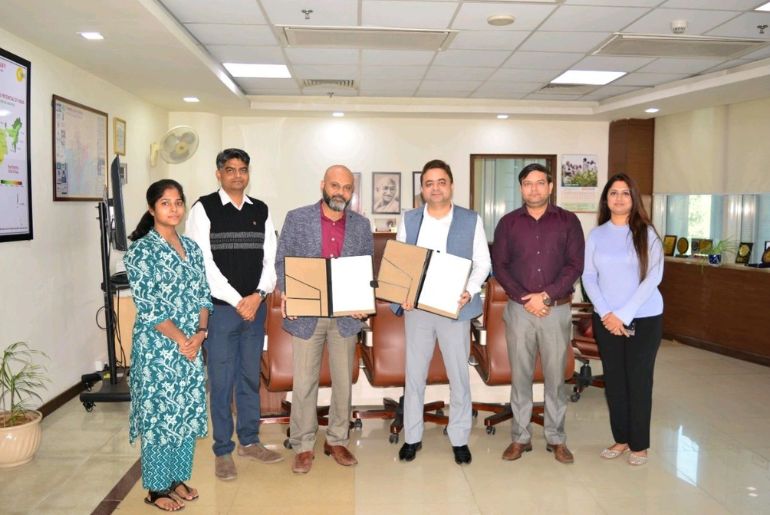
The National Institute of Solar Energy (NISE) and the Center for Study of Science, Technology, and Policy (CSTEP) have signed a Memorandum of Understanding (MoU) to work together more on research, new ideas, and policy support for solar energy.
The MoU was officially signed by Prof. Mohammad Rihan, Director General, NISE, and Mr. Saptak Ghosh, Sector Head – Renewable & Energy Conservation, CSTEP. This agreement creates a general, non-exclusive framework for cooperation that lets both groups work on specific projects through work plans that they both agree on.
Focus Areas of Collaboration
The partnership aims to advance India’s solar energy sector across multiple fronts:
- Solar Deployment at Scale: Efforts will focus on expanding rooftop and distributed solar systems, integrating solar with the grid, and combining solar with storage and smart grid solutions.
- Innovative Solar Applications: The collaboration will explore emerging uses of solar energy, including AgriPV (solar for agriculture), BIPV (building-integrated photovoltaics), hybrid solar systems, resilient infrastructure, and other innovative applications.
- Research and Demonstration: Both institutes will conduct joint studies, pilot projects, and research using AI/ML tools for performance benchmarking and technological innovation.
- Policy and Institutional Support: The partnership will provide advisory support on policy frameworks, standards, and scheme design to strengthen India’s solar ecosystem.
- Capacity Building: The MoU also emphasizes skill development through training programs, workshops, and knowledge dissemination initiatives.
Driving India’s Clean Energy Transition
This partnership shows that both groups are dedicated to speeding up India’s transition to clean energy. NISE and CSTEP want to help solar energy grow by using what they know about research, new technologies, and policy. They want to make solar energy easier to use, more efficient, and more environmentally friendly.
Prof. Mohammad Rihan, Director General, NISE remarked, “This partnership will help strengthen India’s solar innovation ecosystem and support large-scale adoption of clean energy technologies.”
Mr. Saptak Ghosh, Sector Head – Renewable & Energy Conservation, CSTEP added, “Through joint research and capacity-building efforts, we aim to create solutions that benefit both the industry and society at large.”
The MoU is a strategic step toward encouraging collaboration, knowledge sharing, and innovation in India’s solar energy sector. This will help the country reach its goal of a sustainable, resilient, and decarbonised energy future.
 Electrify your feed! Click here to join our Whatsapp group and to get the latest updates, expert insights, and innovations driving India’s energy storage revolution.