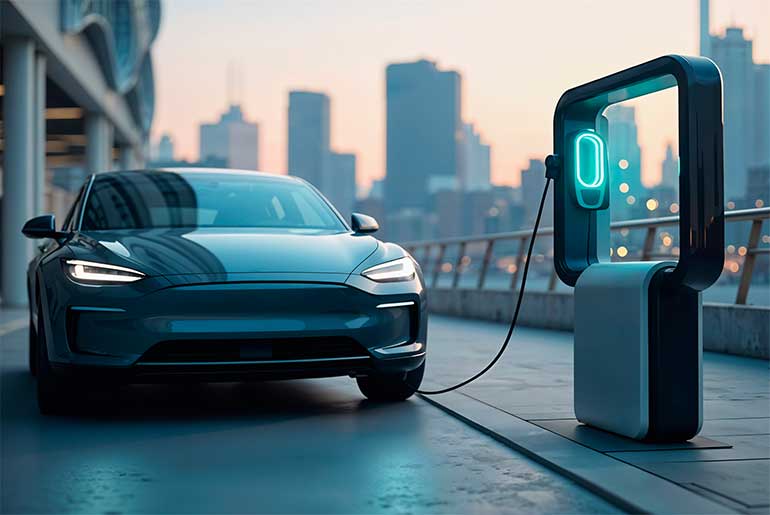
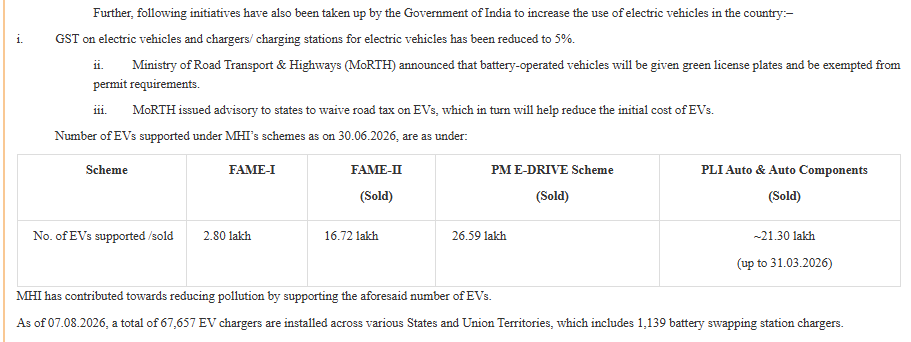
Faster Hybrid and Electric Vehicle Adoption and Production in India (FAME India) Plan Phase II: From April 1, 2019, to March 31, 2024, the government ran this program for five years, using ₹11,500 crore in budgetary support. Demand incentives for e-2Ws, e-3Ws, and e-4Ws were offered by the program, together with grants for e-buses and the establishment of EV public charging stations (EV PCS). About 16.72 lakh electric cars, including e-2Ws, e-3Ws, and e-4Ws, have been sold thanks to FAME-II. Additionally, as of July 31, 2026, 5,299 electric buses, or e-buses, had been deployed under the Scheme. Additionally, the Scheme allotted ₹912.50 crore for the creation of EVPCS throughout the nation. This program has resulted in the installation of 9,583 EV PCS.
Production Linked Incentive (PLI) Scheme for Automobile and Auto Component Industry in India (PLI-Auto): The Government notified this scheme for Automobile and Auto Component Industry in India, on 23.09.2021, for enhancing India’s manufacturing capabilities for Advanced Automotive Technology (AAT) products, including EVs, with a budgetary outlay of ₹25,938 crore.
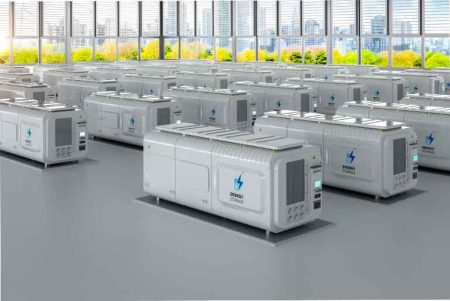
Production Linked Incentive (PLI) Scheme for National Programme on Advanced Chemistry Cell (ACC) Battery Storage : The Government on 09.06.2021 notified the PLI Scheme for manufacturing of ACC in the country with a budgetary outlay of ₹18,100 crore. The scheme aims to establish a competitive domestic manufacturing ecosystem for 50 GWh of ACC batteries, out of which, 40 GWh has been awarded to four beneficiary firms. The 40 GWh capacity is end-use agnostic and can be utilized for any application including electric vehicles.
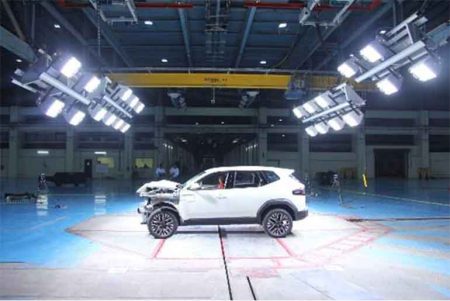
PM Electric Drive Revolution in Innovative Vehicle Enhancement (PM EDRIVE) Scheme: This scheme with an outlay of ₹10,900 crore has been notified on 29.09.2024. This scheme supports incentivization of approximately 28.30 lakh electric vehicles (EVs) including e-2W, e-3W, e-Trucks, e-buses and e-Ambulances. Further, grant for upgradation of testing agencies is also available under this scheme. An allocation of ₹4,391 crore has been made under the scheme for deployment of 14,028 e-buses out of which 14,000 e-buses have been allocated. ₹2,000 crore has been allocated for deployment of EV PCS on pan India basis. Phased Manufacturing Programme (PMP)Mandates the domestic manufacturing of EV components, including battery packs, in a phased manner.
The PM e-Bus Sewa-Payment Security Mechanism (PSM) Scheme, which was announced on October 28, 2024, has an expenditure of ₹3,435.33 crore and is intended to facilitate the deployment of over 38,000 electric buses. This program’s goal is to give e-bus operators payment security in the event that Public Transport Authorities (PTAs) default. 27,555 e-buses are covered under the PM-eBusSewa-Payment Security Mechanism (PSM) Scheme as of July 10, 2026. Of these, 10,000 are part of the Ministry of Housing and Urban Affairs’ (MoHUA) PM-eBusSewa Scheme, 14,000 are part of the Ministry of Heavy Industries’ (MHI) PM E-DRIVE Scheme, and 3,555 are part of other State Government/State Transport Undertaking (STU) programs.
 Electrify your feed! Click here to join our Whatsapp group and to get the latest updates, expert insights, and innovations driving India’s energy storage revolution.