
India took a quiet but historic step on 11 November 2025, when NTPC NETRA inaugurated the country’s first megawatt-hour scale vanadium redox flow batteries (VRFB) — a 3 MWh system designed to store renewable energy for long hours. It wasn’t just a ribbon-cutting. It was India signalling that the next phase of its clean-energy journey will depend not only on adding more solar and wind, but on learning how to hold them for the hours when nature rests.
The question now is simple: can vanadium flow batteries truly help India chase a 24/7 renewable future? To answer that, we must look at the technology, the economics, the supply chain — and the people who first imagined it.
What Exactly Is a Vanadium Flow Battery?
A VRFB is essentially two tanks filled with liquid electrolytes carrying vanadium ions. When power is needed, the liquids are pumped across cell stacks, where chemical reactions release electricity. When there is extra renewable power, the process runs in reverse and the liquids recharge.
The beauty of this system is in its scalability. Want more energy storage? Build bigger tanks. Need more power output? Add more stacks. Power and energy can grow separately, making VRFBs ideal for long-duration storage — the kind needed to store solar energy through the evening and deep into the night.
Who First Brought This Idea to Life?
The modern VRFB traces its roots to the 1980s, when Professor Maria Skyllas-Kazacos at the University of New South Wales developed the first stable all-vanadium system. Her research unlocked a simple but powerful idea: using the same element — vanadium — on both sides of the battery prevents cross-contamination and keeps performance stable for years. Today, her work forms the foundation for every commercial VRFB installation in the world.
Why the Industry Is Excited
VRFBs solve problems that traditional lithium-ion batteries struggle with at grid scale:
1. They Store Power for Long Hours
VRFBs can deliver 8 to 12 hours of continuous energy — much longer than most lithium systems designed for 1–4 hours. This makes them ideal for solar-rich grids like India’s.
2. They Last for Decades
Since the electrolyte never degrades and can be reused, VRFBs offer extremely long cycle life. Components can be replaced individually without discarding the full system.
3. They Are Safe
The aqueous electrolytes are non-flammable, reducing thermal-runaway risks and making VRFBs easier to permit in dense or strategic locations.
4. They Are Flexible
Scaling up VRFBs is straightforward: add tanks or stacks. This modularity is why countries seeking multi-hour storage are looking at flow batteries seriously.
The Hard Truths: Price, Materials and Footprint
No technology comes without trade-offs:
1. Higher Upfront Cost
VRFBs typically have higher capital costs per kWh than lithium-ion today. For short-duration applications, lithium is still more economical.
2. Vanadium Supply Challenges
Vanadium comes largely from steel slags and certain geological deposits. Prices fluctuate, and India currently relies on imports. To scale VRFBs, India will need domestic refining, recycling, or secured global contracts.
3. Larger Space Requirement
Flow batteries need considerably more physical space because of their tanks. They suit utility-scale projects, not rooftops or EVs.
Types of Flow Batteries
Vanadium is just one member of the flow-battery family. Globally, researchers are testing zinc-bromine, iron-organic, and vanadium-free variants. Each type tries to reduce cost or resource dependence. But vanadium remains the most mature and stable for large projects, which is why India chose it for its first demonstration.
Where the World Is Headed
Market forecasts show strong momentum. According to the Grand view research the global vanadium redox flow battery market size was estimated at USD 394.7 million in 2023 and is projected to reach USD 1,379.2 million by 2030, growing at a CAGR of 19.7% from 2024 to 2030, backed by increasing investments in long-duration energy storage (LDES). Countries like China, the U.S., Australia and Japan are already deploying multi-MWh systems to support their renewable grids.
This shift is driven by a simple realisation: adding more solar and wind is not enough — long hours of energy storage are becoming as essential as generation.
India’s First Big Step: The NTPC NETRA Demonstrator
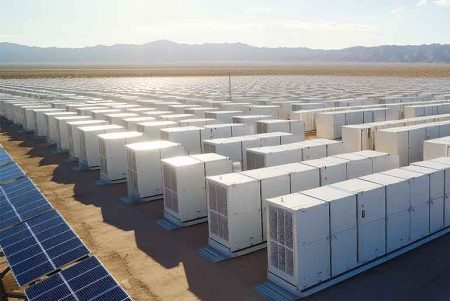
The 3 MWh VRFB at NTPC NETRA in Greater Noida marks India’s entry into long-duration storage. Designed for up to 12 hours of discharge, the system will help engineers study round-trip efficiency, degradation, safety and grid behaviour in Indian conditions.
If these results are promising, it will guide future policies, tenders and manufacturing strategies. NTPC has already indicated that this installation is the beginning of a wider exploration into non-lithium storage options.
The Key Players in India’s VRFB Landscape
Although the ecosystem is young, several institutions and companies have begun shaping India’s flow-battery future.
- NTPC NETRAThe first in India to have an operational vanadium redox flow battery (VRFB) system at the MWh scale and gain operational experience with long-duration energy storage.
- IIT Madras The leading academic research group working on VRFB chemistry electrolytes, membranes, and system optimization. Also developed a working prototype with institutional collaborations.
- Delectrik Systems India’s first commercial manufacturer to sell a vanadium flow battery energy-storage system with a storage capacity of 10 MWh and significant interest shown by the domestic market in large-scale VRFB systems.
- Vanadium Circularity Initiatives (CSIR and Metallurgy Projects)Developing the processes to recover battery-grade vanadium from industrial waste streams such as refinery waste or spent catalysts to enable supply chain for the future VRFB in India.
- ONGC Energy Centre Enabling indigenous VRFB technology development through collaborative projects varying from early stages of prototype development to exploratory phases of large-scale electrolyte production.
Together, these five pillars — government R&D, academia, manufacturers, supply-chain innovators and startups — form the earliest skeleton of India’s flow-battery ecosystem.
The Policy Road Ahead
India’s renewable ambition requires millions of megawatt-hours of storage, not just thousands. For VRFBs to become mainstream, three policy moves will matter:
1. Long-Duration Storage Tenders
Dedicated LDES tenders specifying 6–12+ hour storage would give manufacturers confidence to build factories and investors confidence to fund them.
2. Local Manufacturing Incentives
Production-linked incentives, land support and capital subsidies could help India leapfrog into a leadership position instead of relying on imports.
3. Vanadium Supply Strategy
A national roadmap for vanadium extraction, refining and recycling would stabilise costs and ensure long-term availability.
Government leaders have stated that NTPC’s demonstration will inform India’s next phase of LDES policy, making this period crucial for decision-making.
Can VRFBs Deliver India’s 24/7 Renewable Dream?
Vanadium flow batteries are not here to replace lithium — they are here to complement it. For short storage durations, lithium remains unbeatable. But for the long, quiet hours of the night, where the grid needs steady and affordable backup, VRFBs could become a core technology.
If India succeeds in aligning policy, price, and performance, it can build a storage ecosystem that is safe, scalable and made for local conditions.
The journey starts with 3 MWh at NETRA. The destination?
A power system where renewable energy flows not only when the sun shines or the wind blows, but whenever India needs it.
 Electrify your feed! Click here to join our Whatsapp group and to get the latest updates, expert insights, and innovations driving India’s energy storage revolution.