

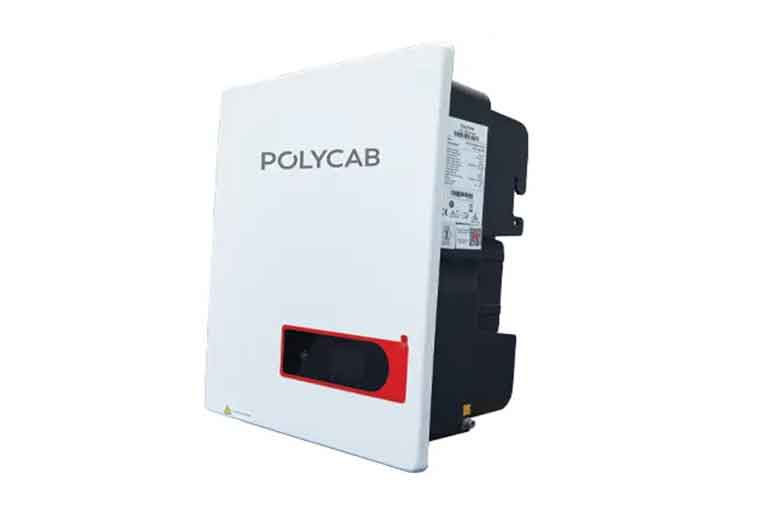
Polycab India Ltd has introduced its hybrid inverter and battery pack at the Renewable Energy India (REI) Expo 2026 in Greater Noida, expanding its solar energy portfolio to include solutions that combine solar power generation with energy storage. The launch comes as India’s renewable energy sector increasingly focuses on integrating battery storage with solar installations for improved energy management.
Held under the theme Smart Sustainability, REI Expo 2026 brings together industry participants to showcase technologies and solutions for the renewable energy sector. Polycab is displaying products designed for residential, commercial, industrial and utility-scale solar projects.
Polycab entered the solar sector in 2012 with solar DC cables and expanded into solar on-grid inverters in 2016. Over the years, the company has broadened its offerings to include solar inverters, cables and balance-of-system components required for solar installations.
The company manufactures grid-tie inverters in India, with capacities ranging from 2 kW to 350 kW. According to Polycab, it has supplied 6 GW of inverter capacity, covering more than 1.1 million inverters. The company also stated that its inverters account for 30% of rooftop installations completed under the PM Surya Ghar: Muft Bijli Yojana, based on the latest Ministry of New and Renewable Energy (MNRE) estimates cited by the company.
At the expo, Polycab is showcasing a range of products, including residential, commercial and industrial inverters, hybrid and utility-grade inverters, AC and DC distribution boxes, solar cables and accessories. Its accessories portfolio includes lugs, glands and jointing kits.
The company is also strengthening its domestic manufacturing capabilities through localisation, backward integration and product innovation. These efforts are intended to improve supply chain resilience and support the development of India’s renewable energy industry.
Polycab currently offers utility-scale inverters with capacities of up to 350 kW and plans to introduce a 500 kW inverter platform in 2027. The company is targeting opportunities in utility-scale solar projects, including those under the PM-KUSUM scheme and the developing floating solar market. Alongside its existing products, Polycab is working on advanced grid-forming inverter technology to support grid stability as the share of renewable energy in the power system increases.
The company’s newly introduced hybrid inverter and battery pack further expand its offerings for rooftop solar installations with energy storage. Hybrid inverters can manage power from solar panels, batteries and the electricity grid, depending on the system configuration. When combined with battery storage, they can help households and businesses use stored solar energy when generation is low or electricity demand rises.
The company sees growing opportunities in rooftop solar storage and technologies that can support the integration of renewable energy into the electricity grid.
Anurag Agarwal, CEO – Global Exports & New Businesses at Polycab India Ltd, said the solar inverter business has evolved significantly over the past decade, creating new opportunities through technological development and changing energy requirements.
He highlighted India’s ambition to achieve 500 GW of non-fossil energy capacity by 2030 and said Polycab aims to contribute to the country’s clean energy transition by strengthening its capabilities and developing solutions for changing market needs.
Agarwal also highlighted the company’s focus on product quality, energy efficiency and regulatory compliance. According to the company, its solar inverter portfolio up to 100 kW has completed Bureau of Energy Efficiency (BEE) registration.
Through its participation in REI Expo 2026, Polycab aims to connect with engineering, procurement and construction (EPC) companies, consultants, project developers and other renewable energy professionals. The company’s product showcase reflects its efforts to expand beyond conventional solar equipment into integrated solutions that combine solar generation, power conversion and battery storage.
As India’s solar market continues to grow, hybrid inverters and battery storage systems are expected to play an important role in improving the use of solar electricity and supporting more flexible energy management across residential, commercial and industrial applications.
 Electrify your feed! Click here to join our Whatsapp group and to get the latest updates, expert insights, and innovations driving India’s energy storage revolution.