
Reliance’s latest business update highlighted the scaling up of its solar manufacturing and Battery Energy Storage System (BESS) operations during FY 2025-26. It particularly emphasizes its cell and module production commissioning lines and the ramp-up of HJT cell manufacturing.
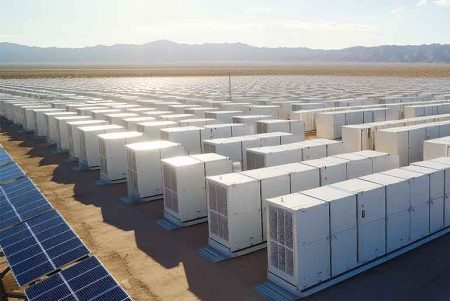
Reliance Industries Limited (RIL) stated that its Battery Energy Storage System (BESS) gigafactory is in the advanced stages of commissioning and is set to operationalise 40 GWh of annual production capacity, with a roadmap to expand to 100 GWh.
The company said that, with civil construction completed and equipment installation underway, production will ramp up during the second half of 2026, focusing on LFP chemistry for utility-scale BESS applications and mobility solutions. The company has been chasing the clock on its Bettery manufacturing plans, but seems well on couyrse to meet the deadline of 2026 it had set for itself.
Reliance HJT Modules
Reliance expects to utilise solar power generated during FY 2026-27 for captive consumption and green fuel production. The company said this will build on the production of its first 200 MWp of high-efficiency HJT modules.
In its business update, Reliance noted that its first 200 MWp of HJT modules delivered 10% higher energy yield and 25% lower degradation compared with industry standards. The company added that the 720 Wp BIS-certified panels are on track to support a manufacturing scale-up to 10 GWp per annum, with a planned expansion to 20 GWp.
Reliance is targeting module efficiencies of 26%, while polysilicon, glass, ingot, and wafer manufacturing facilities are being commissioned in phases as part of its strategy for full vertical integration.
Additionally, its also eyeing expansion in renewable energy generation and transmission infrastructure in Kutch through its 550,000-acre renewable energy hub. The company envisions deploying 55 MWp of solar modules and 150 MWh of battery containers daily at peak installation rates.
 Electrify your feed! Click here to join our Whatsapp group and to get the latest updates, expert insights, and innovations driving India’s energy storage revolution.