The solid-state battery has been labelled “the next big thing” in the race to produce cleaner, safer and more powerful energy storage systems, due to its potential for higher energy density, quicker charge times and better safety over traditional lithium-ion batteries. It is thought that the solid-state battery will dominate future electric vehicle (EV) markets, grid energy storage and portable electronic markets. However, with all of this hype comes an important question – is this cutting-edge technology ready for primetime, or is most of the buzz just that – hype? This article will examine what a solid-state battery is, what it may provide, the challenges that remain and when we can expect to see these batteries become a reality.
What is a Solid-State Battery?

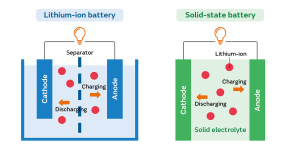
Unlike traditional lithium-ion batteries that use a liquid or gel electrolyte to shuttle ions between the anode and cathode, a solid-state battery replaces that liquid or gel with a solid electrolyte usually a ceramic or solid polymer material.
Because of this structural difference, the solid-state battery can use a metallic lithium anode (rather than graphite), which significantly increases the amount of energy it can store.
In simple terms: a solid-state battery keeps its “insides” solid no flammable liquid giving it advantages in energy storage, safety, and design flexibility.
The Promised Advantages of Solid-State Battery Technology
A number of advantages make solid-state battery technology so attractive. Here are the key ones:
Higher Energy Density & Longer Range
Solid-state batteries have much higher energy densities than their lithium-ion counterparts. To illustrate, solid-state batteries have much greater volumetric and gravimetric energy storage capacity than traditional lithium-ion batteries. In the case of electric vehicles, increased energy density means that they can go significantly further on one charge when using solid-state batteries rather than conventional lithium-ion batteries.
Improved Safety and Thermal Stability
Because of the use of an incombustible solid electrolyte in a solid-state battery as opposed to a liquid electrolyte in lithium-ion batteries, the risk associated with leaking, combusting and exploding is greatly reduced with a solid-state battery. Thus, solid state batteries offer unique prudent advantages for certain applications (i.e., electric vehicle and aerospace systems) where battery safety is a high priority.
Longer Lifespan and Durability
Another benefit of the solid-state battery is that it tends to degrade less over time. The solid electrolyte reduces the formation of dendrites (tiny needle-like structures) that can cause shorts in batteries.
As a result, solid-state batteries may deliver many more charge/discharge cycles than standard lithium-ion cells.
Faster Charging and Compactness
Some designs of solid-state battery allow for faster charging because ions can move rapidly through the solid electrolyte. The substitution of heavy liquid and protection elements in all solid-state batteries (ASSBs) with a more compact design allows for a much smaller battery pack size than previously available through traditional lead-acid technology. These smaller batteries provide an advantage to Electric Vehicle manufacturers as well as a small ecological and economical advantage to consumers who purchase portable consumer electronics.
As previously stated, the increase in efficiency and longevity of ASSBs may reduce the need to routinely purchase new batteries and thus, significantly decrease the waste stream and consumption of the natural resources that are necessary to produce replacement batteries.
Furthermore, by utilising fewer hazardous materials or the potential minimisation of fire or recycling issues, ASSBs also provide an alternative to the use of traditional battery technologies for long-term energy
The Reality: What’s Still Holding Solid-State Battery Back
Despite the many promises, the road to widespread deployment of solid-state battery technology remains bumpy. There are serious challenges — and that makes the “hype vs. reality” balance quite relevant.
Manufacturing Complexity and Cost
Producing a solid-state battery is much more complex and expensive than making a lithium-ion battery. Materials must be carefully processed, interfaces between solid electrolyte and electrodes must be engineered to near-perfection, and manufacturing environment often needs tight control.
Because of these high costs, solid-state battery packs today are often far more expensive than conventional batteries — which threatens their commercial viability in cost-sensitive applications like mass-market
Interfacial Issues and Ionic Conductivity
One major engineering challenge is at the interface where the solid electrolyte meets the electrodes. Poor contact or incompatibility can lead to high interfacial resistance, which reduces efficiency and degrades performance.
Also, many solid electrolytes show lower ionic conductivity at room temperature than required for high-performance applications — which means they struggle to deliver expected power or charging speeds under everyday conditions.
Mechanical / Material Stability Challenges
Some solid electrolytes (especially ceramic ones) are brittle and may crack under stress, heat expansion, or repeated charging/discharging cycles — a serious durability issue.
In addition, when using metallic-lithium anodes, changes in thickness and volume during charge/discharge can stress the structure and degrade performance over time.
Limited Real-World Deployment (As of 2025)
As of now, many solid-state battery versions remain at prototype or pilot-scale stage. Large-scale mass production especially for electric vehicles is still not widespread.
Research on new materials (including solid electrolytes) continues; but widespread commercial deployment will likely take time.
Recent Progress: Is the Solid-State Battery Getting Closer?
Yes — there are signs that solid-state battery technology is edging closer to reality. In 2025, several research groups, companies and industries are actively pushing forward to overcome earlier limitations.
For instance, many solid-state battery designs now use advanced solid electrolytes with improved ionic conductivity or materials engineered to handle mechanical stress better.
There is also growing interest in “semi-solid” or hybrid battery approaches — combining some features of solid-state battery with elements of traditional lithium-ion as bridging technologies during the transition.
Moreover, with global demand for safer, longer-range EVs and better energy storage, manufacturers and governments are investing heavily in solid-state battery research, accelerating innovation cycles.
Hype vs Reality: What to Believe (and What to Watch)
What the hype gets right: A solid-state battery truly has the potential to revolutionize energy storage — higher energy density, safer batteries, longer life, and better performance for EVs and devices. The promises are based on clear scientific advantages over conventional batteries.
What’s still uncertain: Significant technical and manufacturing barriers remain. Scaling up production, ensuring stable performance over time and across environments, and making solid-state battery cost-competitive remain big challenges. Mass production at scale is still several years away.
What’s realistic in next 5–10 years: We may see niche or premium applications — perhaps premium EVs or specialized energy storage systems — using solid-state battery technology. We may also see “transitional” battery types (hybrid or semi-solid) bridging the gap. Full mass-market EV adoption with solid-state battery may take longer.
Conclusion
The solid-state battery remains one of the most promising innovations in battery technology. Its potential to significantly outperform conventional lithium-ion batteries in energy density, safety, charging speed, and lifespan makes it a candidate to power the next generation of electric vehicles, portable electronics, and grid storage. But as of 2025, many real-world challenges — manufacturing cost, material stability, interface issues — still need to be solved before the solid-state battery becomes a mainstream reality.
So, while we should be optimistic, we should also be cautious. The hype around the solid-state battery is not unfounded — but its full benefits are still a work in progress. For now, the solid-state battery is not quite “here” yet — but 2025 may very well be the year when the journey from promise to product gathers real momentum.
Only time (and continued research, investment, and innovation) will tell whether the solid-state battery will truly deliver on its promise.
 Electrify your feed! Click here to join our Whatsapp group and to get the latest updates, expert insights, and innovations driving India’s energy storage revolution.