Every technological revolution has its pioneers and India’s battery revolution is no different. The top battery recycling startups in India are emerging as some of the most important architects of the country’s clean energy future. In industrial parks, research labs and recycling facilities, a new generation of startups is rewriting India’s critical mineral story quietly. These companies are not only treating waste, but also recovering strategic resources, extending battery life, and laying the groundwork for a circular battery economy.
India’s move to electric mobility is gaining momentum at an unprecedented pace. Industry analysis based on Vahan dashboard reveals that the country witnessed more than 2.5 million electric vehicle registrations in FY2025-26 with EV penetration at ~8.5% of total vehicle sales. Electric two-wheelers continue to dominate the market, with electric three-wheelers, buses and passenger vehicles slowly gaining market share.
The rise of electric mobility is causing a corresponding explosion in demand for batteries. A joint study by NITI Aayog and Rocky Mountain Institute (RMI) projects India’s total battery demand to be between 106 GWh and 260 GWh by 2030, depending on the pace of EV adoption and the overall energy transition.
But with this boom in battery deployment comes a critical question: what happens when these batteries reach the end of their first life?
For decades, used batteries were mostly treated as waste that needed to be safely disposed of. Today, they are increasingly recognised as containing valuable stores of lithium, nickel, cobalt, graphite and other crucial minerals needed for next-generation batteries. In many ways, every battery we deploy today is creating the recycling opportunity of tomorrow.
As India seeks to build a robust and self-sufficient battery ecosystem, startups are filling vital gaps in collection, reuse, recycling and material recovery. Their innovations could be game changers in aiding India realise its circular economy ambitions and enhance long-term resource security.
Why Battery Recycling Startups Matter for India
India’s battery goals are not just electric mobility. At the same time, the country is pursuing large-scale battery manufacturing, renewable energy integration and energy storage deployment. All of these are expected to create unprecedented demand for battery materials.
Industry estimates cited by the Institute for Energy Economics and Financial Analysis (IEEFA) suggest that Advanced Chemistry Cell (ACC) battery demand in India could spike from about 28 GWh in 2025 to close to 272 GWh by FY2030, based on projections from the India Energy Storage Alliance (IESA). The growth curve is expected to remain steep well past 2030 with IESA predicting cumulative demand for lithium-ion batteries in a variety of applications will exceed 500 GWh.
But every battery needs materials.
Research by WRI India estimates that producing 100 GWh of lithium-ion batteries could require approximately 193,000 tonnes of cathode active material annually by 2030. These materials include lithium, nickel, cobalt, manganese, and graphite—the critical minerals that power modern battery technologies.
This is where the challenge emerges.
India still depends almost entirely on imports for critical battery minerals such as lithium, cobalt and nickel, according to the Ministry of Mines, IEEFA and various industry studies. Such reliance leaves the country’s battery makers exposed to geopolitical risks, supply chain disruptions and volatile world commodity prices.
For a country that aspires to be a global manufacturing hub for batteries, long-term resource security is increasingly becoming a priority.
Battery recycling startups are thus being touted as strategic enablers of India’s clean energy transition. These startups are helping to develop a domestic supply of critical minerals and reduce import dependence by recovering valuable materials from used batteries.
The recovery of every tonne of lithium, nickel or cobalt within the country not only adds to the resilience of supply chains but also supports the larger vision of India in building a circular and self-reliant battery ecosystem.
These startups recycle batteries. But they are also, in many ways, securing the raw materials that could fuel India’s next phase of industrial growth.
From Waste to Wealth: The Rise of India’s Circular Battery Economy
Not long ago, a used lithium-ion battery was largely viewed as hazardous waste requiring safe disposal. Today, that perception is undergoing a dramatic transformation.
Increasingly, end-of-life batteries are being recognized as valuable reservoirs of critical minerals capable of supporting India’s future manufacturing ambitions. What was once considered waste is now being viewed as an opportunity.
This shift lies at the heart of India’s emerging circular battery economy.
WRI India estimates that nearly 128 GWh of end-of-life lithium-ion batteries could be generated in India by 2030, of which around 46% of the volume is likely to be from electric vehicles alone. This represents a huge future feedstock opportunity for recyclers.
The upside in the market is equally attractive. Industry estimates indicate that the Indian EV battery recycling market, valued at USD 12.9 million in 2023, is expected to reach close to USD 463 million by 2030, driven by the rapid rise in battery retirements and material recovery opportunities. Meanwhile, JMK Research estimates that India’s cumulative lithium-ion battery market could grow from about 2.9 GWh in 2018 to nearly 800 GWh in 2030. This means a huge feedstock base for recyclers to tap in the future.
The opportunity hidden within these batteries is enormous.
Recycling of end-of-life lithium-ion batteries in India by 2030 could recover approximately 17,500 tonnes of lithium, 22,600 tonnes of nickel, 2,600 tonnes of cobalt and almost 141,800 tonnes of graphite,” says WRI India. Recovery of these materials can significantly reduce India’s dependence on imported critical minerals and strengthen domestic battery production.
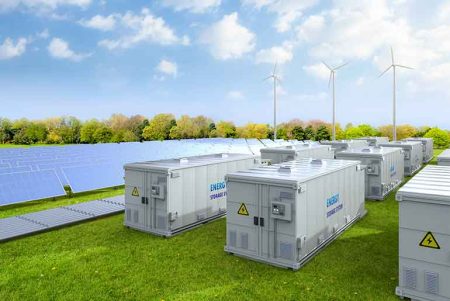
Many of these batteries also retain 70-80% of their original capacity after completing their automotive life cycle. Before entering the recycling stream, such batteries can often be reused, refurbished, or deployed in second-life applications such as stationary energy storage, thereby extending their useful life.
Eventually, however, every battery reaches the end of its journey.
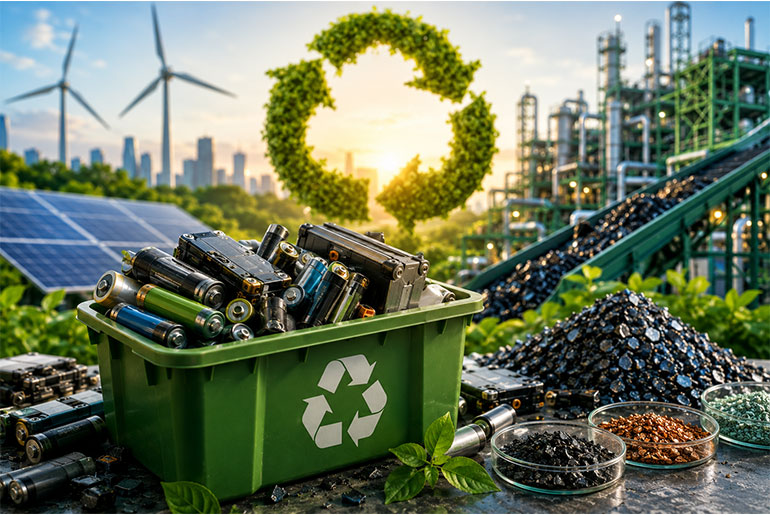
This is where the advanced recycling technologies come in. As outlined in our full article on the Lithium Battery Recycling Process, end of life batteries are safely discharged, disassembled, shredded and material separated to recover the valuable constituents.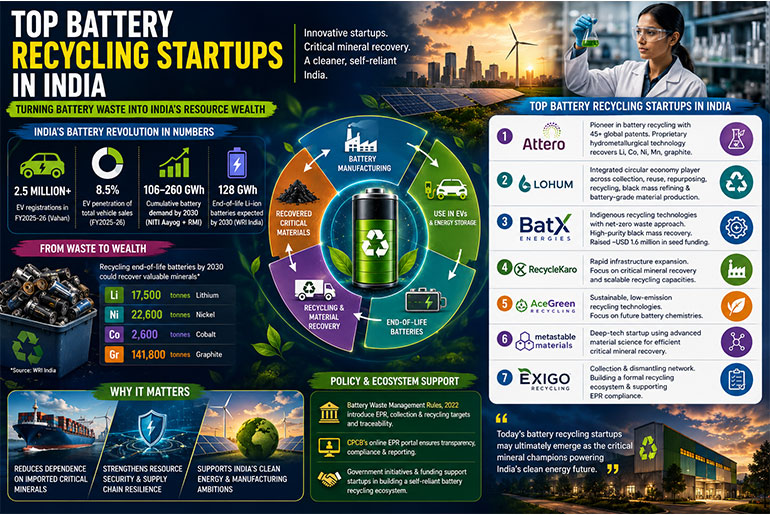 A key output of this process is black mass, a concentrated mix rich in lithium, nickel, cobalt, manganese and graphite. Our article on Black Mass Recovery Companies talks about how black mass is becoming a strategic resource to strengthen India’s critical mineral ecosystem.
In essence, battery recycling startups are transforming retired batteries into urban mines. By extracting valuable materials and returning them to the manufacturing cycle, these companies are helping build a truly circular battery economy—one where yesterday’s batteries can help power tomorrow’s clean energy transition.
Top Battery Recycling Startups in India Transforming the Sector
Deep-tech startups and material recovery specialists are flocking to India’s nascent circular battery economy to invest in the country’s fast-changing battery ecosystem, with a new cadre of recyclers. These companies aren’t just recycling used batteries. They’re re-using critical minerals, extending the life of batteries, investing in indigenous technologies, and building domestic supply chains for strategic materials.
Together, they are helping transform battery recycling from a waste management activity into a strategic industry aligned with India’s clean energy and manufacturing ambitions.
Attero is one of India’s leading battery recycling companies and among the earliest players to recognise the potential of urban mining amongst the pioneers.
The company has developed proprietary hydrometallurgical technologies capable of recovering lithium, cobalt, nickel, manganese, graphite and other strategic materials from end-of-life batteries. Attero, with more than 45 global patents in e-waste and lithium-ion battery recycling, has proven that battery recycling in India can transition from a waste management activity to a strategic critical mineral business. The company also announced plans to invest more than ₹8,300 crore over five years to expand its recycling operations, a sign of growing confidence in India’s battery recycling opportunity.
Another sector shaper, Lohum, has grown into one of the largest integrated battery circular economy companies in India. Lohum differs from traditional recyclers as its operations span multiple stages of the battery lifecycle including collection, reuse, repurposing, recycling, black mass refining and battery-grade material production. Its vertically integrated model is helping to build one of India’s most comprehensive closed loop battery ecosystems.
BatX Energies is part of a new wave of deep-tech innovation. The startup is developing indigenous battery recycling technologies to recover high purity battery materials in a net-zero waste approach. The Technology Development Board (TDB) under the Government of India has also been assisting BatX in commercialising indigenous recycling technologies. The company also drew investor interest after raising around USD 1.6 million in seed funding, underscoring growing investor confidence in the potential of battery recycling in India.
Another important player is Recyclekaro, which has quickly ramped up its lithium-ion battery recycling infrastructure in the last few years. The company wants to recover strategic materials from end-of-life batteries, while constantly scaling-up its processing capacities to cope with increasing volumes of battery waste.
Companies like Ace Green Recycling are bringing environmentally focused recycling technologies to market. It is aiming at sustainable, low-emission recycling processes for emerging battery chemistries, which are expected to be widely adopted in the next few years.
There are also startups like Metastable Materials that are innovating with new technologies for critical mineral recovery and battery material circularity. These companies are expected to play a key role in shaping the future of the EV Battery Recycling Market India.
In the meantime, Exigo Recycling is working on the formal recycling ecosystem in India through collection, dismantling, material recovery activities and supporting compliance under Extended Producer Responsibility (EPR) regulations.
These companies are examples of the evolution of the recycling ecosystem in India beyond waste management. The sector is increasingly a strategic industry focused on critical mineral security, reducing import dependence and enabling a circular battery economy.
Readers seeking a broader understanding of the ecosystem can also explore our detailed feature on Battery Recycling Companies in India.
Challenges Facing Battery Recycling Startups in India
Despite the huge potential, there are multiple challenges faced by battery recycling startups in India that could impact the speed of the sector’s growth.
The biggest challenge is availability of feedstock. India’s EV market is growing fast but large volumes of end-of-life EV batteries have not yet entered the recycling stream. As a result, many startups currently rely on manufacturing scrap, consumer electronics batteries, and imported feedstock to sustain operations. In many ways, India’s startups are building recycling infrastructure today for a waste stream that will mature tomorrow.
Another big challenge is developing robust reverse logistics systems. Lithium-ion batteries are hazardous, bulky and geographically dispersed, unlike conventional waste streams. The industry still faces major challenges to develop efficient infrastructure for collection, transportation, storage and traceability.
The continued dominance of the informal sector also remains a concern. A significant amount of battery and e-waste in India continues to be processed through informal channels, which often leads to unsafe handling practices, lack of traceability, environmental hazards, and loss of valuable materials.
Another difficulty is the cost of technology and capital. Recovery of lithium, cobalt, nickel and graphite to battery grade requires sophisticated hydrometallurgical processes, advanced equipment, environmental safeguards and highly skilled manpower. Commercialisation of such technologies often requires huge investments and long gestation periods.
But investors are starting to feel more confident about the sector. BatX Energies is a company that has successfully attracted funding. In the meantime, established players like Attero have announced ambitious expansion plans running into few thousands crores. Investor enthusiasm is growing, indicating rising confidence in India’s circular economy and critical mineral recovery ecosystem.
Also, policy support is getting stronger. The Ministry of Environment, Forest and Climate Change (MoEFCC) has notified Battery Waste Management Rules which have put in place Extended Producer Responsibility (EPR), mandatory collection and recycling targets and traceability mechanisms. The online EPR portal of the Central Pollution Control Board (CPCB) is enhancing transparency, compliance and reporting, further helping formalise the ecosystem.
The Road Ahead: Startups Powering India’s Resource Future
India’s battery story does not end when a battery reaches the end of its first life. In many ways, that is where a new journey begins.
As millions of batteries eventually retire from electric vehicles, energy storage systems, and consumer electronics, the country will simultaneously create one of the world’s largest future streams of battery waste. The challenge will not simply be managing this waste but transforming it into an opportunity.
The Top Battery Recycling Startups in India are already demonstrating how innovation can convert retired batteries into valuable sources of lithium, nickel, cobalt, graphite, and other strategic materials. In doing so, these startups are helping India move closer to a circular, self-reliant, and resource-secure future.
The future of battery recycling in India will not be shaped by waste alone. It will be shaped by innovation.
Today’s battery recycling startups may ultimately evolve into tomorrow’s critical mineral champions.
 Electrify your feed! Click here to join our Whatsapp group and to get the latest updates, expert insights, and innovations driving India’s energy storage revolution.