Innovative financing frameworks and policy interventions would be essential to bridge the cost gap in green hydrogen production and accelerate India’s transition to a low-carbon economy, say industry stakeholders during SPDA sessions.
The Sustainable Projects Developers Association (SPDA) spearheaded two key sessions at the 3rd International Conference of Green Hydrogen (ICGH) 2025 conference, i.e., a panel discussion on the topic “Financing Green Hydrogen: Bridging the Cost Gap” and a roundtable on the topic “India-France Roundtable with Industry CEOs on Green Hydrogen Value Chain.” Both the sessions aimed to deliberate and chart a roadmap for the future of green hydrogen and its derivative industry in India.
The high-level sessions brought together eminent scientists, industry leaders, global financiers, and lenders to discuss pathways for accelerating investment in green hydrogen. During the ‘Financing Green Hydrogen: Bridging the Cost Gap’ panel discussion, the dialogue was focused on understanding cost drivers, identifying advanced financing tools, sharing global best practices, strengthening risk mitigation frameworks, and building robust offtake mechanisms. The panel discussion was moderated by Dr. Ashvini Kumar, former managing director of SECI, and the keynote address was given by Mr. Joshit Ranjan Sikidar, director of finance at SECI. The key speakers at the discussion include Mr. Ashok Sharma, Deputy Managing Director, SBI; Mr. Sudeep Sural, Senior Executive Vice President – Head of Thematic Research, HDFC Bank; Dr. Susana Moreira, Executive Director, H2Global Foundation; Mr. Anuj Banga, Head of Structured and Project Finance, India, SMBC; Mr. Mudit Parashar, CFO, ACME; and Mr. Ranjit Gupta, CEO, Ocior Group, among others.
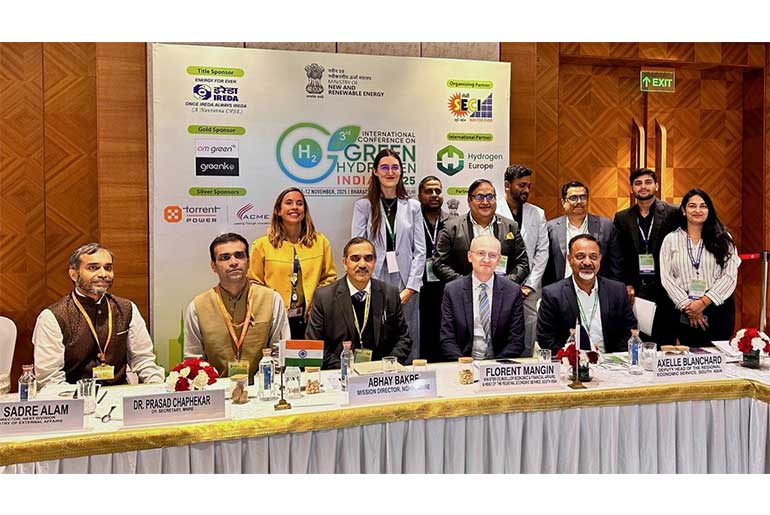
The deliberations at the India-France roundtable focused on a specific roadmap on green hydrogen, endorsed in October 2022 and aimed at strengthening collaboration on regulatory frameworks, carbon certification, scientific research, and industrial partnerships. The round table included eminent speakers such as Mr Mahaveer Singhvi, Joint Secretary -New Emerging and Strategic Technologies (NEST) Division, Ministry of External Affairs; Mr Florent Mangin, Minister Counsellor Economic & Financial Affairs, & Head of the Regional Economic Service, South Asia; Ms Axelle Blanchard, Deputy Head of the Regional Economic Service, South Asia; Ms. Elisa Vigato, Energy and Environment Attache, Regional Economic Service, South Asia; Mr. Thierry Advocat, Counsellor, representative of the CEA; Dr. Meenakshi Singh, Scientific Coordinator, IFI; Mr. Guirec Servan, Chief Executive Officer India, EDF Power Solutions; Mr. Rajeev Tiwary, Head of BD & Partnerships – New Business, EDF Power Solutions; Mr. Amit Jain, Chief Executive Officer India, ENGIE; Mr.Anand Srivastava, Business & Project Developer, HDF Energy and Ms. Laura Gilotte, Economic Attache, South Asia among others.
“India has emerged as one of the fastest-growing ecosystems for green hydrogen in the past three years since the launch of the Green Hydrogen Mission. Technology, skilling, and standards will help strengthen the ecosystem for green hydrogen. The kind of projects coming up offer immense potential for replacing fossil fuel imports into the country and also facilitate decarbonization of many sectors,” says Shri Abhay Bakre, Mission Director, Ministry of New and Renewable Energy, while speaking at the ICGH conference.
Speaking at the SPDA session, Dr. Sadre Alam, Director, New Emerging and Strategic Technologies (NEST) Division, Ministry of External Affairs, said, “We should aim that our green hydrogen and its derivatives’ production target should be more and more export-oriented. Besides, we are confident of increasing our domestic consumption for green hydrogen and its derivatives as industries are becoming more competitive in setting up more plants in record time.”
While emphasizing on the need for increasing the share of green fuels in India’s energy mix, Shri Vineet Mittal, Chairman of Avaada Group, opined at ICGH that “the future of energy must be clean, secure and equitable and India’s renewable energy journey over the past decade has been transformative. Achieving the vision of Atmanirbhar Bharat and Viksit Bharat will be “challenging” if we do not bring in a change in the fuel mix in the Indian economy.”
Adding to it, Shri Vineet Mittal said that “we have the technology in place, and the government has proved green fuel could be competitive; now we have to collectively build a model where hard-to-abate sectors and industries can start using it more aggressively, and the government should support this with mandates like it did in case of wind and solar. Energy transition is not just about technology; it is about transforming the destinies of nations. It is one of the strong pillars of Viksit Bharat.”
While green hydrogen is rapidly gaining prominence as a key pathway for deep decarbonization in hard-to-abate sectors such as steel, cement, heavy mobility, and chemicals and fertilizer, its commercial uptake remains constrained by a significant cost gap compared to grey hydrogen.
Shri Ravi Verma, Member, Governing Council, Sustainable Projects Developers Association (SPDA), discussed with his French counterparts how India is aggressively working towards developing the ecosystem for green hydrogen and its derivatives, such as green ammonia and green methanol, within the country, and invited the French companies to work closely with India.
He also assured his French counterparts by saying that “the Indian government has, from time to time, been addressing the various issues confronting the green hydrogen industry, and a lot of policy intervention has been done to promote the sector so as to make it more and more competitive, both for renewable energy as well as for export purposes. There will be a lot of focus on the cost reduction, efficiency, and technology localization.”
Though India has taken significant strides through the National Green Hydrogen Mission, the high cost of electrolyzers, renewable power, and infrastructure remains a major impediment to commercial viability. Moreover, limited offtake assurance and underdeveloped transport and storage infrastructure continue to hinder large-scale deployment.
 Electrify your feed! Click here to join our Whatsapp group and to get the latest updates, expert insights, and innovations driving India’s energy storage revolution.