India today stands at a decisive moment in its energy transition. Renewable capacity is rising fast, solar tariffs are hitting record lows, and large-scale tenders for storage are being announced almost every quarter. The future looks exciting on paper. But when you get closer to the ground, a different story starts to emerge—one shaped not by ambition, but by Battery Bottlenecks. These Battery Bottlenecks are not caused by a lack of technology or money; they are hidden in execution gaps, grid behavior, financial models, and even climate realities. For industry leaders, understanding these bottlenecks is no longer optional; it is essential.
A Market Growing Faster Than Its Foundations
India’s Battery Energy Storage System (BESS) market is expected to grow exponentially in the coming decade. According to the International Energy Agency and multiple industry analyses, India may require over 200 GWh of battery storage by 2030–2032 to support its renewable targets.
At the same time, the government has been aggressively pushing storage-linked tenders through agencies like Solar Energy Corporation of India.
However, a major gap exists.
The Institute for Energy Economics and Financial Analysis says that even though more than 10–15 GWh of storage space has been offered, only a small part of it has been put into use.
This gap between ambition and execution is the first signal of deeper Battery Bottlenecks.
India is not struggling to announce storage—it is struggling to operationalize it.
The Duck Curve: When Timing Becomes the Enemy
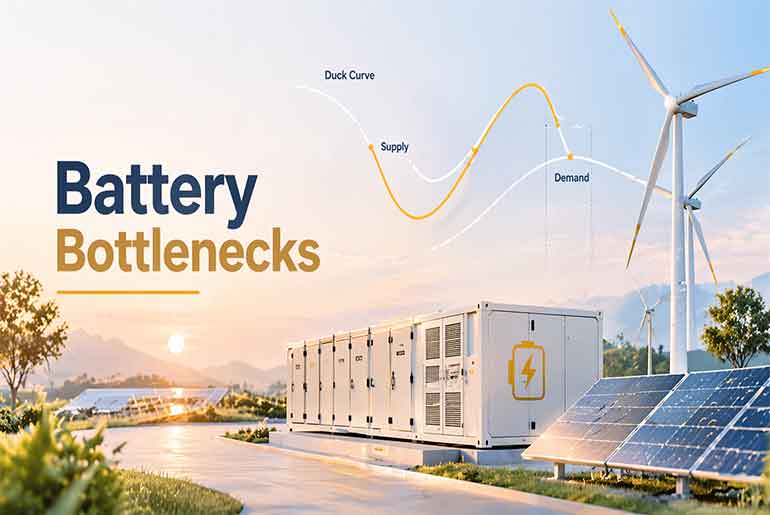
One of the most talked-about yet underestimated Battery Bottlenecks is the “duck curve.”
As solar capacity increases, India experiences excess power generation during the day. Electricity prices drop sharply—sometimes to ₹2–3 per unit, as observed in multiple renewable auctions reported by Ministry of Power.
But as the sun sets, demand spikes sharply while solar generation disappears.
This creates a steep “neck” in the curve—forcing batteries to discharge rapidly within a short window.
Why this is a problem:
- High discharge rates increase battery degradation
- Power electronics (PCS systems) face stress
- Grid stability becomes harder to maintain
The result? Batteries are not just storing energy—they are being pushed to perform under extreme operational stress.
This is a classic Battery Bottleneck where the issue is not capacity, but timing mismatch.
Revenue Stacking: A Market Still Finding Its Logic
Another critical Battery Bottleneck lies in how storage actually makes money.
Globally, batteries earn through multiple streams:
- Energy arbitrage (buy low, sell high)
- Frequency regulation
- Voltage support
- Capacity markets
In India, however, this model is still evolving.
According to studies referenced by the Central Electricity Authority, storage projects often rely heavily on a single revenue stream, making them financially fragile.
The challenge:
- Regulatory frameworks for ancillary services are still developing
- Real-time market participation is complex
- Software and control systems are expensive
This creates confusion among developers:
Should they optimize for trading?
Or for grid services?
India has built storage assets—but not yet a fully functional storage market.
This uncertainty is one of the most overlooked Battery Bottlenecks, because it directly affects investor confidence and long-term viability.
Ghost Capacity: The Tender vs Reality Gap
On paper, India’s storage pipeline looks massive.
But a closer look reveals what many experts now call “ghost capacity.”
Reports from Reuters and IEEFA indicate that a large portion of awarded projects face delays or financial stress.
Why this happens:
- Aggressive underbidding to win tenders
- Fluctuating raw material costs
- Unclear long-term revenue visibility
Tariffs in some storage tenders have dropped to extremely low levels, raising concerns about project viability.
The result is a pipeline filled with announcements—but limited execution.
The biggest Battery Bottlenecks today are not technological—they are financial.
Thermal Reality: The Invisible Energy Loss
India’s climate introduces a unique and often ignored Battery Bottleneck—heat.
When temperatures rise above 45°C, it becomes hard to keep batteries in good condition.
The National Renewable Energy Laboratory says that lithium-ion batteries need to be kept at certain temperatures in order to work safely and efficiently.
The issue:
- Cooling systems (HVAC) consume 5–10% of stored energy
- Thermal stress accelerates degradation
- Risk of thermal runaway increases
This means a portion of stored energy is constantly being used just to keep the system alive.
In India, batteries don’t just store energy—they consume it to survive.
This thermal inefficiency is one of the most critical yet underestimated Battery Bottlenecks affecting project economics.
Grid-Forming Gap: The Future Arriving Too Fast
The final and perhaps most strategic Battery Bottleneck lies in grid behavior itself.
In the past, power grids used coal and hydro plants that gave them inertia, which is stability through rotating mass.
But as renewables replace these sources, grid stability weakens.
Modern systems now require grid-forming batteries—systems that can actively stabilize the grid rather than just follow it.
However, most existing installations in India are still grid-following.
Why this matters:
- Weak grids become unstable
- Renewable integration becomes risky
- Blackouts become more likely in high-renewable regions
According to technical discussions by the International Renewable Energy Agency, grid-forming technologies will be essential for future energy systems.
Without grid-forming storage, renewable expansion risks destabilizing the very grid it powers.
This transition gap is a long-term Battery Bottleneck that will define the next decade.
A System Problem, Not a Battery Problem
When we step back, a pattern becomes clear.
These Battery Bottlenecks are not isolated issues—they are interconnected.
The duck curve stresses operations
- Revenue gaps affect financing
- Ghost capacity slows execution
- Thermal losses hit efficiency
- Grid limitations restrict integration
Together, they reveal a deeper truth:
- India does not have a battery problem.
- It has a systems integration problem.
What Comes Next? A Shift in Thinking
Despite these challenges, the momentum is undeniable.
India’s push toward 500 GW renewable capacity by 2030, as outlined by the Ministry of New and Renewable Energy, ensures that storage will remain central to the energy transition.
But the next phase will demand a shift.
From:
Capacity addition
To:
System optimization
Key focus areas:
- Intelligent dispatch using AI
- Better thermal design and materials
- Clear ancillary market structures
- Realistic bidding frameworks
- Adoption of grid-forming technologies
Conclusion: Beyond the Hype
India’s energy storage story is not a failure—it is a transition in progress.
The country has already answered the question:
Do we need batteries?
The real challenge now is far more complex:
How do we make them work—efficiently, profitably, and reliably?
The answer lies in addressing the Battery Bottlenecks that currently define the system.
Because in the end, the success of India’s energy transition will not be measured by how many batteries are installed—
But by how intelligently they are integrated.
 Electrify your feed! Click here to join our Whatsapp group and to get the latest updates, expert insights, and innovations driving India’s energy storage revolution.