
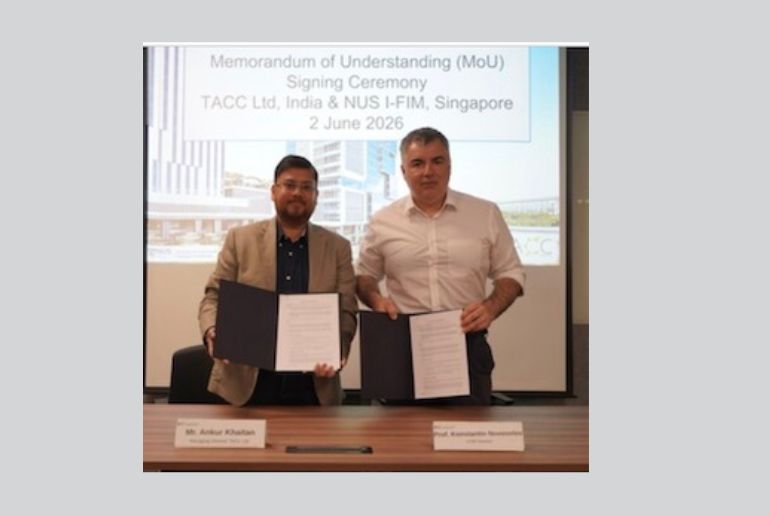
TACC Limited, a wholly owned subsidiary of HEG Limited and part of the LNJ Bhilwara Group, has signed a Memorandum of Understanding (MoU) with the Institute for Functional Intelligent Materials (I-FIM) at the National University of Singapore (NUS). The partnership will focus on advancing research and innovation in advanced materials and nanotechnology to speed up the development and commercialization of next-generation technologies, including graphene and other high-performance nanomaterials.
This collaboration sets the stage for long-term cooperation between TACC and NUS I-FIM, combining TACC’s industrial and commercialization capabilities with NUS’ globally recognized scientific research expertise. The initiative will focus on research and innovation in advanced functional materials, translating laboratory discoveries into industrial applications, and accelerating technology readiness through applied R&D and pilot projects.
Key areas of cooperation include the development, testing, validation, and commercialization of new technologies, as well as exploring commercialization pathways through licensing agreements, startups, and joint ventures. The partnership will also support researcher exchange programs, industry training initiatives, and efforts to build a stronger innovation bridge between India and Singapore. Additionally, both organizations will explore the use of artificial intelligence and laboratory automation to develop novel advanced functional materials.
Ankur Khaitan, Managing Director and CEO of TACC Limited, said, “Carbon based advanced materials are redefining industries, and TACC sits at the intersection. Our MOU with NUS is a deliberate step toward accelerating technology maturity, creating tangible commercialization pathways, and strengthening the Indian innovation ecosystem by uniting world-class research with industrial-scale ambition.”
Professor Sir Konstantin Novoselov, Director of NUS I-FIM and Nobel laureate recognized for the discovery and characterization of graphene, said, “Graphene’s potential has never been in question, but the challenge has been its successful integration into real-world applications. Strong collaboration between academia and industry is essential to accelerate innovation and translate scientific research into scalable technologies.”
The partnership comes as advanced materials such as graphene gain increasing importance across sectors including energy storage, electronics, thermal management, coatings, infrastructure, mobility, and industrial manufacturing. By combining scientific innovation with industrial scalability, the collaboration seeks to develop commercially viable graphene and advanced material applications for future global industries.
 Electrify your feed! Click here to join our Whatsapp group and to get the latest updates, expert insights, and innovations driving India’s energy storage revolution.