India is entering 2026 with an energy system that looks very different from the one it had even five years ago. Renewable energy has scaled rapidly, crossing 190+ GW, and the pipeline for solar and wind combined is now among the world’s largest. But renewable growth has outpaced the grid’s ability to absorb and balance it. This is why energy storage is no longer a complementary technology—it is the backbone of India’s power transition.
According to the Central Electricity Authority’s National Electricity Plan (NEP 2023), India will require over 60 GW of total energy storage capacity by 2029–30, of which more than 40 GW is expected to come from Battery Energy Storage Systems (BESS).
Every major policy update—from storage viability gap funding (VGF) to hybrid project guidelines, pumped hydro incentives and the National Green Hydrogen Mission—signals a clear direction: India’s power stability, flexibility and decarbonisation now depend on storage.
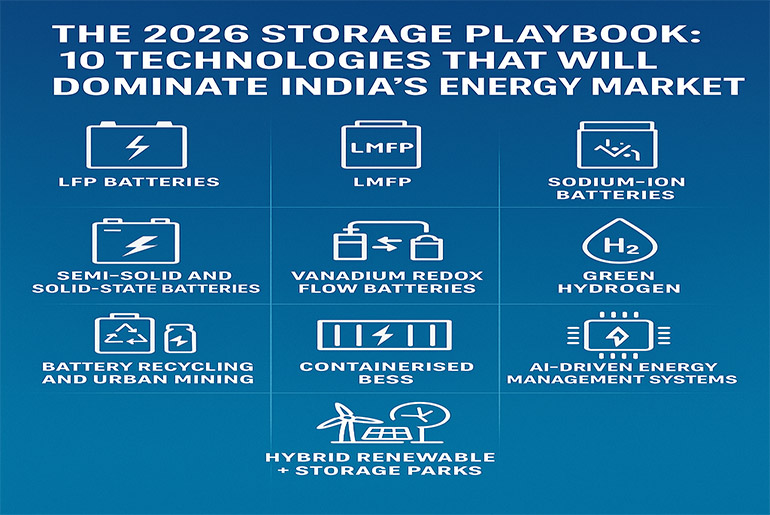
Here is a detailed, research-driven look at the 10 technologies that will shape India’s energy storage landscape in 2026.
1. LFP Batteries: The Foundation of India’s Storage Build-Out
Lithium Iron Phosphate (LFP) batteries will remain the dominant chemistry for energy storage deployments in 2026. Their thermal stability in India’s 45–50°C conditions, long cycle life, and comparatively lower cost make them ideal for both grid and mobility applications.
Most gigafactory proposals under India’s PLI scheme prioritise LFP because it offers the fastest path to scalable domestic manufacturing. For utility-scale tenders in 2026, LFP will continue to be the preferred chemistry due to its predictable safety profile and maturing supply chain.
2. LMFP: The High-Energy Successor to LFP
Lithium Manganese Iron Phosphate (LMFP) is rapidly entering commercialisation globally, and India is closely aligned with that trend. LMFP offers 15–20% higher energy density than LFP while retaining safety and cost advantages.
In 2026, LMFP is expected to appear in pilot-scale energy storage installations, longer-range EVs and industrial applications, especially as Indian R&D groups and early pilot lines begin validating LMFP cathodes. It represents a natural upgrade path for India’s emerging cell manufacturing sector.
3. Sodium-Ion Batteries: The Cost-Climate Advantage India Needs
Sodium-ion batteries align strongly with India’s energy needs because they operate well in high temperatures, rely on abundant raw materials, and promise meaningful cost reductions over time.
India’s interest surged after major global manufacturers announced commercial sodium-ion lines. In 2026, sodium-ion systems may enter telecom backup, microgrids, C&I storage and low-voltage ESS, serving segments where cost sensitivity is critical. They will not replace lithium-ion but complement it as part of a diversified energy storage mix.
4. Semi-Solid and Solid-State Batteries: High-Safety Storage for Strategic Use
Solid-state batteries are not expected to reach mainstream commercial scale in India in 2026, but early pilot deployments—particularly semi-solid variants—are likely.
These technologies offer high safety, improved cycle life and superior energy density. Defence, railways and high-value industrial segments will be among the earliest adopters. For now, solid-state will contribute a small share of India’s storage capacity, but its R&D momentum will strongly influence long-term product development.
5. Vanadium Redox Flow Batteries: The Multi-Hour Storage India Needs
India’s renewable generation curve is increasingly mismatched with evening demand peaks. This requires long-duration energy storage—something lithium-ion cannot solve alone.
Vanadium redox flow batteries (VRFBs) offer stable 6–12-hour storage, 20+ years of life and no thermal runaway risk.
States like Rajasthan, Gujarat and Tamil Nadu—where renewable build-out is densest—will see early VRFB pilots in 2026. Flow batteries will become central to balancing multi-hour wind-solar fluctuations.
6. Green Hydrogen: India’s Seasonal Storage Architecture
Under the National Green Hydrogen Mission, India is targeting production of up to 5 million tonnes per annum by 2030, supported by large electrolyser roll-outs and renewable capacity additions.
In 2026, hydrogen will not yet be a mass-scale solution, but it will begin playing a decisive role as seasonal energy storage, supporting industrial decarbonisation, hydrogen-blending pilots in gas plants and renewable-hydrogen-power integrations. Hydrogen will complement batteries—addressing durations batteries cannot cover.
7. Battery Recycling and Urban Mining: The Raw Material Supply-Chain Reset
With rising EV penetration and early BESS installations reaching mid-life, India will enter its first meaningful phase of battery recycling by 2026.
Battery Waste Management rules make extended producer responsibility (EPR) mandatory, pushing OEMs and recyclers toward black mass recovery and high-purity material regeneration.
Recycling will become a strategic pillar of India’s energy storage supply chain, reducing reliance on imported lithium, nickel and cobalt while lowering battery production costs.
8. Containerised BESS: The Standard Format for Utility Storage
India’s storage tenders increasingly specify containerised BESS as the preferred system design. The format offers rapid deployment, predictable safety systems, modular scalability and lower EPC complexity.
As NTPC, SECI and state utilities commission hybrid renewable-plus-storage projects, containerised BESS will emerge as the standard hardware architecture for grid-connected energy storage across substations and renewable parks.
9. AI-Driven Energy Management Systems: The Brain Behind Storage Assets
AI-enabled Energy Management Systems (EMS) will be essential for operating India’s growing storage fleet. These platforms optimise battery dispatch, predict renewable generation, manage grid congestion, and protect battery health.
In 2026, EMS adoption will rise sharply as utilities and developers seek bankability, revenue stacking opportunities and integration with real-time power markets. The intelligence layer will define how effectively India utilises its physical energy storage assets.
10. Hybrid Renewable + Storage Parks: India’s New Power Supply Model
The Ministry of Power and SECI have made it clear that future renewable development will move toward hybrid configurations—solar, wind and energy storage combined.
These projects deliver firm, schedulable green power, reduce curtailment, improve grid reliability and enable corporate consumers to secure round-the-clock renewable supply.
By late 2026, India’s most competitive renewable tenders will almost certainly be hybrid-plus-storage, marking a major shift from intermittent to reliable clean energy.
Conclusion: 2026 Is India’s Pivot to a Storage-Driven Energy System
India’s transition is no longer measured solely in renewable gigawatts but in the gigawatts and gigawatt-hours of energy storage that make those renewables viable.
The technologies shaping 2026—from LFP and LMFP to flow batteries, sodium-ion, hydrogen and AI-driven EMS—are not just innovations; they are the foundations of India’s future power architecture.
The companies investing in these technologies today will set the direction for India’s power sector for the next decade.
 Electrify your feed! Click here to join our Whatsapp group and to get the latest updates, expert insights, and innovations driving India’s energy storage revolution.