India’s Growing Energy Storage Dilemma
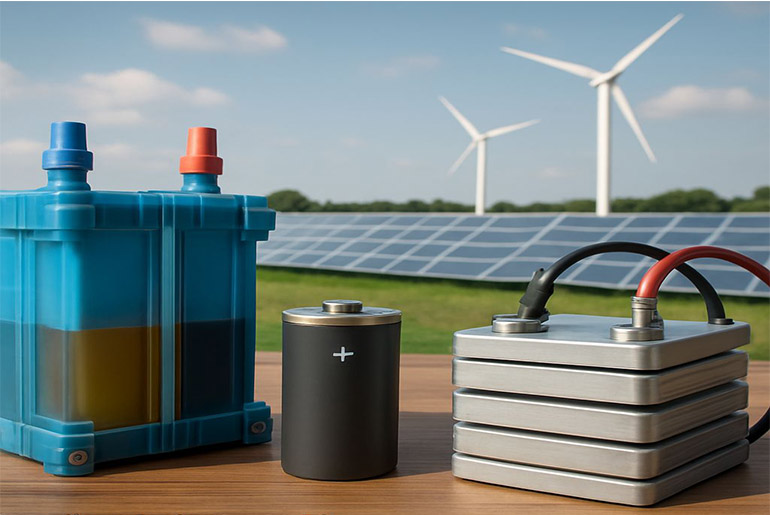
India is on an ambitious mission to decarbonize its energy sector, aiming for 500 GW of installed capacity of non-fossil fuels by 2030. While the country develops solar and wind assets at a breakneck speed, the most critical challenge is to deal with their intermittency. Resilient, scalable storage technology is required for grid stability and energy security. Lithium-ion batteries may have the edge right now, but their weaknesses — price, material limitation, and safety concerns — have left the door ajar for alternative battery tech to make its move. Among these, vanadium redox flow batteries are emerging as a promising, long-duration storage option suited for large-scale grid applications.
Why Go Beyond Lithium-Ion?
Lithium-ion batteries (which take high energy when a substance has a trade-off to play a game) have high efficiency and energy as costs.
- Dependence on the import of raw materials (lithium, cobalt, nickel).
- Environmental and human rights abuses in mining.
- It has low heat resistance & will burn.
- It is expensive, and the recycling process is complicated.
For India, in seeking strategic energy independence and sustainable development, storage technologies need to be diversified.
Vanadium Redox Flow Batteries (VRFBs): The Long-Life Contender
VRFBs work by pumping vanadium-based electrolytes through a cell stack to charge and by discharging energy. They have a number of benefits:
- Very high cycle life (up to 20,000 cycles).
- Energy and power capacity that are decoupled.
- Non-flammable and safe for mass deployment.
Internationally, countries including China, Australia, and the US have been trialing VRFBs for grid use. Vanadium reserves are abundant in India, inasmuch as it is found in Karnataka and Odisha. Indian research institutes and startups, for their part, have tinkered with this technology already.
Zinc Batteries: Cheaper, More Scalable, and ECO Friendly
Zinc-based batteries, like zinc-air, zinc-ion, and zinc-bromine, are also favored for their low cost and abundance of materials.
- Utilization of commonly available and recyclable materials.
- Good safety record with no risk of thermal runaway.
Competitive cost per kWh.
They are challenged by dendrite growth and comparatively lower energy density. Nevertheless, companies such as NantEnergy and ZincFive are improving performance and life. India can localize the supply chain and establish itself as a hub for the production of zinc batteries due to its substantial zinc reserves.
High-Energy Potential for Stationary Use with Aluminum-Air Batteries
By oxidizing aluminum with oxygen from the air, aluminum-air batteries generate electricity. They possess:
- extremely high energy density (up to eight times that of lithium-ion).
- Lightweight structure well suited for backup and mobility applications.
- Aluminum as a low-cost, very abundant, and recyclable resource.
Although these batteries are not yet rechargeable in the classical sense, the used aluminum can be recycled, so they can be used for one-time, high-energy applications such as emergency backup or long-range EVs. Indian startups and collaborations, like Indian Oil and RIL’s alliance, are working on developing aluminum-air solutions.
6. Comparative Analysis: Which Tech Fits Where?
| Technology
|
Strengths
|
Weaknesses
|
Best Use Cases
|
| Vanadium Redox
|
Long lifespan, safe, scalable
|
High upfront cost
|
Grid storage, renewables balancing
|
| Zinc-Based
|
Low cost, abundant, safe
|
Dendrites, energy density limitations
|
Commercial backup, telecom
|
|
Aluminum-Air
|
High energy density, recyclable
|
Not rechargeable, infrastructure need
|
EVs, remote backup, disaster relief
|
India’s Investment and Policy Environment
The National Energy Storage Mission of India is promoting the development and adoption of cutting-edge storage technologies. Battery manufacturing is supported by the Production-Linked Incentive (PLI) program, and infrastructure and pilot projects are encouraged by a number of state policies. Research and the expansion of alternative battery solutions are being fueled by public-private partnerships and collaborations with institutions.
Diversifying India’s Energy Storage Mix
India’s evolution relies on a diversified and strong storage infrastructure. While lithium-ion remains the core, others like VRFBs, zinc-based, and aluminum-air offer unique benefits for different applications. Investment in these technologies not only reduces import reliance but also enhances energy security, promotes employment, and facilitates India’s climate policy. India can achieve a sustainable and self-reliant energy future with a multi-chemistry approach.
 Electrify your feed! Click here to join our Whatsapp group and to get the latest updates, expert insights, and innovations driving India’s energy storage revolution.