For decades, the Indian power sector operated like a slow, rhythmic concerto. You built a plant, signed a 25-year Power Purchase Agreement (PPA) with a state utility, and the government ensured your revenue stayed predictable. It was a world of safety nets and long-term guarantees. But as we move deeper into 2026, the music is changing. The rhythm of the grid is becoming faster, more volatile, and decidedly more “Market-Driven.” At the heart of this disruption is the Merchant BESS (Battery Energy Storage System)—the “Free Agent” of the energy world. These are not just containers filled with lithium-ion cells; they are sophisticated financial instruments designed to turn the volatility of time into a liquid asset.
The Concept: Moving Beyond the PPA Crutch
Until very recently, standalone energy storage in India was tethered to government-backed tenders (like those from SECI or NTPC). Developers were comfortable with the “Viability Gap Funding” (VGF) model, where the government cushioned the high cost of batteries.
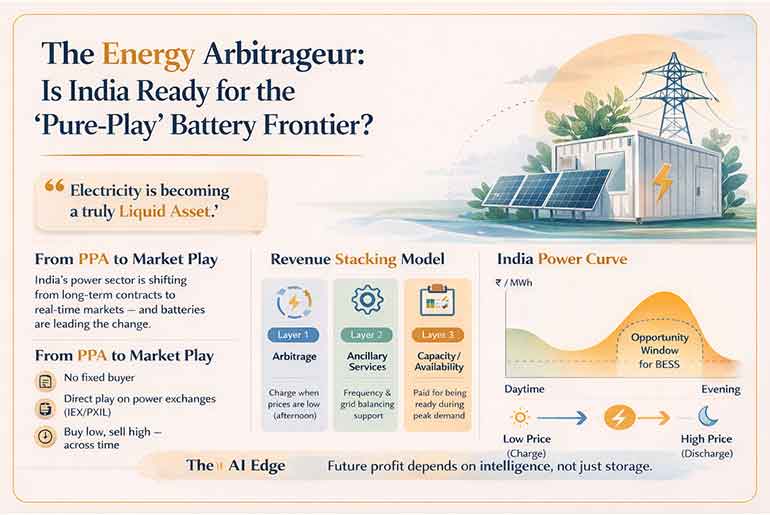
However, a Merchant BESS is a different beast entirely. It operates without a fixed buyer. It doesn’t wait for a 25-year contract. Instead, it sits directly on the Power Exchange (IEX/PXIL) and plays the market. It is the ultimate “buy low, sell high” machine. In a landscape where solar power is abundant and cheap at 2 PM but demand (and prices) skyrocket at 8 PM, the Merchant BESS performs what economists call “Spatial and Temporal Arbitrage.”
The Economic Engine: Revenue Stacking
For a Merchant BESS to be viable in India, it cannot rely on a single source of income. It must be a “Multi-Tasker.” Experts call this Revenue Stacking. A successful Merchant battery in 2026 thrives on three distinct revenue streams:
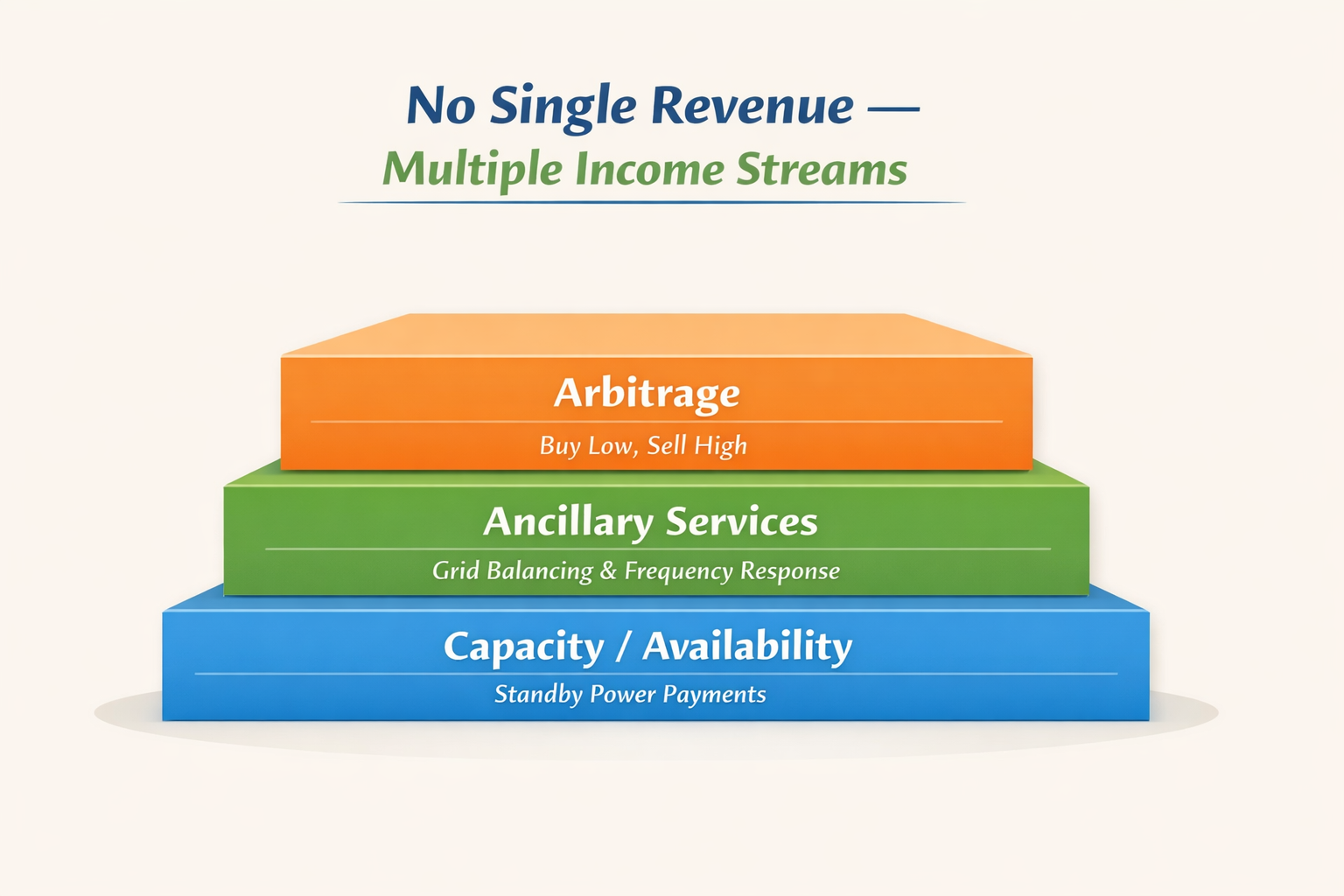
- Energy Arbitrage: This is the bread and butter. Charging the battery when the High-Price Day-Ahead Market (HP-DAM) is at its floor (often during solar-heavy afternoons) and discharging when the rates hit the ceiling during the evening peak.
- Ancillary Services: This is where the depth lies. The National Load Despatch Centre (NLDC) needs “Frequency Response.” When the grid frequency fluctuates due to sudden cloud cover over a solar park, the Merchant BESS can inject or absorb power in milliseconds. These “Secondary” and “Tertiary” reserve services are now being monetized through the CERC’s new regulatory frameworks.
- Capacity Markets: In many mature markets like the UK or Australia, batteries get paid just for being there—providing a guarantee that they can discharge if the grid faces a blackout. India is slowly moving toward this “Capacity-as-a-Service” model.
The “Ghost in the Machine”: The Degradation Paradox
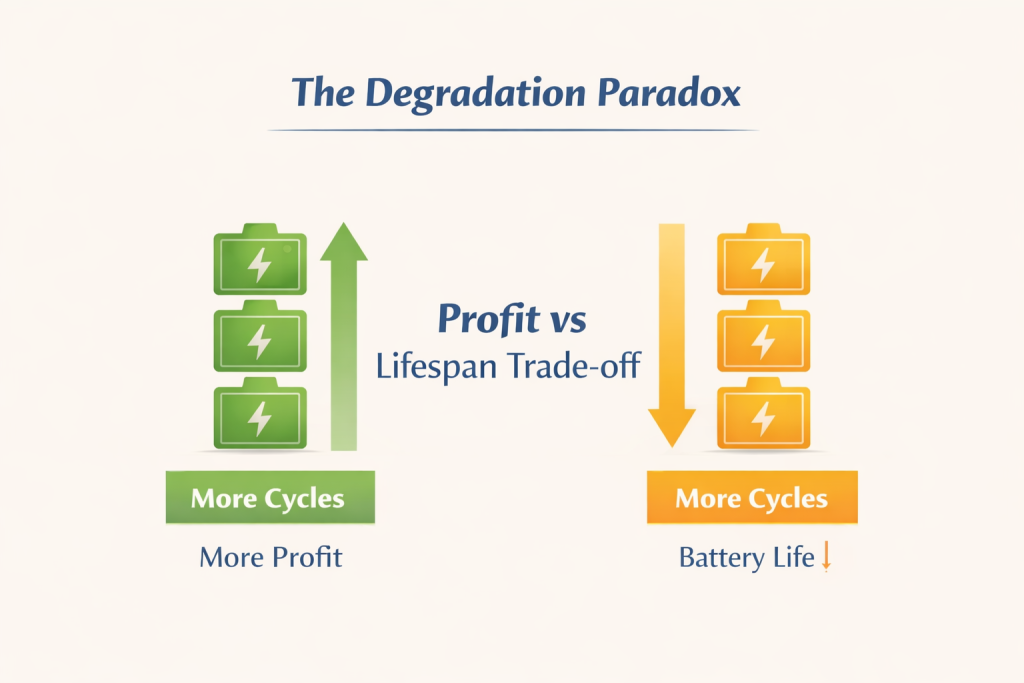
To maximize profit, a Merchant BESS must trade often. But every time a battery “cycles” (charges and discharges), it ages. This is the Degradation Paradox.
If a merchant operator cycles their battery twice a day to catch two different price peaks, they might double their daily revenue, but they will also cut the battery’s lifespan from 10 years to 6. The engineering challenge for 2026 isn’t just about LFP vs. NMC chemistry; it’s about “Software-Defined Operation.” Successful players are now using AI algorithms that calculate, in real-time, whether a specific trade is worth the “wear and tear” on the lithium cells.
The “Cannibalization” Effect: A Warning for 2030
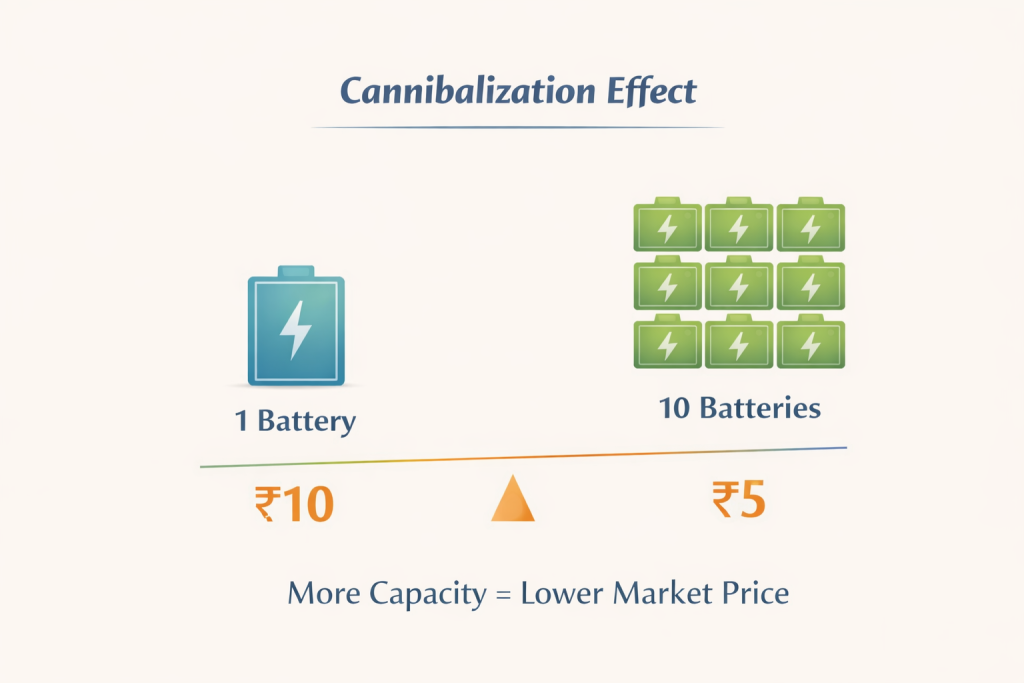
As more developers jump onto the Merchant BESS bandwagon, a new risk emerges: Cannibalization.
Imagine 10 GW of Merchant batteries all waiting for the 7 PM peak. The moment the price hits ₹10/unit, every battery starts discharging. This massive surge of supply will naturally push the price down to ₹6 or ₹5. By solving the grid’s problem, the batteries inadvertently “eat” their own profit margins. We have seen this in the UK market, where “saturation” led to a sharp drop in arbitrage revenue. For Indian developers, the winners won’t be those with the biggest “hardware,” but those with the best Market Forecasting tools to predict when others will discharge.
The Regulatory Landscape: From VGF to Market Maturity
The transition to Merchant models has been fueled by the Central Electricity Regulatory Commission (CERC). The introduction of the “High Price Day Ahead Market” (HP-DAM) was a game-changer. It allowed prices on the exchange to go up to ₹20/unit (previously capped lower), which is the primary incentive for a Merchant BESS to exist.
Furthermore, the Energy Storage Obligation (ESO) targets set by the Ministry of Power mean that Discoms (Distribution Companies) must procure a percentage of their energy from storage. If they can’t build their own, they will have to buy from “Merchants.”
Global Mirrors: What Australia Taught Us
Look at the Hornsdale Power Reserve in Australia (the famous Tesla big battery). It proved that Merchant batteries could earn more from “Ancillary Services” (fixing the grid’s frequency) than from actually selling bulk electricity. India is following a similar trajectory. We are realizing that a battery’s value isn’t just in the “Units” it stores, but in the “Flexibility” it offers.
The Verdict: Risk vs. Resilience
Is India ready for the Merchant BESS? The answer lies in the project economics. With battery prices falling below $100/kWh at the pack level, the “Capital Expenditure” (CAPEX) is finally low enough to allow for market risk.
However, the roadblocks remain: High GST (18%) on batteries and the high cost of debt in India make it difficult for pure merchant projects to find bankable financing. Most Indian banks still prefer the “safety” of a PPA. Therefore, the first wave of Merchant BESS in India will likely be “Semi-Merchant”—where 60% of the capacity is tied to a fixed contract, and 40% is left “Open” to play the market.
Conclusion: The Independent Power Bank
The rise of the Merchant BESS marks the end of the “Protected Era” of Indian power. It is a sign of a maturing, confident energy ecosystem where technology is ready to stand on its own feet without the crutches of long-term subsidies. For the first time, electricity is becoming a truly Liquid Asset.
In the rhythm of the new grid, the Merchant BESS is the “Metronome”—the silent, intelligent heartbeat that keeps the music playing, even when the sun goes down and the wind stops blowing.
 Electrify your feed! Click here to join our Whatsapp group and to get the latest updates, expert insights, and innovations driving India’s energy storage revolution.