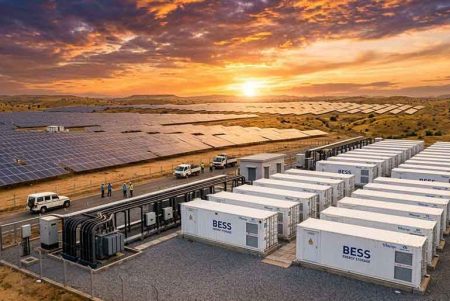

India needs battery energy storage at scale. But forcing it to sit mainly at the generation end of the grid may create capacity faster than it creates value.
India does not have a storage ambition problem. But it may have a storage architecture problem. The CEA’s National Electricity Plan projects total storage requirement rising from 16 GW/ 82 GWh in 2026-27 to 74 GW/ 411 GWh in 2031-32, including 47 GW/ 236 GWh of battery energy storage systems (BESS) alone. Yet, within the country’s installed energy storage base as of 30th April 2026, 7.4 GW was pumped storage1 (using a 6-hour single-cycle equivalent, that comes to 44.6 GWh), and 5.6 GWh was BESS2. India is, in effect, trying to build an entirely new balancing layer for the grid within a single planning cycle.
That scale gap explains why policymakers are turning to mandates. In its 18th February 2025 advisory, the CEA asked renewable energy implementing agencies and state utilities to include a minimum two-hour ESS equivalent to 10% of solar project capacity in future solar tenders, estimating this could add approx. 14 GW/ 28 GWh by 2030.3 Maharashtra is moving far faster. Its new renewable energy C energy storage policy, notified in March 2026, seeks storage procurement equivalent ≥ 10% of demand by FY 2035-36, implying around 100 GWh per day. The policy also requires energy storage of 50% of RE capacity for at least 2 hours for projects commissioned up to FY 2029-30.4
The direction of travel is understandable. But the engineering question is not simply how many MWh get procured. It is where the inverter is connected to the network and what services that location enables. Storage at the generation bus has a clear role: it reduces renewable curtailment, smooths variable solar output, and improves utilisation of evacuation infrastructure. That is the logic underlying most co-location proposals. But that is only one part of the BESS value stack. Multiple studies on storage valuation have identified a much broader set of services – energy arbitrage, resource adequacy, ancillary services, and non-wires alternatives such as TsD upgrade deferral.5,6 Technical studies on transmission and distribution applications reach the same conclusion: when storage is placed closer to load centres and network constraints, it can defer feeder reinforcement, transformer augmentation and line upgrades, while also improving reliability and power quality.
This is the part Indian policy still underweights. A MW of storage is not electrically equivalent at every node. A battery tied to a solar park largely arbitrages the solar production profile. A battery installed near a 220/132 kV substation, an urban load pocket or a stressed medium-voltage feeder can do something more system-critical: relieve thermal overload, absorb reverse power flow from distributed PV, improve local voltage profile, provide fast reserves, and postpone expensive capex on wires and transformers. Thus, in a grid with rising renewable penetration and more volatile intra-day dispatch, siting becomes the determinant of system value.
Global experience broadly supports this. BloombergNEF estimates the world added 112 GW/ 307 GWh of battery storage in 2025, the first time annual additions crossed 100 GW, with the solar-to-storage build ratio tightening to 6:1 and expected to narrow further to 4:1 in 2026.7 But the more valuable lesson is not the speed of deployment; it is the way mature systems have differentiated storage by grid function. California’s AB 2514 did not treat storage as a generic extension to renewables. It set a 1,325 MW procurement target while explicitly recognizing value across transmission, distribution and customer-side applications. AB 2868 separately pushed utilities to accelerate up to 500 MW of distributed storage.8 In the US more broadly, FERC Order 841 opened wholesale capacity, energy and ancillary-service markets to storage9, while Order 2222 enabled distributed and aggregated DERs, including batteries, to participate via aggregation.10
China offers the cautionary version of the story. More than 20 provinces required wind and solar projects to carry storage, often at 10-20% of plant capacity, and SCP Global estimated those mandates drove 50-75% of domestic BESS demand.11 But in February 2025, Beijing removed storage as a prerequisite for project approval and grid connection, shifting the sector toward more market-based remuneration as utilisation and monetisation lagged deployment.12 That experience matters for India because it shows the limits of forcing batteries onto renewable projects before reserve markets, congestion pricing, and capacity remuneration are deep enough to support the asset class. Forced installation is not the same thing as effective system integration.
India’s own bottleneck is increasingly one of revenue architecture rather than pure procurement volume. The market-based ancillary-services platform operated by GRID-INDIA had 312 registered entities as of 25th May 2026, and India’s ancillary regulations already allow ESS participation in secondary and tertiary reserves.
There is another reason to be cautious about aggressive mandates right now: tender tariffs are not the same thing as capital cost reality. India’s BESS tenders in 2025 discovered very low tariffs – as low as ₹1.65 lakh/MW/month in daily 1-cycle and ₹1.48 lakh/MW/month in daily 2-cycles, in some VGF-backed procurements. But that pricing may not fully capture the current cost environment. Since late 2025, the battery supply chain has become less benign. Multiple reports have indicated that LFP cell costs rose by 15-20% within six months.13 China, central to India’s battery supply chain, has also begun phasing out export VAT rebates for battery products – from 9% to 6% in 2026 and zero from 1 January 2027, raising the likelihood of higher India-facing procurement costs.14
The policy conclusion is not that India should slow down on storage. It is that India should become more locationally precise about how it scales storage. A modest RE-linked storage floor may be justified. But the next step should be separate procurement windows; and where needed, targeted support for transmission-node BESS, distribution-substation BESS and consumer-end BESS on feeders with overload, reverse-flow risk, poor reliability metrics, or deferred network capex. Peak shifting at the generation bus will flatten part of the duck curve. It may not, by itself, create the ancillary and grid-support market India needs.
India may not need a battery attached to every solar busbar. It needs the right battery on the right node.
1 CEA’s status report dated 30.04.2026
2 IESA ESS Market Update – April 2026
3 Advisory on colocating Energy Storage System with Solar Power Projects to enhance grid stability and cost efficiency
4 Maharashtra Renewable Energy C Energy Storage Policy 2025-26 to 2035-36
5 US DOE – Energy Storage Valuation: A Review of Use Cases and Modeling Tools
6 NREL – Storage Futures Study (2021)
7 Energy Storage Enters the 100-Gigawatt Era: Three Things to Know | BloombergNEF
9 Federal Register: Electric Storage Participation in Markets Operated by Regional Transmission Organizations and Independent System Operators
10 FERC Order No. 2222 Explainer: Facilitating Participation in Electricity Markets by Distributed Energy Resources
11 China scraps energy storage mandate for renewable energy plants – Energy Storage
12 Impact of China’s market-oriented reform on the energy storage sector-Industry-InfoLink Consulting
14 China Export Tax Rebate Changes 2026: Complete Supply Chain Planning Guide for Importers and Exporters
 Electrify your feed! Click here to join our Whatsapp group and to get the latest updates, expert insights, and innovations driving India’s energy storage revolution.