For more than a century, power grids across the world were designed around one simple principle: large spinning machines generated electricity and naturally stabilized the grid. Coal plants, gas turbines, hydroelectric stations, and nuclear reactors all worked not only as power generators, but also as the invisible stabilizers of modern electricity systems. Now, that foundation is changing faster than many expected. As renewable energy installations accelerate globally, traditional rotating generators are gradually being replaced by solar plants, battery energy storage systems, and inverter-based renewable infrastructure. Solar panels do not spin. Batteries do not naturally provide inertia. Wind turbines interact with the grid differently. Yet electricity demand continues to rise, and grids still need stability every second of the day. This is exactly where Grid-Forming Inverters are beginning to redefine the future of power systems.
Most people outside the utility and power electronics industry rarely hear about them. But inside engineering circles, utilities, and advanced renewable projects, grid-forming technology is quickly becoming one of the most important developments in modern electricity infrastructure.
And honestly, without it, the future renewable-heavy grid may struggle to function reliably.
Why Traditional Power Grids Worked So Smoothly
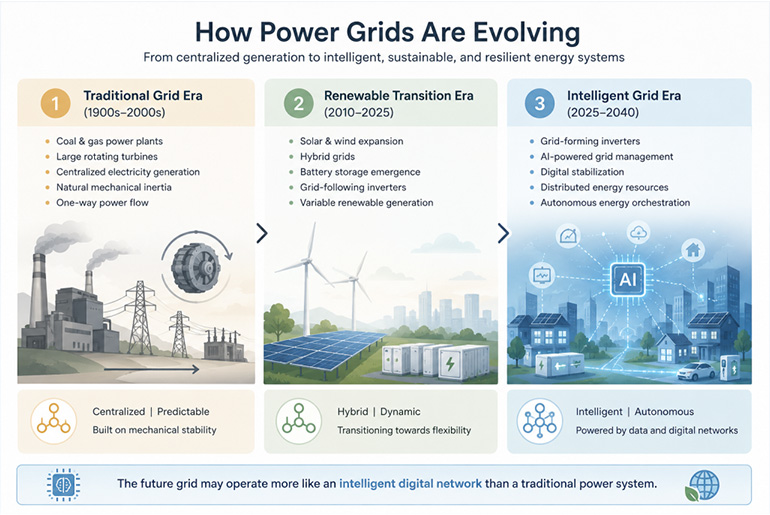
To understand why Grid-Forming Inverters matter, we first need to understand how conventional grids behaved for decades.
Traditional thermal and hydroelectric power plants used massive rotating turbines synchronized to grid frequency. These rotating machines naturally resisted sudden changes in frequency because of their physical momentum. This phenomenon is called inertia.
When a sudden disturbance occurred — such as a transmission failure or rapid change in electricity demand — these spinning generators automatically slowed down the rate of frequency change. That bought operators valuable time to stabilize the system.
In simple words, inertia acted like a shock absorber for the power grid. But renewable-heavy grids are now losing that natural protection layer.
Solar PV systems and many modern wind systems connect to the grid through power electronics rather than directly through synchronized rotating machines. These inverter-based resources generate electricity efficiently, but they do not inherently provide inertia in the traditional sense.
And that is creating an entirely new engineering challenge.
The Renewable Energy Stability Problem
Countries worldwide are aggressively expanding renewable energy capacity. According to the International Energy Agency, renewables are expected to dominate new electricity generation additions globally through this decade.
India itself is targeting massive renewable expansion under its clean energy transition strategy. Solar and battery projects are scaling rapidly across Gujarat, Rajasthan, Tamil Nadu, and other states.
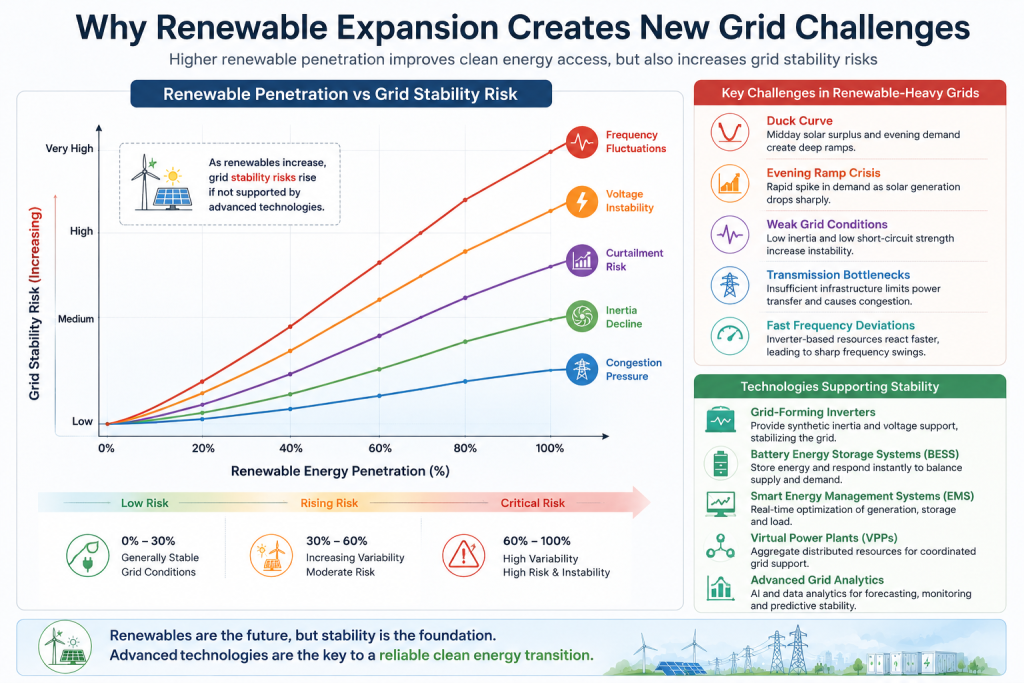
But as renewable penetration increases, utilities are starting to encounter something called “low-inertia grids.” This is where the conversation becomes extremely technical — and extremely important.
Low-inertia grids react much faster to disturbances. Frequency deviations happen more aggressively. Voltage stability becomes harder to manage. Fault recovery dynamics change completely. In severe cases, entire sections of the grid can become unstable. This is not theoretical anymore.
Regions like South Australia, California, parts of Europe, and even sections of the UK grid have already experienced challenges associated with inverter-dominated electricity systems.
And this is precisely why Grid-Forming Inverters are gaining global attention.
What Exactly Are Grid-Forming Inverters?
Traditional renewable inverters are generally “grid-following.” That means they wait for the grid to establish voltage and frequency conditions first, and then synchronize themselves accordingly.
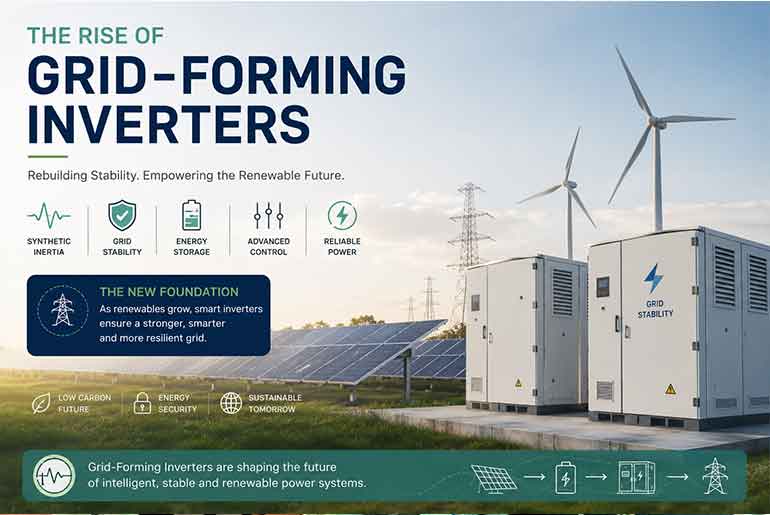
Grid-Forming Inverters behave very differently. Instead of simply following the grid, they actively help create and stabilize grid conditions themselves. That changes everything. These advanced inverters can:
- establish voltage and frequency references,
- provide synthetic inertia,
- support black-start capability,
- stabilize weak grids,
- improve fault ride-through performance,
- and enable smoother renewable integration.
In simple language, they allow renewable-heavy systems to behave more like conventional power plants from a stability perspective.
That is why many experts now see Grid-Forming Inverters as one of the foundational technologies of future renewable power systems.
Synthetic Inertia: The Hidden Technology Changing Power Systems
One of the most discussed capabilities of Grid-Forming Inverters is synthetic inertia. Traditional generators physically resist sudden frequency changes because their turbines carry rotational energy. Inverter-based systems obviously do not have that mechanical momentum. So engineers developed software-driven approaches that imitate this stabilizing behavior electronically.
This synthetic inertia allows inverter-based systems to rapidly inject or absorb power during disturbances, helping maintain frequency stability. The response speed is often significantly faster than conventional thermal plants. And that opens a fascinating new chapter in power engineering. Modern grids are slowly evolving from mechanically stabilized systems toward digitally stabilized systems.
This transition is enormous.
The future electricity grid may depend less on spinning steel turbines and more on ultra-fast software-controlled power electronics.
Battery Storage Is Accelerating the Shift
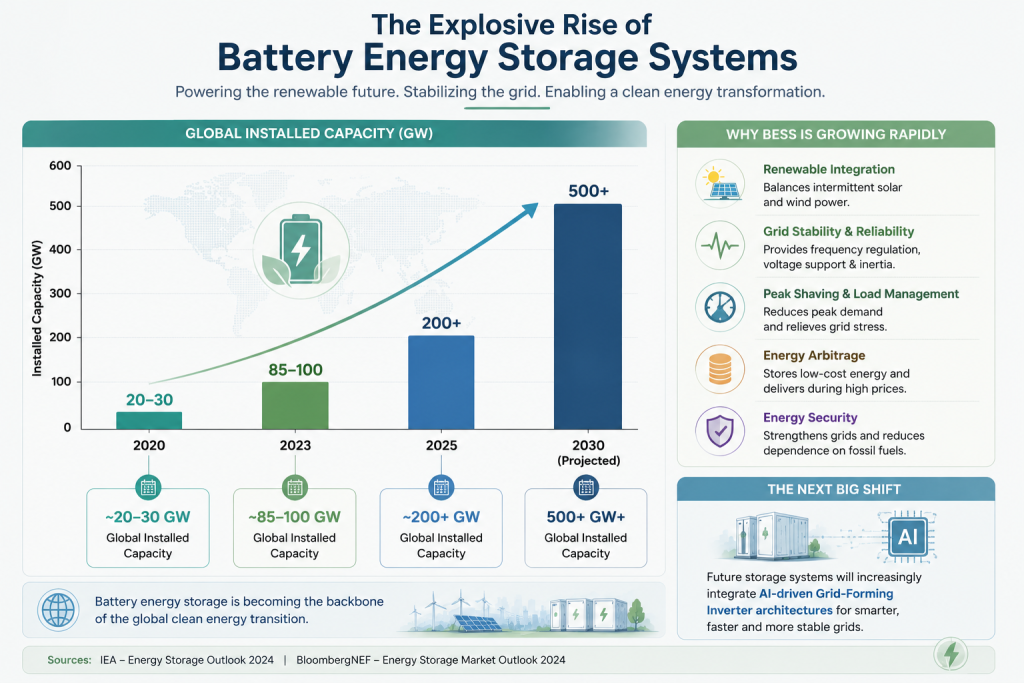
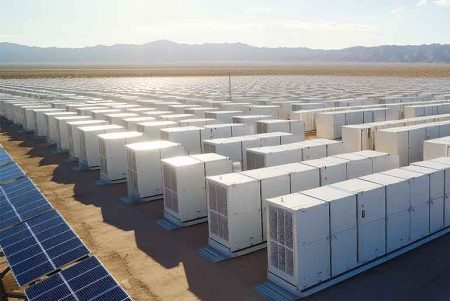
The rapid rise of Battery Energy Storage Systems (BESS) is further accelerating demand for Grid-Forming Inverters.
Large-scale storage projects are increasingly being deployed not only for energy shifting, but also for:
- ancillary services,
- frequency regulation,
- voltage support,
- spinning reserve replacement,
- and grid balancing.
But batteries require advanced inverter architecture to perform these grid-support functions effectively.
This is why many next-generation BESS projects globally are now integrating grid-forming capability directly into their inverter systems.
In fact, several utility operators are beginning to view advanced inverter functionality as equally important as battery chemistry itself.
That is a remarkable shift in industry thinking.
Why Utilities Are Paying Serious Attention
Utilities historically operated predictable centralized grids. Renewable-heavy systems are far more dynamic and decentralized.
Grid operators now need infrastructure capable of:
- millisecond-level response,
- autonomous grid stabilization,
- decentralized coordination,
- and rapid disturbance management.
Grid-Forming Inverters are emerging as one of the few technologies capable of addressing these requirements simultaneously.
Companies across the power electronics sector are investing heavily in this area, including Hitachi Energy, Siemens Energy, GE Vernova, and SMA Solar Technology.
Meanwhile, advanced grid operators in Australia and Europe are already testing renewable systems capable of operating with extremely low conventional generation support.
This is effectively a preview of future global electricity systems.
The Engineering Challenges Nobody Talks About
Despite all the excitement, Grid-Forming Inverters are not a perfect solution yet. The technology still faces major technical and operational challenges.
One of the biggest issues is interoperability. Future grids may contain thousands — or even millions — of inverter-based devices operating simultaneously. Coordinating their behavior safely and efficiently is incredibly complex. Then comes the challenge of control algorithms. Different manufacturers use different approaches:
- droop control,
- virtual synchronous machines,
- matching control,
- dispatchable virtual oscillator control,
- and hybrid architectures.
Industry-wide standardization is still evolving.
Protection systems also become more difficult in inverter-dominated grids because fault characteristics differ significantly from conventional power systems. In many cases, utilities must rethink decades-old grid engineering assumptions entirely. This is not simply an equipment upgrade. It is a fundamental redesign of electricity infrastructure.
Why This Matters for India
India’s renewable ambitions are enormous.
The country is aggressively expanding:
- utility-scale solar,
- wind energy,
- battery storage,
- green hydrogen infrastructure,
- and transmission modernization.
But renewable expansion without grid modernization could eventually create operational instability challenges.
As renewable penetration rises, India will increasingly require:
- advanced inverter technologies,
- smart grid systems,
- digital energy management,
- and stronger storage integration.
Grid-Forming Inverters may soon become essential for supporting India’s next phase of energy transition.
Especially as the country moves toward:
- 24/7 renewable power,
- FDRE projects,
- hybrid renewable systems,
- and large-scale BESS deployment.
The future grid will not only need clean electricity. It will need intelligent electricity.
The Real Future of Electricity May Be Software-Defined
Perhaps the most fascinating part of this transition is that electricity systems are slowly becoming software-defined infrastructure.
Historically, grid stability came primarily from mechanical engineering.
Tomorrow, it may increasingly come from:
- algorithms,
- digital controls,
- predictive power electronics,
- AI-assisted energy management,
- and autonomous inverter coordination.
That changes the entire energy conversation.
The renewable transition is no longer only about generating green power cheaply. It is becoming a control systems challenge, a digital infrastructure challenge, and a power electronics race simultaneously.
And Grid-Forming Inverters sit directly at the center of that transformation.
Conclusion
For years, renewable energy discussions focused mostly on solar panels, wind turbines, and battery prices. But the deeper challenge was always hiding underneath: how do you stabilize a renewable-heavy grid without traditional spinning generators?
Grid-Forming Inverters are emerging as one of the most important answers to that question.
They may not receive the same public attention as gigafactories or solar megaprojects, but their role in future electricity systems could become absolutely foundational.
Because ultimately, the future energy race will not only be won by the countries generating the most renewable electricity.
It may be won by those capable of controlling, stabilizing, and intelligently orchestrating the world’s first truly inverter-dominated power grids.
 Electrify your feed! Click here to join our Whatsapp group and to get the latest updates, expert insights, and innovations driving India’s energy storage revolution.