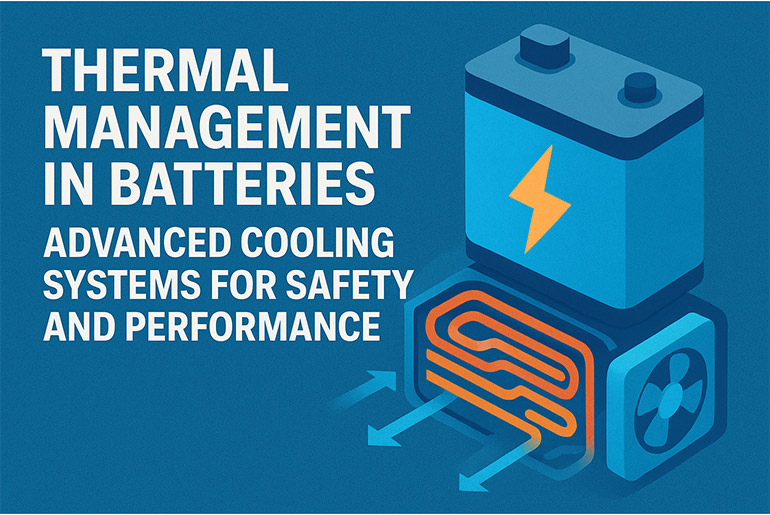
The advancing world of electric vehicles (EVs) and renewable energy storage relies heavily on batteries as a primary component of the energy system. Temperature is one of the largest factors that influence how they operate and how long they will last. Therefore, effective thermal management is necessary to ensure that batteries are operating safely, efficiently, and last a long time. The performance of a battery is driven by ambient / operating temperature-sensitive behavior. Lithium-ion batteries, which are expected in electric vehicles (EVs), have a design point for optimal operation temperatures and deviations away from this optimal design will lead to decreased efficiency, accelerated degradation, or thermal runaway. High temperature operation leads to reduced capacity and excessive cooling leads to increased internal resistance. In each case, the two extremes reduce battery lifetime and safety.
Typical Cooling Methods
Air Cooling: Air cooling uses fans to move air around the battery pack and provides good heat dissipation. Due to its simplicity and low-cost, air cooling is an acceptable method in lower-performance applications.
Liquid Cooling: Liquid cooling relies on a low-boiling liquid coolant to absorb heat energy from the battery system. The liquid cooling system is likely to provide better efficiency, but is requires a higher complexity of the system.
Advanced Cooling Approaches
- Phase Change Materials (PCMs): These materials take in and give up heat throughout phase transitions while keeping the temperature distribution constant. PCMs are light and dense and provide better energy efficiency and increased thermal stability, making them well suited for thermal management of EV batteries.
- Immersion Cooling: This method involves immersing battery cells in a dielectric fluid, which promotes heat dissipation and uniform temperature distribution. Notably, immersion cooling systems inhibit thermal spreading, providing an important safety advantage, and it is being used increasingly in large-scale applications.
- Thermoelectric Cooling: This method uses the Peltier effect to create a flux of heat between converging junctions of different types of materials, providing very exact temperature control. This solid-state method is more appealing mainly for its efficiency, and compactness. This may become an attractive option for battery cooling.
Innovative Hybrid Systems
Hybrid Battery Thermal Management Systems (HBTMS): These systems use a combination of active and passive cooling methods, such as liquid cooling + phase change materials (PCMs) to create the best overall performance and efficiency. Hybrid systems can effectively address local hot spots while providing better temperature distribution of the system to increase the overall battery performance of the HBTMS.
Challenges and Future Areas of Work
- Integration and Scalability: Addressing the need for cooling efficiency without increasing the complexity and cost of the cooling system remains a challenge. Research presented by Microsoft’s microfluidic chip cooling method that etches channels directly onto the silicon die has potential for efficiently removing heat from high-performance processors. (Tom’s Hardware)
- Sustainability: As an important area of focus for next-generation thermal management systems, the development of sustainable coolants and recyclable materials is crucial.
- Emerging Technologies: The use of AI-driven thermal management systems to optimize thermal performance in real time appears to be one area that may enhance battery performance and safety.
Case Studies and Real-World Applications
- Electric Vehicles: Innovative instances of thermal management can be seen in companies such as Tesla and Rivian to provide a better thermal experience for the battery to improve battery performance. Tesla is using both a liquid cooled battery and phase change materials to maintain performance of the battery at optimal temperatures to increase driving range and battery life.
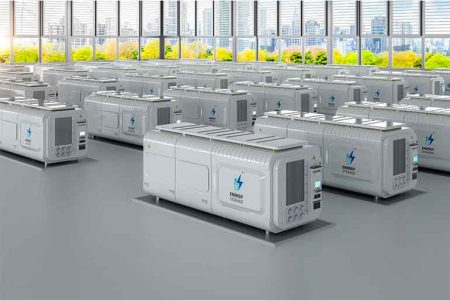
- Energy Storage Systems: Thermal management is an important aspect of large-scale battery storage solutions to support renewable energy. Proper thermal management and cooling systems lead to safety and effectiveness of these large-scale renewable energy utility systems, leading to sustainability for the electric grid.
Conclusion
Proper thermal management is essential for maximizing the potential of battery technologies. Advancements in battery technology will develop innovative designs for thermal management which we hope lead to sustainability and energy solutions in the future.
 Electrify your feed! Click here to join our Whatsapp group and to get the latest updates, expert insights, and innovations driving India’s energy storage revolution.