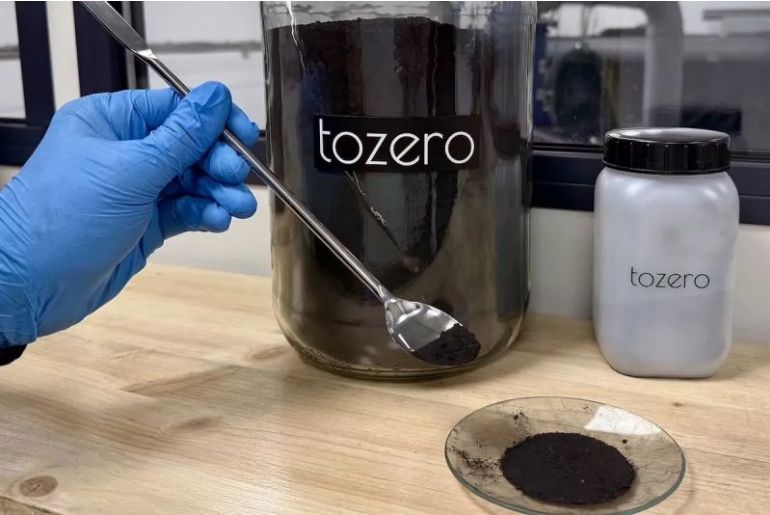
Tozero has launched its first industrial demonstration plant for battery recycling in Bavaria, marking a key milestone in scaling circular solutions for lithium-ion batteries. Located at Chemical Park Gendorf, the facility is designed to process over 1,600 tonnes of end-of-life battery scrap annually, converting it into domestic supplies of lithium, graphite, and a nickel-cobalt mix.
The plant was built in six months and can make high-purity lithium carbonate as well as recover nickel-cobalt and graphite on a large scale. The company’s proprietary acid-free hydrometallurgical process enables recycling in a single cycle, with recovered materials meeting quality standards suitable for direct reuse in manufacturing.
Supporting Europe’s Raw Material Independence
Tozero said that cathode and anode makers have already tested and approved its recycled lithium and graphite for use in lithium-ion batteries. The project fits with Europe’s larger goal of getting important raw materials and relying less on imports. This is in line with the EU’s Critical Raw Materials Act, which aims for 25% of supply to come from recycling sources.
The Munich-based firm also plans to supply recycled materials to industries such as construction, ceramics, and lubricants, with further applications expected to follow.
Leadership Perspective on Scaling Technology
Tozero co-founder and CEO Sarah Fleischer said, “Europe doesn’t yet have the critical raw materials it needs to build and scale its own energy transition and battery industry,” adding, “Our technology, now scaled 10,000 times, changes this by enabling us to recycled end-of-life batteries and extract these materials at industrial scale for the first time.”
She further noted, “recycling isn’t just a pilot project—it can be delivered at a level capable of giving Europe a homegrown, circular supply of critical materials its future runs on.”
Rapid Transition from Lab to Industrial Scale
Co-founder and Chief Technology Officer Ksenija Milicevic Neumann stated, “Scaling our technology from lab to industrial production in such a short time is a defining milestone for any deep-tech founder and marks the transition from development to real-world validation at industrial scale. It’s a milestone I’m very proud of, especially seeing the team bring this plant to life.”
Blueprint for Future Expansion
The demonstration plant will serve as a model for a planned full-scale commercial facility by 2030, expected to produce thousands of tonnes of lithium carbonate and graphite.
With global lithium demand projected to quadruple by 2030 and graphite demand in the EU expected to rise up to 25 times by 2040, Tozero emphasized the urgency of recycling. The company noted Europe remains heavily dependent on imports, stating, “It hasn’t been possible to recover them effectively until now.”
Tozero added that its process enables sustainable material recovery without a “green premium,” instead delivering a “green discount,” positioning battery recycling as a critical solution to future supply gaps.
 Electrify your feed! Click here to join our Whatsapp group and to get the latest updates, expert insights, and innovations driving India’s energy storage revolution.