The sixth edition of the India Energy Summit & Expo is being held on 18–19 August 2026 in Hyderabad, bringing together policymakers, utilities, technology providers, investors and industry leaders around India’s energy transition. The official event platform places sustainable mobility, smart energy, grid modernisation and clean-energy innovation among the areas of focus. Its Telangana energy roadmap highlights an expansion of EV charging infrastructure from 872 stations to 6,000 by FY30 and 12,000 by FY35.
At the Trinity pavilion, senior visitors included Telangana Deputy Chief Minister and Minister for Finance & Planning, Energy, Sri Bhatti Vikramarka Mallu; Telangana Special Chief Secretary, Energy, Sri Naveen Mittal, IAS; TGSPDCL Chairman & Managing Director Sri Jitesh V. Patil, IAS; and APEPDCL Director (Projects) Smt T.Vanaja. Several visitors also recognised the Trinity brand from transformers supplied during the company’s best of the quality delivered since 2013. For Trinity, the response was significant because the recognition came from field experience and long-term product performance rather than from current marketing alone.
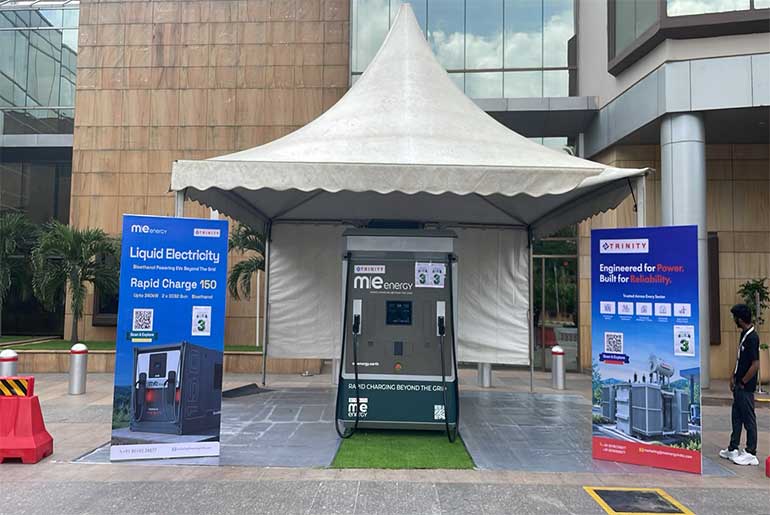
The ME Energy Rapid Charger 150 is a 150 kW DC fast charger with dual CCS2 outputs that generates electricity on site from liquid bioethanol, enabling EV charging without a conventional grid connection. Trinity identifies highways, fleet depots, mining and industrial sites, defence and strategic locations, rural hubs, construction sites and emergency-response applications among potential use cases.
The technology also received national-level attention on 2 August 2026 when Union Minister for Coal and Mines Shri G. Kishan Reddy participated in the inauguration of the ethanol-based mobile EV charging technology in Hyderabad. He highlighted its potential to promote green mobility, support ethanol use and reduce petroleum dependence.
Trinity also showcased Package Substations from 250 kVA to 2500 kVA, up to 33 kV, integrating transformer, HV/LV switchgear, protection, metering and digital connectivity. The platform is SCADA ready and EMS compatible, making it relevant to grid-connected EV charging, industrial and infrastructure applications.
On the participation Raj Kumar Medimi, Executive Director, Trinity Cleantech Private Limited affirmed “Today’s response at the India Energy Summit & Expo was particularly meaningful for Trinity. The interest in ME Energy and our Package Substations reflects the direction in which the energy sector is moving, but the recognition of Trinity from transformers supplied years ago was equally important. It reminded us that quality creates a legacy. We are now taking that engineering legacy into the next generation — combining reliable electrical infrastructure with grid-independent EV charging and clean-energy technologies manufactured in Telangana.”
| ME ENERGY | 150 kW | Dual CCS2 • Bioethanol • Off-grid |
| PSS / CSS | 250–2500 kVA | 11 / 22 / 33 kV • SCADA/EMS ready |
| TRANSFORMERS | 25 kVA–12.5 MVA+ | Distribution • Power • Inverter Duty |
ME Energy: charging beyond the grid
The principal technology showcased by Trinity was the ME Energy Rapid Charger 150, a 150 kW off-grid, bioethanol-powered DC fast charger with dual CCS2 outputs. The system is designed to generate electricity on site from liquid bioethanol and deliver DC fast charging without requiring a conventional grid connection. Trinity’s product literature positions it as “Bioethanol Powering EVs Beyond the Grid”.
The Rapid Charger 150 integrates an onboard bioethanol-fuelled power-generation system, power-conversion electronics, an energy buffer and a dual CCS2 DC fast-charging interface in a single industrial enclosure. Published product data specifies up to 150 kW DC charging output, either as a single charging session or split across two simultaneous CCS2 sessions. Trinity’s technical note cites an ARAI-referenced figure of approximately 250 km of driving range in 15 minutes for a mid-range battery electric vehicle; this is vehicle- and operating-condition-dependent and should not be treated as a universal charging result.
The value proposition is particularly relevant where high-power charging is constrained by grid availability, connection timelines or the need for new electrical infrastructure. Trinity identifies highways, fleet and bus depots, mining and industrial sites, defence and strategic locations, agriculture and rural hubs, construction sites, ports, airports, railway maintenance yards, renewable-energy parks and emergency-response deployments among potential applications.
The ME Energy technology was originally developed in Germany. Trinity’s July 2026 strategic white paper states that Trinity completed a 100% acquisition of me Energy, including a portfolio of 17 patents, and that product development and manufacturing have been consolidated at Trinity’s 20-plus-acre facility at Jadcherla Green Industrial Park in Telangana. The document states that commercial production has commenced at Jadcherla and identifies international exports as a target later in 2026.
This creates a strong Make-in-India clean-mobility story: an internationally developed off-grid charging technology is being manufactured and further developed in Telangana under Indian ownership, with the potential to serve Indian and international markets.
Package Substations: the power infrastructure behind connected charging
Alongside ME Energy, Trinity showcased its Package Substation/Compact Substation platform for grid-connected EV charging and other distributed-power applications.
Trinity’s PSS brochure specifies a capacity range of 250 kVA to 2500 kVA and system-voltage options of 11 kV, 22 kV and 33 kV. The packaged system can integrate an oil-filled or dry-type transformer, RMU or VCB on the high-voltage side, ACB/MCCB-based low-voltage switchgear, numerical/protection relays and multifunction energy metering.
The PSS platform is designed as a compact, factory-engineered solution intended for quick installation and reduced site work. It is offered with SCADA readiness and EMS compatibility, with optional remote monitoring and IoT connectivity. Communication options include Modbus RTU, Modbus TCP, IEC 61850 and IEC 60870-5-104, depending on configuration.
The relevance to EV infrastructure is direct. A conventional high-power, grid-connected charging station requires dependable medium-voltage-to-low-voltage power infrastructure. Trinity’s proposition therefore covers the electrical infrastructure surrounding the charger: transformer, HV switching, LV distribution, protection, metering and digital connectivity.
In simple terms, Trinity can address two charging architectures: grid-connected charging through a Trinity PSS/CSS, and grid-independent charging through ME Energy. This allows the company to participate in EV infrastructure projects both where adequate grid power is available and where grid expansion is difficult or commercially unattractive.
Transformers: a legacy of quality that continues to speak
While clean-energy technologies were the primary focus of the exhibition, Trinity’s transformer portfolio provided an important reminder of the company’s engineering foundation.
Trinity’s current portfolio includes Distribution Transformers from 25 kVA to 2500 kVA, Power Transformers from 3.15 MVA to 12.5 MVA and Inverter Duty Transformers from 500 kVA to 10 MVA, up to 36 kV/33 kV system class. The range includes CRGO and amorphous cores, copper or aluminium windings, mineral oil or natural ester options, OCTC/OLTC arrangements and hermetically sealed or conservator-type construction, subject to application and specification.
The strongest transformer message at the expo, however, was not a specification. It was recognition. Several senior visitors remembered Trinity transformers supplied during the company’s earlier operating period, including equipment delivered between 2013 and 2022. That recognition after a period away from the market reinforced a simple proposition: equipment that performs reliably in the field continues to build brand value long after the purchase.
From proven power equipment to future energy infrastructure
Trinity sees the combination of transformers, Package Substations and ME Energy as a progression rather than separate product lines. Transformers provide the electrical foundation; Package Substations integrate that foundation into compact, intelligent power systems; and ME Energy extends the charging proposition beyond conventional grid dependence.
The company is also developing the next phase of the ME Energy platform, with an 80 kW variant and a combined Generator + EV Charger platform identified in its current product roadmap. The combined platform is intended to provide both electrical power and EV charging from a single mobile asset for applications such as disaster response, defence field power, construction and critical infrastructure.
Trinity’s participation in the India Energy Summit & Expo 2026 reflects its ambition to build an integrated clean-energy manufacturing platform from Telangana for India and global markets — connecting established electrical engineering with the emerging requirements of electric mobility, distributed power and energy resilience.
Trinity Cleantech Private Limited is an Indian manufacturer of transformers, packaged substations and EV charging infrastructure. The company operates a 20-plus-acre manufacturing facility at Jadcherla Green Industrial Park in Telangana. Its current portfolio spans distribution, power and inverter-duty transformers; Package/Compact Substations; and ME Energy off-grid EV charging technology. Trinity’s ME Energy platform is based on technology originally developed in Germany and is now under Trinity ownership, with product development and manufacturing being consolidated in Telangana.
 Electrify your feed! Click here to join our Whatsapp group and to get the latest updates, expert insights, and innovations driving India’s energy storage revolution.