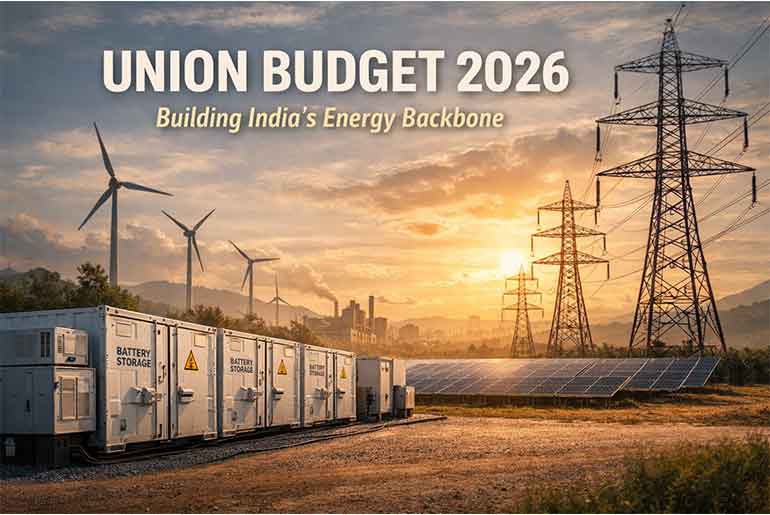
Union Budget 2026–27 may not have relied on headline-grabbing announcements, but it has clearly laid out the government’s intent to strengthen India’s economic and industrial foundation. With sustained capital expenditure, a sharper focus on domestic manufacturing, energy security, critical minerals, and advanced technologies, the Budget signals a shift from short-term stimulus to long-term capacity building.
Across the energy, infrastructure, manufacturing, electronics, and chemicals sectors, industry leaders see Budget 2026 as a blueprint for durable growth. From strengthening renewable energy and grid infrastructure to enabling battery manufacturing, semiconductors, MSME scaling, and carbon capture technologies, the Budget has drawn strong responses from corporate leaders who view it as a catalyst for competitiveness, self-reliance, and innovation.
Here is what experts from across the energy and manufacturing ecosystem have to say about Union Budget 2026–27.
Vineet Mittal, Chairman, Avaada Group
“Budget 2026–27 strikes balance between ambition, growth and discipline. With sustained public capex of ₹12.2 lakh crore, a clear fiscal consolidation path, and reforms like the Infrastructure Risk Guarantee Fund, it focuses on building long-term productive capacity rather than short-term stimulus. The emphasis on infrastructure, MSME scaling, transport, digital and logistics readiness sends a strong signal that India is investing for durable growth, competitiveness, and investor confidence.”
Raman Bhatia, Managing Director, Servotech Renewable Power System Ltd.
“The Union Budget 2026 sends a powerful signal that India is ready to lead the global energy transition. The extension of customs duty exemptions on capital goods for Lithium-Ion cell manufacturing is a game-changer. For an industry-player like Servotech, which has just ventured into the Electric 3-Wheeler battery segment, this move significantly lowers the cost of scaling up and allows us to innovate faster. It effectively strengthens the domestic value chain, making ‘Make in India’ batteries more competitive on a global scale.
In tandem, the India Semiconductor Mission 2.0 and the ₹40,000 crore outlay for electronics manufacturing will build the necessary resilience in our supply chains. This is critical for the advanced electronics that power our EV chargers and energy systems. Furthermore, the ₹10,000 crore SME Growth Fund is a visionary step that will empower enterprises to scale from domestic leaders to global champions.
I am particularly excited by the government’s focus on Purvodaya. The development of five tourism destinations in the Eastern states, supported by the deployment of 4,000 electric buses, creates a massive opportunity for sustainable transit. This is where micro-mobility and public transport will converge to drive regional growth.
Finally, the proposal of ₹20,000 crore for Carbon Capture, Utilisation, and Storage (CCUS) over the next five years, alongside the deep push for AI integration, validates our direction at Servotech. We are already automating our processes and integrating AI into our energy solutions. This budget doesn’t just provide funds; it provides a roadmap for a smarter, greener, and digitally-advanced India.”
Meenu Singhal, Regional Managing Director – Greater India, Socomec Group
“The Union Budget 2026–27 charts a decisive course for India’s evolution into a global technology leader. The enhanced capital outlay of ₹12.2 lakh crore and the launch of the India Semiconductor Mission 2.0 reaffirm the government’s commitment to deep-tech indigenization. The ₹40,000 crore allocation for electronics component manufacturing is a strategic intervention that propels the ecosystem toward advanced engineering and value creation. The focus on establishing Rare Earth Corridors further strengthens the foundation for a secure and self-reliant supply chain. The budget’s emphasis on providing skilling programmes will encourage the youth in providing quality employment opportunities.
At Socomec, we welcome the government’s thrust on high-tech manufacturing and the ₹10,000 crore MSME Growth Fund, both of which will accelerate innovation and competitiveness across the electrical sector, driving the vision of an ‘Aatmanirbhar’ and ‘Viksit Bharat’ by 2047.”
Girish Tanti, Chairman, Indian Wind Turbine Manufacturers Association (IWTMA)
“Budget 2026 is a testament to our nation’s resilience and commitment to growth, even amidst global uncertainty. With a significant increase in capital expenditure to ₹12 lakh crore and energy spending to ₹1 lakh crore, we’re laying the foundation for a sustainable future. Focusing on renewable energy growth, grid modernization, and energy security will accelerate India’s energy transition. Atmanirbhar Bharat pushes with rationalizing policies and incentivizing innovation through PLI and tax benefits for domestic R&D and manufacturing. Bond market reforms will further boost our economic momentum. This inclusive and comprehensive budget ensures we’re on course for continued growth and prosperity”
CEO IWTMA – Aditya Pyasi
“IWTMA welcomes the Union Budget’s commitment towards doing away with the critical bottlenecks for Wind and RE generation like the enhanced push to grid integration with higher capex provision for green energy corridors and battery integration for Wind Solar Hybrid projects.
By bringing the wind turbine ecosystem under the National Manufacturing Mandate the government has sent a clear signal that wind is a strategic manufacturing priority not just a capacity addition target.
The Association will also work with member OEMs and component manufacturers to map localisation pathways for critical parts especially bearings blades generators and power electronics leveraging the extended 5 percent BCD window SEZ manufacturing flexibility and upcoming ALMM timelines.”
Nitin Gupta, Co-founder & CEO, Attero
“The Union Budget 2026-27 delivers a strong agenda for Atmanirbhar Bharat by prioritising domestic capacity in critical minerals and reducing India’s strategic import dependencies. The announcement of dedicated rare earth corridors across states like Odisha, Kerala, Andhra Pradesh and Tamil Nadu is especially significant, as rare earth permanent magnets are essential for EVs, renewable energy systems and advanced manufacturing. By supporting domestic mining, processing, research and manufacturing, the government is building resilient supply chains that will be central to India’s clean-tech future. The proposed outlay of Rs. 20,000 crore over five years for CCUS technologies also reflects a parallel commitment to scaling climate-focused industrial solutions. At Attero, we are aligning strongly with this direction by scaling our Rare Earth Element recycling capacity from 300 tonnes to 30,000 tonnes annually with a Rs. 100 crore investment. This growth is backed by Attero’s deep innovation base, with 47+ global patents and over 200 applications across our recycling and resource recovery technologies, strengthening India’s circular economy leadership.”
Shreya Mishra, CEO, SolarSquare
“Residential solar remains the biggest focus in India’s renewable energy push, with nearly 70% of the MNRE budget and ₹22,000 crore under the PM Surya Ghar scheme now dedicated to the residential solar segment. As India’s energy needs grow, decentralised power will be critical, especially when transmission and distribution infrastructure cannot scale at the same pace. Residential solar is not just an energy solution; it is central to India’s energy security and independence.”
Dhiren Jatakia, Head – Accounts & Finance, Covestro India
“We welcome the government’s focus on strengthening domestic manufacturing, particularly in the chemicals sector. Initiatives like chemical parks and cluster-based infrastructure will help scale production, strengthen supply chains, and create opportunities for local businesses. Support for industrial and logistics infrastructure, along with simplified compliance, will enable manufacturers to grow and innovate.
We also value the emphasis on sustainability, energy transition, and carbon capture technologies, which aligns with Covestro India’s commitment to responsible growth and advanced materials for a greener future. These measures lay a strong foundation for innovation, reduced import dependence, and a competitive, resilient chemical industry in India.”
Manish Garg, CEO, Interarch Building Solutions Ltd.
“Union Budget 2026 lays down a compelling roadmap for India’s growth, with a clear emphasis on strengthening infrastructure and bolstering manufacturing. The sustained capital expenditure on key infrastructure projects and amplified support for domestic manufacturing ecosystems will enhance industrial competitiveness, reinforce supply chains, and unlock new opportunities for job creation. We also welcome the Government’s announcement of India Semiconductor Mission 2.0, which will deepen India’s capabilities in advanced chip and electronics manufacturing and position India as a critical player in the global tech ecosystem. Such forward-looking measures are essential for accelerating India’s journey toward economic resilience and global leadership.”
Pawan Kumar Garg, Chairman & Joint Managing Director, Fujiyama Power Systems Ltd.
“Union Budget 2026 signals a strong strategic thrust towards technology-led growth and sustainable energy transformation. The launch of India Semiconductor Mission 2.0 with significant support for industry-led R&D and manufacturing is a landmark step in advancing India’s semiconductor ecosystem and strengthening our global competitiveness. At the same time, the renewed focus on solar and renewable energy value chains in the broader budget framework underscores the government’s commitment to achieving clean energy goals and enhancing energy security while reflecting the industry’s call for deeper support across solar infrastructure, grid readiness, storage, and domestic manufacturing. These combined priorities will not only accelerate India’s technology and sustainability ambitions but also unlock meaningful opportunities for innovation and industrial growth. We are optimistic about contributing to this dual momentum in semiconductors and the clean energy transition.”
Samrath S Kochar, Founder & CEO, Trontek Electronics
“The Union Budget 2026–27 shows that the government is serious about strengthening India’s energy storage and electronics manufacturing sector. By extending customs duty exemptions on machinery used for making lithium-ion batteries and processing critical minerals within India, the Budget helps lower manufacturing costs and encourages more local production.
The focus on energy security, a stable power grid, and domestic manufacturing of advanced equipment is a positive step for the industry. These measures make it easier for companies like Trontek to expand local manufacturing, invest in innovation, and build reliable energy storage and power electronics solutions.
Overall, the Budget supports India’s move towards self-reliance in clean energy while keeping technology adoption practical, affordable, and supportive for manufacturers.”
Collectively, industry reactions to Union Budget 2026–27 highlight a clear consensus: the government’s emphasis on infrastructure, energy security, advanced manufacturing, and long-term capability building is aligned with industry expectations. While the Budget avoids short-term populism, it sets the foundation for sustained industrial growth, innovation, and India’s emergence as a globally competitive energy and manufacturing hub.
 Electrify your feed! Click here to join our Whatsapp group and to get the latest updates, expert insights, and innovations driving India’s energy storage revolution.