Urban energy storage systems are undergoing a profound transformation as cities evolve into digitally enabled, low-carbon ecosystems. With over half of the global population residing in urban areas and this figure expected to rise significantly cities are at the center of the energy transition. Smart cities, characterized by digital infrastructure, electrification, and decentralized energy resources, require flexible, resilient, and intelligent power systems.
Battery Energy Storage Systems (BESS) have become an important part of this change. BESS is changing the way cities make, store, distribute, and use electricity by connecting intermittent renewable generation with changing urban energy demand.
The Growing Need for Urban Energy Storage
Urban energy storage demand is highly variable and increasingly complex due to electrification of transport, proliferation of distributed generation, and rising cooling needs. Traditional centralized grids are often ill-equipped to handle these dynamics.
The International Energy Agency (IEA) says that modern urban energy systems need integrated planning, digitalisation, and flexibility solutions to work well and be strong. Energy storage, especially batteries, is a key part of making this possible.
Key challenges driving the adoption of BESS in cities include:
- Intermittency of solar and wind generation
- Peak load management in dense urban clusters
- Grid congestion and infrastructure constraints
- Increasing demand from EV charging networks
- Need for energy resilience against outages
BESS addresses all these challenges by acting as a buffer, stabilizer, and optimizer within the energy ecosystem.
BESS as the Backbone of Smart Cities
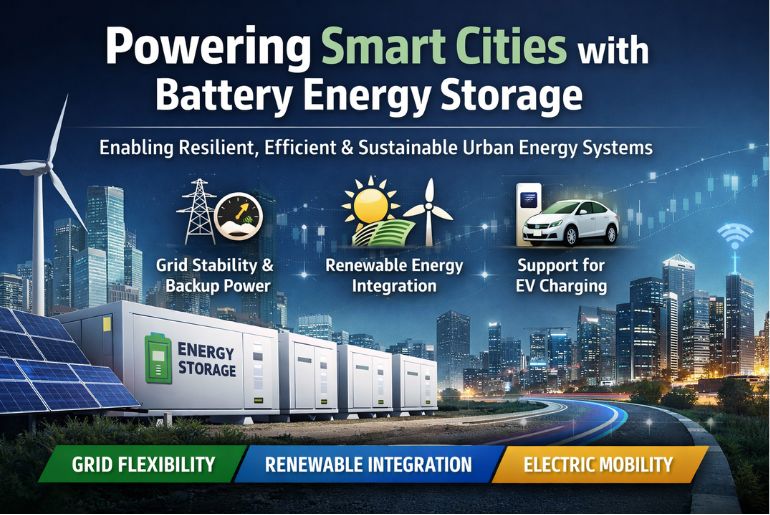
Smart cities depend on interconnected systems such as smart grids, IoT-enabled devices, electric mobility, distributed energy resources (DERs), and intelligent urban energy storage networks. This integrated architecture works seamlessly with BESS, enabling cities to manage power more efficiently, flexibly, and sustainably.
1. Grid Stability and Flexibility
Battery storage on the grid provides important services like controlling voltage, regulating frequency, and spinning reserves. The IEA says that storage systems help with short-term balancing, extra services, and getting the grid back up after a blackout.
2. Renewable Energy Integration
Renewable energy sources like solar and wind are inherently intermittent. BESS enables cities to store excess generation and dispatch it during demand peaks, ensuring higher renewable penetration.
Research shows that energy storage is crucial for balancing centralized and distributed generation while improving energy security .
3. Peak Load Management
BESS reduces peak demand by discharging stored energy during high-load periods. A study demonstrated that BESS can achieve up to 100% reduction in peak power demand in certain building-level applications .
4. Infrastructure Optimization
By reducing strain on transmission and distribution networks, BESS can defer or eliminate the need for costly grid upgrades an important factor for rapidly growing urban centers.
Integration with Distributed Energy Systems (DERs)
Distributed Energy Resources, like rooftop solar panels, microgrids, and behind-the-meter systems, are becoming an important part of urban energy systems. But because they are decentralised, they can be unpredictable and hard to coordinate.
BESS acts as the central orchestrator in DER ecosystems:
- Enhancing Self-Consumption: Batteries store surplus rooftop solar energy for later use, increasing self-consumption rates by up to 30% .
- Enabling Prosumers: Consumers become producers (“prosumers”), contributing energy back to the grid.
- Supporting Microgrids: BESS enables islanding capabilities, ensuring uninterrupted power supply during grid failures.
- Demand Response Optimization: Smart BESS systems can respond to real-time pricing signals, optimizing energy costs.
The IEA says that when combined with storage and the right policies, DERs can make the grid much more reliable and lower system costs.
Role in Urban Mobility and Electrification
Urban mobility is rapidly shifting towards electrification, with EV adoption accelerating globally. This creates both challenges and opportunities for city grids.
BESS supports EV integration by:
- Managing peak loads from fast-charging stations
- Enabling vehicle-to-grid (V2G) applications
- Reducing stress on local distribution networks
- Supporting renewable-powered charging infrastructure
Energy storage also goes well with electro-mobility, which is a key way to cut down on emissions in cities and reach climate goals.
Environmental and Social Impact
Beyond technical benefits, BESS contributes significantly to sustainability goals:
- Lowering carbon emissions: Makes it easier for renewable energy to become more common, which means we don’t have to rely on fossil fuels as much.
- Better air quality: helps electrify transport and cuts down on the use of diesel generators
- Energy Equity: Makes it possible for people in underserved urban areas to get energy without having to go through a central source.
- Job Creation: Creates new value chains in making, installing, and maintaining batteries.
Studies indicate that integrating storage into smart grids delivers positive environmental and social outcomes, including CO₂ reduction and job creation .
Market Trends and Technological Evolution
The global BESS market is experiencing exponential growth:
- In 2022, the global grid-scale battery capacity reached about 28 GW, a 75% increase from the year before.
- Expected to grow 35 times by 2030, reaching almost 970 GW in scenarios where emissions are zero.
- Lithium-ion batteries are the most common type, but flow batteries and other types are becoming more popular.
BESS is becoming more and more possible because of lower costs, which are due to the growth of EVs and new technologies. Analysts think that battery prices will keep going down, which will make projects in cities more cost-effective.
Policy and Regulatory Landscape
Policy support is critical for scaling BESS deployment in urban environments. Governments worldwide are introducing:
- Incentives for standalone storage systems
- Time-of-use tariffs to encourage energy shifting
- Grid modernization programs
- Support for local energy communities
India, for instance, has incorporated ambitious storage targets in its national electricity planning, signaling strong future demand .
However, challenges remain:
- Lack of standardized regulations
- High upfront costs
- Limited financing mechanisms
- Integration complexity with legacy grids
Addressing these barriers will be essential to unlock the full potential of BESS in smart cities.
Challenges and Considerations
Despite its advantages, BESS deployment in urban environments faces several constraints:
- Economic Viability: While costs are declining, initial investment remains high
- Space Constraints: Urban land availability limits large-scale installations
- Lifecycle Management: Recycling and disposal of batteries require robust frameworks
- Cybersecurity Risks: Integration with digital systems increases vulnerability
Strategic planning, policy support, and technological innovation will be key to overcoming these challenges.
The Future Outlook
Digitalisation, decentralisation, and decarbonisation are all coming together to change how cities get their energy. This change will be centred on BESS.
Future developments include:
- Energy management systems powered by AI
- Combining with hydrogen and hybrid storage options
- Growth of vehicle-to-grid systems
- Building neighbourhoods that make more energy than they use
As cities transition toward net-zero and energy-resilient models, BESS will evolve from a supporting technology to a core infrastructure component.
Conclusion
Battery Energy Storage Systems are no longer optional, they are foundational to the future of urban energy. By enabling flexibility, resilience, and sustainability, BESS is transforming smart cities and distributed energy systems into dynamic, efficient, and low-carbon ecosystems.
 Electrify your feed! Click here to join our Whatsapp group and to get the latest updates, expert insights, and innovations driving India’s energy storage revolution.