As India’s electric mobility ecosystem matures from rapid adoption to structural optimisation, intelligence is emerging as the decisive differentiator. Batteries are no longer passive energy units measured only by range and capacity; they are evolving into dynamic, data-driven systems that determine safety, uptime, and long-term economics. In a market shaped by extreme weather, dense urban duty cycles, and rising regulatory scrutiny, the conversation is shifting from hardware performance to embedded intelligence.
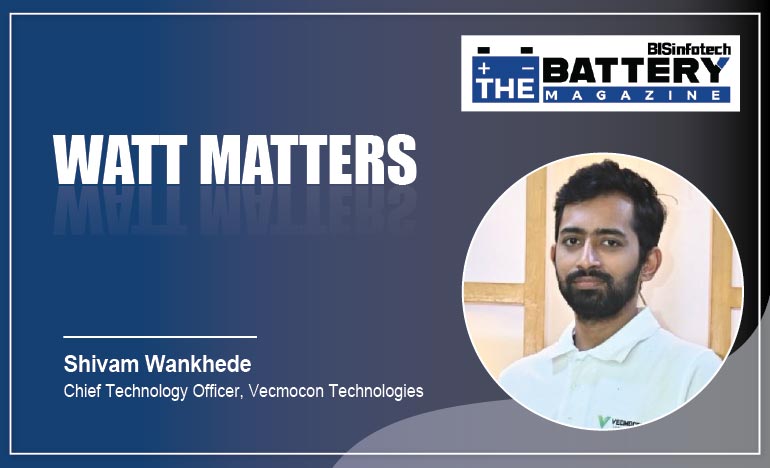
In this exclusive interaction with The Battery Magazine, Shweta Kumari, Sub-editor, engages in a detailed conversation with Shivam Wankhede, Chief Technology Officer at Vecmocon Technologies, to explore how battery management is transitioning from reactive monitoring to predictive, software-defined control. He highlights the evolution of real-time state estimation, fleet-level diagnostics across 100,000+ EVs, Indianised validation frameworks, battery swapping transparency, and the growing importance of compliance-ready data architectures.
As EV platforms diversify and localisation deepens, intelligence-led systems may define the next phase of India’s mobility transformation.
Let’s delve into the interview.
Vecmocon is often described as the “intelligence layer” of EVs rather than just a hardware supplier. From your perspective, what does true battery intelligence mean today—and how is it evolving beyond basic monitoring into prediction, prevention, and performance optimisation?
True battery intelligence today goes far beyond monitoring voltage, current, or temperature. The integration of cloud connectivity and edge AI capabilities has enabled EV systems to interpret data contextually and act intelligently in real time. Algorithms continuously adapt to usage patterns, environmental conditions, and cell-level behaviour, allowing systems to make dynamic decisions rather than simply report status. The shift underway is from reactive monitoring to predictive and preventive intelligence. Modern architectures can forecast potential failures, estimate internal battery states more accurately, optimise charging strategies, and enhance performance throughout the lifecycle. This transition is redefining batteries as software-defined systems, where intelligence directly drives safety, efficiency, and longevity.
India operates EVs under some of the toughest real-world conditions—heat, overloading, uneven duty cycles, and dense urban usage. What design choices in your BMS and vehicle intelligence architecture are specifically made for Indian operating realities, and how different are these from global benchmarks?
Indian operating conditions demand a fundamentally different design philosophy. We typically assume ambient temperatures up to 50°C and include overload scenarios — often up to 25% above nominal load — within our validation cycles. These parameters reflect real-world usage rather than idealised lab environments. Our systems undergo extensive testing beyond standard benchmarks, including ESD resilience, vibration endurance, humidity exposure, salt spray corrosion testing, thermal stress cycles, and long-duration reliability validation. The goal is to ensure stability under extreme environmental and operational stresses common in Indian mobility applications. Compared to many global benchmarks, our approach emphasises ruggedisation and adaptive intelligence to maintain performance in unpredictable real-world conditions.
Battery safety has moved from being a technical concern to a reputational and regulatory risk for OEMs. Based on fleet-level data across 100,000+ EVs, what are the most underestimated safety failure modes you see in the field—and how can intelligence-led systems mitigate them early?
One of the most underestimated risks is improper State of Power (SOP) planning and inaccurate understanding of battery capability under dynamic conditions. Batteries may appear healthy from basic monitoring metrics while internal stress or degradation mechanisms are progressing silently. Advanced techniques such as Electrochemical Impedance Spectroscopy (EIS) allow us to estimate impedance during runtime and infer core cell temperature and ageing trends. Intelligence-led systems can detect anomalies early, adjust power delivery dynamically, and trigger preventive interventions before safety thresholds are crossed. Moving toward predictive diagnostics significantly reduces failure probability and improves operational safety at scale.
Battery swapping is gaining momentum, but interoperability, pack health visibility, and liability remain grey areas. From a BMS and intelligence standpoint, what must change—technically and institutionally—for battery swapping to scale sustainably in India?
Sustainable battery swapping requires deeper transparency into pack health and standardised data visibility. Pack longevity depends heavily on both BMS intelligence and charging behaviour — faster charging, for example, can accelerate degradation if not managed intelligently. Interoperability remains technically challenging due to differences in pack sizes, connectors, architectures, and operating parameters. Meaningful scale may require regulatory standardisation or strong industry collaboration to define common protocols. Clear visibility into State of Health (SOH), pre- and post-swap diagnostics, and usage-based pricing models will also improve trust and accountability. From a user perspective, scaling swapping ecosystems will depend on reduced charging times, higher swap station density, real-time availability visibility, and dynamic route planning that integrates battery logistics into the driving experience.
As EV adoption grows, OEMs are shifting focus from range marketing to lifecycle economics and uptime. How do data-driven insights from BMS and VIM systems influence decisions around warranty models, total cost of ownership, and fleet economics?
Data-driven intelligence enables OEMs to move from generic assumptions to evidence-based decision-making. Continuous monitoring of degradation patterns using techniques like impedance analysis allows ageing rates to be managed more effectively, reducing unexpected failures and extending battery life. Driving behaviour, environmental exposure, and geo-specific usage data can inform dynamic warranty models that reflect real-world conditions rather than static assumptions. Predictive analytics also enables pre-emptive maintenance or battery replacement, improving uptime and lowering lifecycle costs. Over time, this opens opportunities for innovative models such as performance-based incentives, buyback programs, and usage-linked service offerings.
Localisation is no longer just about manufacturing—it’s about design ownership and system control. Which parts of the EV electronics and intelligence stack do you believe India must indigenise next to reduce long-term dependency and improve resilience?
India has made meaningful progress in localising core hardware manufacturing, but the next phase of indigenisation must focus on advanced system architectures and deep technology ownership. This includes sophisticated BMS designs such as active balancing systems, high-voltage BMS architectures, contactor-based safety systems, telecom-grade BMS solutions for stationary energy infrastructure, and scalable master-slave configurations required for large battery packs and commercial EV platforms. Equally important is the localisation of embedded intelligence — state estimation algorithms, safety analytics, and energy optimisation software that define system performance. As battery systems become increasingly connected, cybersecurity must also become a foundational design layer to protect vehicle networks, cloud interfaces, and OTA upgrade pathways from emerging threats. Owning these advanced layers of battery intelligence and system architecture will not only reduce long-term dependency on external technologies but also enable India to build resilient, adaptable platforms tailored to its unique mobility and energy ecosystem.
With upcoming regulations, standardisation efforts, and discussions around battery passports and traceability, how prepared is India’s EV ecosystem from a data, software, and compliance-readiness perspective—and where do you see the biggest gaps?
The ecosystem is evolving, but several gaps remain. Low-cost telematics solutions capable of reliably transmitting dynamic battery data are still limited, and there are insufficient incentives encouraging OEMs to integrate advanced data architectures into battery packs. Future compliance frameworks such as battery passports will require both static identifiers and dynamic operational data — including accurate SOH estimation. However, many current systems lack sufficiently robust BMS architectures to calculate these parameters with high confidence. Strengthening data infrastructure, improving state estimation accuracy, and creating regulatory incentives for data transparency will be critical steps toward compliance readiness.
Looking ahead to the next 3–5 years, as battery chemistries diversify and EV platforms mature, what role will software-defined batteries and intelligence-led architectures play in shaping the future of mobility and energy storage in India?
Software-defined batteries will become central to managing increasing complexity as chemistries diversify and use cases expand. Adaptive intelligence will enable real-time optimisation of safety, performance, and lifespan across different operating scenarios. Intelligence-led architectures will accelerate integration through OTA updates, modular software platforms, and improved interoperability across EV ecosystems. At the same time, predictive analytics and cloud-connected battery intelligence will transform mobility into a data-driven ecosystem, improving fleet efficiency, energy management, and lifecycle value.
 Electrify your feed! Click here to join our Whatsapp group and to get the latest updates, expert insights, and innovations driving India’s energy storage revolution.