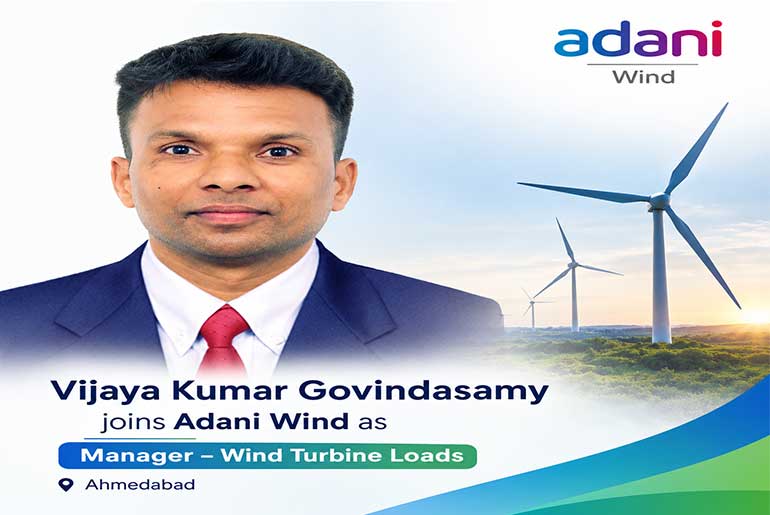
Vijaya Kumar Govindasamy has joined Adani Wind as Manager – Wind Turbine Loads, marking his move into a new role focused on one of the most technically critical areas of wind-turbine engineering.
Govindasamy brings specialised experience in wind turbine load analysis, aeroelastic simulations, structural analysis and certification, with professional exposure spanning both onshore and offshore wind energy. His career has combined engineering work in the wind industry with research focused on offshore structures, giving him experience across turbine design, structural behaviour and technical evaluation.
Before joining Adani Wind, Govindasamy worked with UL Solutions as a Wind Turbine Loads & Certification Engineer. His professional profile identifies him as a specialist in wind-turbine load analysis, simulation and certification. His work at UL Solutions included areas related to wind-turbine certification and technical evaluation.
His experience in wind turbine loads also extends back to Senvion India, where he worked as a Wind Turbine Loads Engineer. During his earlier industry career, he was involved in areas including aeroelastic simulations, turbine performance analysis and design optimisation.
His professional journey has therefore remained closely linked to the engineering side of wind-turbine development, particularly the assessment of loads and structural responses that are central to turbine design and certification.
Govindasamy’s academic background adds another dimension to his wind-energy expertise. He pursued his doctoral research at the Indian Institute of Technology Madras (IIT Madras) in the Department of Ocean Engineering, with research centred on offshore wind-turbine structures and wave interactions.
Research records list his work on the hydrodynamic behaviour of offshore wind-turbine substructures, including studies of breaking-wave impact on monopile structures. His published research includes work on breaking-wave impact pressures and forces on offshore wind-turbine support structures.
He has also contributed to research on floating offshore wind turbines. A 2024 paper in the Journal of Ocean Engineering and Marine Energy, for example, lists Govindasamy among the authors of research examining the coupled response of a floating wind turbine using a free-hanging solid ballast concept.
His academic work consequently provides a strong offshore-wind foundation alongside his industry experience in turbine loads and certification.
The move to Adani Wind comes as India’s wind-energy sector continues to develop larger and increasingly sophisticated turbine platforms, creating demand for engineering capabilities covering aeroelastic behaviour, structural loads, turbine performance, certification and design optimisation.
Govindasamy’s combination of industry experience and offshore-wind research places him at the intersection of these areas. His public professional profile also highlights experience with tools and technical areas including aeroelastic simulation, offshore wind turbines, Bladed, Flex5 and OrcaFlex.
His appointment at Adani Wind therefore represents another addition to the company’s technical talent base as the wind industry increasingly focuses on engineering optimisation, turbine reliability and the development of larger-generation wind assets.
At present, no further details such as a specific project assignment, reporting structure or new turbine programme associated with Govindasamy’s appointment have been publicly established in the sources reviewed. The confirmed development is his move to Adani Wind as Manager – Wind Turbine Loads, based in Ahmedabad.
Govindasamy’s background combines wind-turbine loads and certification experience with specialised offshore-wind research. That combination is particularly relevant to an industry where turbine design increasingly depends on accurately modelling aerodynamic, structural and environmental loads across increasingly demanding operating conditions.
Govindasamy’s move to Adani Wind could strengthen the company’s technical capabilities in wind-turbine loads, aeroelastic analysis, certification and structural engineering as India’s wind sector moves towards more advanced turbine technologies.
 Electrify your feed! Click here to join our Whatsapp group and to get the latest updates, expert insights, and innovations driving India’s energy storage revolution.