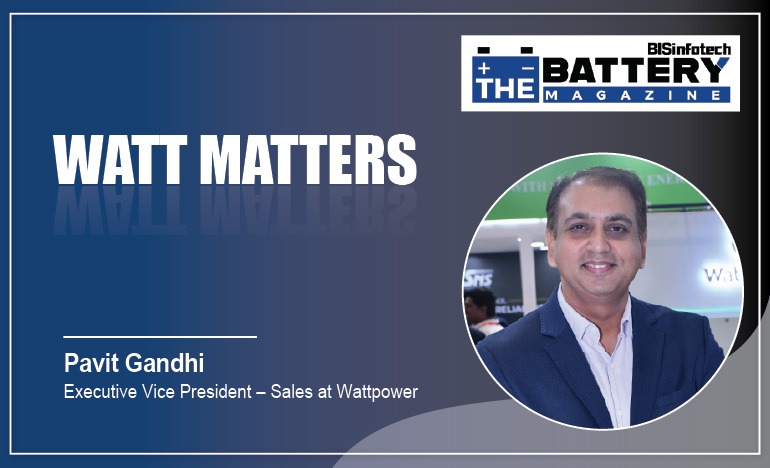
At the Renewable Energy India Expo (REI) 2025, The Battery Magazine engaged in a compelling conversation with Mr. Pavit Gandhi, Executive Vice President – Sales at Wattpower, a company redefining India’s renewable-energy landscape through cutting-edge inverter technology and advanced energy storage solutions. Mr. Manas Nandi, Editor-in-Chief of The Battery Magazine, sat down with Mr. Gandhi to discuss the brand’s journey, technological innovations, and its expanding presence across India’s solar ecosystem.
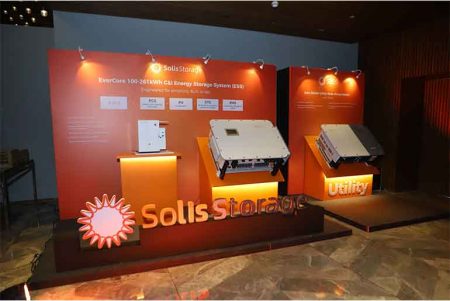
During the interaction, Mr. Gandhi spoke about Wattpower’s global foundation under its German parent company Wattkraft, and the company’s strategic decision to establish a 10 GW manufacturing facility in Chennai. With an initial focus on utility-scale string inverters, Wattpower is now rapidly venturing into the commercial and industrial (C&I) segment and battery energy storage systems (BESS) with its latest dual-stage string-based PCS solutions.
Emphasising safety, localisation, and R&D expansion, Mr. Gandhi shared Wattpower’s commitment to making India a hub for innovation-driven renewable manufacturing. Let’s delve deeper into this exclusive exchange to understand how Wattpower is empowering India’s clean-energy ambitions with precision engineering and sustainable technology.
How was Renewable Energy India (REI) 2025 for Wattpower this year?
REI 2025 has been remarkable for us. The overall engagement, awareness, and participation levels have been significantly higher compared to the previous editions. The knowledge about renewable energy and clean technologies is growing rapidly within the Indian market.
Government initiatives such as KUSUM and other major renewable-energy schemes have given a tremendous boost to the sector. This year, we have seen encouraging participation not just from large developers, but also from small and medium players who are showing genuine interest in solar and energy-storage solutions. The overall industry trend is clearly moving towards Battery Energy Storage Systems (BESS), and we see this as a strong sign of market maturity and diversification.
Wattpower was launched in Germany in 2013. How has the company’s global experience shaped its presence in India?
Wattpower’s parent company, Wattkraft, was established in Germany in 2013 as a solar distribution firm. After nearly a decade of experience in global solar and power-electronics markets, we brought that expertise to India.
We began operations here through product distribution before transitioning to full-fledged manufacturing. Based on a deep understanding of the Indian energy landscape and its evolving demand, we decided to invest strategically in India. In 2023, we commissioned our manufacturing unit in Chennai, which has an annual production capacity of 10 GW of string inverters.
Initially, our focus was on utility-scale projects, but we are now expanding into the commercial and industrial (C&I) segment, which offers significant potential for growth.
How do you assess the potential of the commercial and industrial (C&I) segment in India?
The C&I segment is extremely promising. As the residential market stabilises, we are seeing a rapid shift towards C&I installations. Industrial rooftops and factory spaces provide excellent opportunities for solar deployment.
While there are occasional variations in policy support, the overall framework is highly favourable. Businesses that understand the economic and sustainability benefits of renewable energy are increasingly adopting it. Presently, we estimate that only 15–20% of the C&I solar potential has been tapped, leaving vast room for expansion in the years to come.
Could you elaborate on Wattpower’s inverter product portfolio?
Certainly. Our journey began with a focused, single-product approach designed specifically for utility-scale applications. That conservative start allowed us to understand market requirements deeply and fine-tune our engineering and quality parameters.
Today, with our 10 GW manufacturing facility, we are meeting our projected targets consistently. Having achieved stability in utility solutions, we are now scaling production for the C&I segment and simultaneously investing in Battery Energy Storage Systems (BESS).
We are expanding our production line to include Power Conversion Systems (PCS) that will serve the storage market.
Are these products designed and manufactured in India?
Yes, our manufacturing is entirely based in India. The Chennai plant caters exclusively to the Indian market. As of now, our focus is on building a strong domestic base before exploring exports. However, in the near future, we plan to expand our export footprint to Europe and other international markets once our Indian operations reach optimal scale.
Can you tell us more about your Battery Storage Systems (BSS) and how they integrate with your product line?
Our BESS portfolio complements our inverter technology seamlessly. The system we have launched is a 5 MWh containerised solution, featuring complete safety from cell to container level.
At the core of this system is a string-based PCS (Power Conversion System) designed with a dual-stage converter architecture. This configuration enhances grid compliance, flexibility, and stability, making it ideally suited for Indian grid conditions.
Currently, the market is witnessing the growing adoption of such dual-stage PCS, which we believe will set a new benchmark in reliability and performance for energy storage systems.
Wattpower has been known for its technological precision. How are you ensuring safety across your products?
Safety is a critical design parameter for all our products. For our string inverters, we employ a unique string-level fault detection technology.
Each inverter is equipped with automatic disconnectors that constantly monitor temperature and performance parameters. If there is any abnormal rise in temperature at the connector or cable level, the system automatically disconnects the inverter to prevent faults or damage.
In our Battery Energy Storage Systems, multiple safety layers are implemented — from cell to pack to container level — supported by liquid cooling and cell-level optimisers. These ensure precise monitoring, optimal temperature management, and rapid response in case of anomalies.
Is the product design and R&D handled in India or overseas?
At present, the product design and R&D are primarily managed by our teams in Germany and China, as those facilities are equipped with advanced testing and development infrastructure.
However, we are actively expanding our product planning and management capabilities in India. The goal is to create a self-sustained innovation ecosystem here — from product planning & management and manufacturing to testing and integration. We expect this transition to take shape soon, and perhaps by next year, we will have more exciting updates to share in this area.
Finally, what message would you like to convey to your customers and partners?
We truly appreciate the trust our customers have placed in us. It is their confidence that drives our growth and innovation. We will continue introducing advanced technologies, reliable products, and stronger service support to help customers achieve the best performance and value from their renewable investments.
We remain committed to supporting India’s renewable energy transition with sustainable, efficient, and locally manufactured solutions.
 Electrify your feed! Click here to join our Whatsapp group and to get the latest updates, expert insights, and innovations driving India’s energy storage revolution.