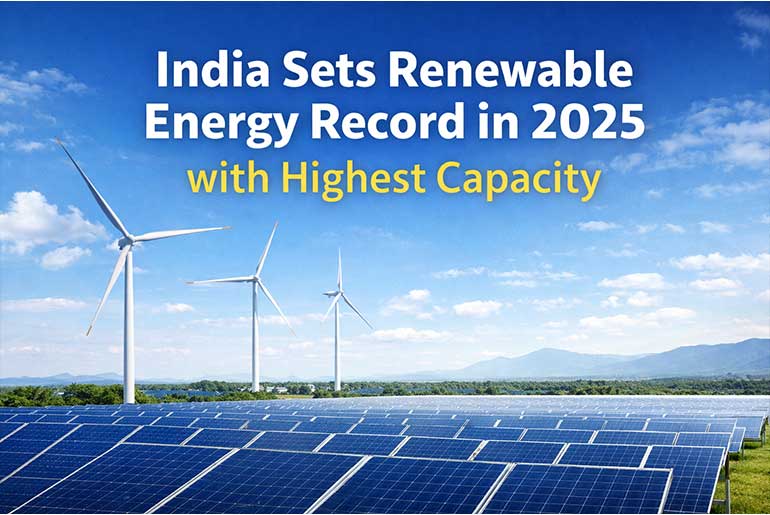
India’s clean energy transition crossed a historic inflection point in 2025, with the country recording its highest-ever annual renewable energy capacity addition and achieving major climate milestones years ahead of schedule. According to data released by the Ministry of New & Renewable Energy (MNRE), India added 44.51 GW of renewable energy capacity in 2025 (till November)—nearly doubling last year’s pace and firmly establishing renewables as the backbone of the nation’s power system.
This unprecedented expansion reflects not just scale, but a structural transformation of India’s electricity landscape—one where non-fossil fuels now dominate capacity additions, grid planning, manufacturing policy, and investment flows.
India Achieves 50% Non-Fossil Capacity—Five Years Ahead of Target
In line with the Hon’ble Prime Minister’s vision announced at COP26, India committed to achieving 500 GW of non-fossil energy capacity by 2030. In a remarkable acceleration of this roadmap:
- India achieved 50% non-fossil fuel share in installed power capacity in June 2025, five years ahead of its Nationally Determined Contribution (NDC) timeline.
- By November 2025, total non-fossil capacity reached 262.74 GW, accounting for 51.5% of India’s total installed electricity capacity of 509.64 GW.
- India crossed the 250 GW non-fossil milestone in August 2025, reinforcing its position as a global clean energy leader.
This shift signals a decisive departure from fossil-dominated capacity growth toward a renewables-first electricity system.
Record Renewable Additions: 44.5 GW in One Year
The scale of renewable deployment in 2025 is unprecedented:
- 44.51 GW of renewable capacity added (till November 2025)
- Nearly double the 24.72 GW added during the same period in 2024
- Total renewable installed capacity reached 253.96 GW, up 23% year-on-year
This momentum reflects stronger policy execution, faster tendering, improved grid integration, and growing confidence among developers and financiers.
Solar Power Leads the Surge, Crosses 132 GW
Solar energy emerged as the single largest driver of India’s renewable growth:
- 34.98 GW of solar capacity added in 2025, compared to 20.85 GW last year
- Solar installed capacity reached 132.85 GW, a 41% jump from November 2024
- India crossed the 100 GW solar milestone in January 2025
Large solar parks, CPSU-backed projects, rooftop solar under PM Surya Ghar, and falling equipment costs collectively powered this expansion.
India today ranks:
- 3rd globally in solar installed capacity (IRENA RE Statistics 2025)
Wind Energy Regains Momentum, Crosses 54 GW
After a period of slowdown, wind energy made a strong comeback:
- 5.82 GW wind capacity added in 2025, up from 3.2 GW last year
- Total wind capacity reached 53.99 GW, crossing the 50 GW milestone in March 2025
- Wind installations grew 12.5% year-on-year
Reforms under ALMM (Wind), domestic component mandates, and updated turbine certification processes helped revive investor confidence.
India now ranks:
- 4th globally in wind power capacity
Renewables Power More Than Half of India’s Electricity Demand
A defining moment came on 29 July 2025, when renewables met:
- 51.5% of India’s total electricity demand (203 GW) on a single day
This milestone underscores how renewables are no longer supplementary—but system-critical.
Massive Pipeline Points to Accelerated Growth Ahead
India’s clean energy expansion is far from peaking. As of 30 November 2025:
- 486.94 GW of renewable capacity (installed + under implementation + tendered)
- 509.32 GW of total non-fossil capacity pipeline, including nuclear
Solar alone accounts for:
- 237.43 GW (installed + pipeline)
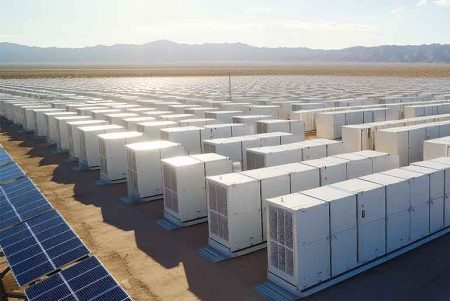
Hybrid, RTC, and firm dispatchable renewable energy (FDRE) projects—70.72 GW—highlight the growing role of storage-backed renewables.
PM Surya Ghar & PM-KUSUM Transform Rooftops and Farms
PM Surya Ghar: Muft Bijli Yojana
- 14.43 lakh rooftop solar systems installed in 2025
- Benefiting 18.14 lakh households
- ₹75,021 crore scheme targeting 1 crore homes by FY27
PM-KUSUM
- 10,203 MW solar capacity installed cumulatively
- 64% installed in 2025 alone
- Over 20 lakh agricultural pumps installed or solarized
- ₹2,706 crore expenditure in 2025
These schemes anchor renewable growth at the grassroots level, linking clean energy with livelihoods.
Green Hydrogen Mission Gains Industrial Scale
India’s National Green Hydrogen Mission progressed from policy to execution:
- 4.5 lakh TPA green hydrogen capacity awarded
- 7.24 lakh TPA green ammonia contracts finalized
- Global-low prices discovered (₹53.27/kg)
- Pilot projects launched in refineries, steel, transport, ports
- 128 hydrogen standards published
- 43 skill qualification packs approved
India is rapidly positioning itself as a global green hydrogen manufacturing and export hub.
Manufacturing Push: ALMM, PLI, GST Cuts Drive Self-Reliance
Key manufacturing milestones in 2025:
- 144 GW annual solar module manufacturing capacity under ALMM
- 81 GW added in 2025 alone
- 24 GW solar cell capacity enlisted under ALMM-II
- 11 GW module and 5 GW cell capacity added under PLI
- GST reduced to 5% on solar devices and components
- REEIMS portal launched to monitor imports and strengthen supply-chain transparency
India is transitioning from import dependence to manufacturing dominance.
Energy Storage, R&D, and Emerging Technologies Gain Focus
- National Conference on Energy Storage highlighted BESS as critical for grid stability
- IIT Bombay achieved 26% perovskite cell efficiency
- CSIR-NPL established India’s first national solar calibration standard
- National Geothermal Energy Policy notified
- Strong push for bioenergy, CBG, and biomass projects
Global Standing: India Among Renewable Superpowers
As per IRENA (2025):
- 3rd in Solar
- 4th in Wind
- 4th in Total Renewable Capacity
Conclusion: 2025 Redefines India’s Energy Trajectory
2025 will be remembered as the year when India’s energy transition moved from ambition to inevitability. With record capacity additions, early achievement of climate targets, manufacturing self-reliance, and storage-backed renewables gaining ground, India has firmly entered a new phase—where clean energy is no longer the alternative, but the default.
The scale achieved in 2025 sets the foundation for India’s march toward 500 GW non-fossil capacity by 2030—and toward global leadership in the clean energy era.
 Electrify your feed! Click here to join our Whatsapp group and to get the latest updates, expert insights, and innovations driving India’s energy storage revolution.