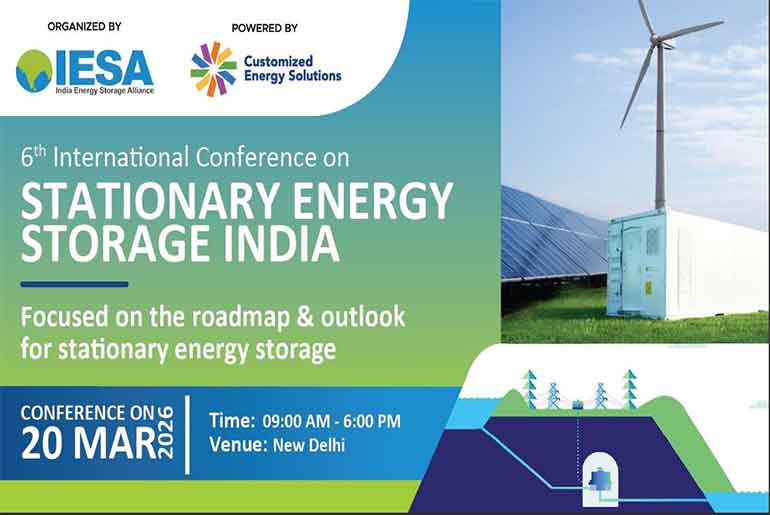
The 6th International Conference on Stationary Energy Storage India (SESI 2026) is set to bring together policymakers, utilities, technology providers, developers, and investors from across the energy ecosystem on March 20, 2026, at Hall Mogra, Room No. 404, IICC, Yashobhoomi, Dwarka, New Delhi. Organized by the India Energy Storage Alliance (IESA) and powered by Customized Energy Solutions, the conference will focus on shaping the roadmap and outlook for stationary energy storage in India.
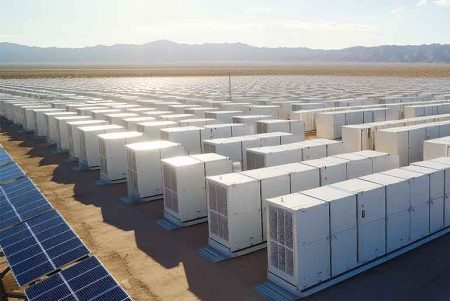
The event will serve as a critical forum for discussions around Battery Energy Storage Systems (BESS), Pumped Storage Projects (PSP), and emerging long-duration energy storage technologies, all of which are becoming essential for integrating renewable energy into India’s grid and ensuring reliability as renewable penetration grows.
India’s energy transition is accelerating rapidly. The country aims to achieve 500 GW of non-fossil fuel capacity by 2030, making energy storage systems indispensable for managing intermittency from solar and wind power while ensuring stable power supply.
Key Highlights of SESI 2026
SESI 2026 will feature a series of inaugural addresses, leadership talks, technical sessions, project showcases, and panel discussions covering the full spectrum of energy storage technologies and market developments.
The inaugural session will feature key industry leaders and policymakers including:
- Ajitabh Sharma, IAS, Additional Chief Secretary, Government of Rajasthan
- Akash Tripathi, Managing Director, Solar Energy Corporation of India (SECI)
- S. C. Saxena, Chairman & Managing Director, GRID India
These leaders will discuss the policy direction, infrastructure requirements, and regulatory framework needed to scale energy storage deployment across India.
The conference will also include specialized sessions such as:
- BESS Safety & Standards
Discussion on safety protocols and regulatory frameworks for battery storage systems. - Leadership Talk: The Journey to Utility-Scale BESS
Insights into large-scale battery deployment and grid integration. - Policy & Regulatory Fireside Chat
Featuring experts from the World Bank, SECI, and Apraava Energy, focusing on regulatory developments and market mechanisms for storage deployment
Technology Showcases and Industry Insights
Several technology demonstrations and project showcases will highlight real-world implementations and emerging solutions in the energy storage sector.
Sessions will feature innovations such as:
• Solar + BESS projects
• Battery manufacturing plants
• Battery Management Systems (BMS)
• Pumped hydro storage projects
• Energy management systems
• Merchant BESS projects
Industry experts from companies including Mahindra Susten, ReNew, Engie, Juniper Green Energy, and SPML will share insights into project development and grid-scale deployment strategies. A major panel discussion on Behind-the-Meter and C&I Applications will also explore how battery storage can support industrial and commercial energy users through cost optimization, grid stability, and energy management.
India’s Rapidly Expanding Energy Storage Market
The conference comes at a time when India’s energy storage market is witnessing significant growth. The country’s cumulative energy storage capacity has expanded from 122 GWh to 224 GWh, with over 60 GWh currently under execution and more than 80 GWh under tendering stages.
Industry analysts expect 2026 to become a milestone year, with around 5 GWh of energy storage capacity expected to come online, representing nearly a ten-fold increase in installed capacity compared to earlier years.
The deployment of large-scale battery projects by companies such as Adani and the emergence of merchant battery storage projects are also signaling the rapid commercialization of the storage market in India.
Looking Back: Key Takeaways from SESI 2025
The previous edition of SESI was held in Ahmedabad in April 2025, bringing together policymakers, regulators, and industry leaders to discuss India’s energy storage transition.
Key discussions during the conference highlighted:
- The importance of Viability Gap Funding (VGF) to support large-scale BESS projects
- The need to develop domestic battery manufacturing capabilities
- Expanding long-duration energy storage technologies beyond lithium-ion
- Strengthening safety standards and testing infrastructure for energy storage systems
 Electrify your feed! Click here to join our Whatsapp group and to get the latest updates, expert insights, and innovations driving India’s energy storage revolution.