
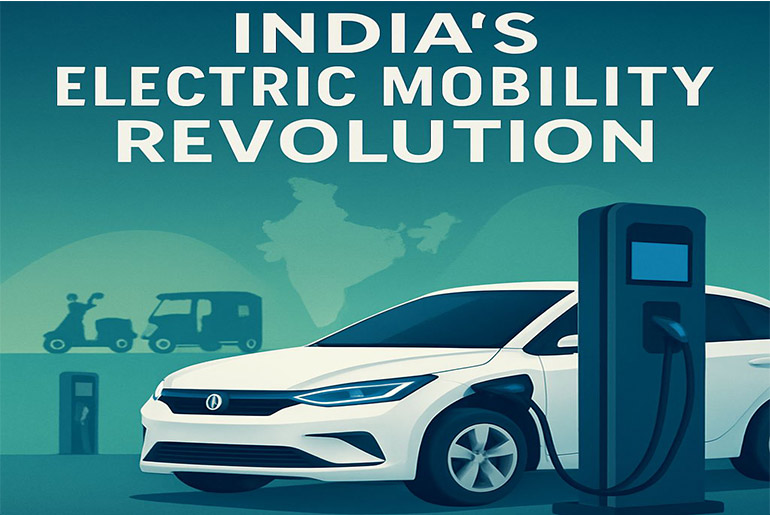
India’s transition to electric mobility is no longer a distant dream—it is unfolding rapidly, driven by ambitious government initiatives, growing environmental consciousness, technological advancement, and changing consumer behavior. As the world’s third-largest automobile market, India is poised to become a global hub for electric vehicles (EVs), both in manufacturing and adoption. Let’s look at the EV trends in India
Market Overview
The Indian EV market witnessed exponential growth over the last few years. In FY 2023–24, over 1.5 million EVs were sold, marking a 50% year-on-year growth, according to data from the Ministry of Heavy Industries. The two-wheeler segment dominates the space, followed by three-wheelers, which serve as a backbone for urban and peri-urban last-mile connectivity.
With strong policy pushes like FAME-II, PLI schemes, and state-specific EV policies, India aims to reach 30% electrification of new vehicle sales by 2030. Automakers are responding with increasing investments in EV manufacturing, battery localization, and charging infrastructure.
Key Trends Shaping India’s EV Revolution
1. Adoption of Electric Two- and Three-Wheelers
Electric 2W and 3W are an affordable and efficient vehicles being embraced by consumers much more quickly than in higher segments (with the exception of buses which have limited players in the Indian market for EVs). Climate change mitigation (diminished carbon footprints) and reductions in urban air pollution are major drivers for adoption of EVs in congested Indian market quaintities, bountiful 100% electric fleets (Yulu, Zypp, BluSmart) have emerged surrounding demand in shared mobility.
2. Local Battery Production Conundrum
Most lithium-ion cells are imported in India through a variety of leading vehicle manufacturers, battery producers and wide variety of organizations. The advent of battery (gigafactorships?) and manufacturing of cells as Reliance New New Energy, Ola Electric, Amara Raja, Exide and many more are ramping local production of lithium-ion batteries: significant importance for India is to reduce costs and thereby the potential of local productions, expanding their resources and potencial of having more domestic supply chains with unmeasured resilience.
3. Charging Infrastructure Initiatives
Yes, EV is definitely scaling it with public and private investment, especially the Place based charging or fast-charging along highways. Organizations like Tata Power, Statiq’s charge zone and BPCL have attempting to achieve EV objectives in regards to fast charging on highways and metro stations public electrolyserg conferences fastest to urge Governments to stipulate standards that ensure adequate access and interoperable charging systems
4. OEM Diversification and Global Collaborations
Automotive manufacturers can also be construed as retailers diversifying their electrification portfolios. Tata Motors, which wholesales the Nexon EV and Tiago EV, claims almost 70% of the passenger EV fleet market. The MG motor, Hyundai, and BYD appear to be more regional global enterprises and have brought a variety of ways to enhance EV strategies and road show innovation through tuning opportunities where other opportunities establish a trusted brand in India.
5. Battery Swapping Getting Traction
Battery swapping is gaining traction, especially in the commercial segments. Companies like SUN Mobility, Battery Smart, and RACE Energy are deploying ecosystems that replace energy quickly to keep delivery and fleet vehicles on the road and operating.
Policy Push and Support from Government
The electric mobility strategy in India is supported by a number of flagship programs:
- FAME-II (Faster Adoption and Manufacturing of Hybrid and EVs): With ₹10,000 crore funding for demand support and infrastructure.
- PLI Scheme for ACC (Advanced Chemistry Cell): With ₹18,100 crore funding to promote domestic battery cell manufacture.
- State EV Policies: States including Delhi, Maharashtra, Tamil Nadu, and Gujarat have instituted incentives for registration, road tax and charging station use.
Challenges That Still Exist
While there is significant momentum, many obstacles have to be overcome:
- Economic barriers, primarily high upfront costs of EVs, especially passenger vehicles.
- Range anxiety and limited charging facilities, especially in rural areas.
- Supply chain risks related to critical minerals (lithium, cobalt and nickel).
- No common battery technologies or recycling infrastructure.
The Way Forward
The next five years will shape India’s electric mobility narrative. Developments in solid-state batteries, hydrogen fuel cells, and grid integration might transform the sector. Also, government targets such as 100% electrification of public transport in a select number of cities and mandatory electrification of their fleets will stretch the envelope.
The private sector investment side, when combined with planned urbanization, digital integration of payments, and right manufacturing to lower energy consumption, will be essential to future-proof this green transition. EVs will play a central role in India’s, which aims to decrease emissions intensity by 45% by 2030, agenda for net-zero.
India’s EV ecosystem is definitely moving from a fledgling stage to a high-growth stage. With strong policy enabling, technological improvements, and increasing consumer demand, India aims to be an EV superpower. The scope, from two-wheelers to electric buses and from battery swapping to localized gigafactories, shows this ecosystem is rapidly evolving.
Given the pace of work we are able to see, it is important we also recognize some of the unresolved challenges—like infrastructure, affordability, and raw material security—that will be key. EV trends in India clearly highlight these persistent hurdles even as the sector gains momentum. As the EV transition becomes more inclusive and innovation-led, India’s electrification journey holds immense promise for a cleaner, greener, and more resilient mobility future.
 Electrify your feed! Click here to join our Whatsapp group and to get the latest updates, expert insights, and innovations driving India’s energy storage revolution.