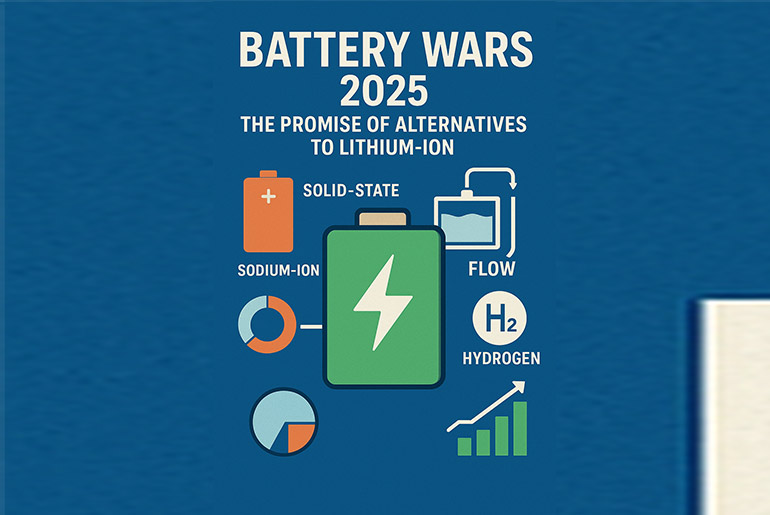
For over three decades, lithium-ion (Li-ion) batteries have been the backbone of the world’s energy transition—from powering smartphones to enabling electric vehicles (EVs) and storing renewable energy. Yet, as 2025 unfolds, cracks are appearing in lithium-ion’s dominance. Rising costs of lithium, cobalt, and nickel, growing geopolitical risks, environmental concerns, and supply chain vulnerabilities are pushing researchers, governments, and companies to search for viable alternatives. This has ignited what industry watchers are calling the “Battery Wars 2025”—a race to find scalable, affordable, and sustainable energy storage technologies that can challenge lithium-ion’s supremacy.
Why Lithium-Ion Can’t Win Alone
Lithium-ion technology still accounts for over 90% of the global rechargeable battery market (IEA, 2024). However, the challenges are hard to ignore:
- Supply Chain Pressures: Over 60% of lithium processing is controlled by China, while cobalt mining is dominated by the Democratic Republic of Congo. Any geopolitical tension or export restriction can disrupt global EV plans.
- Environmental Footprint: Extracting lithium consumes large amounts of water. According to the U.S. Geological Survey, producing one ton of lithium requires nearly 500,000 gallons of water.
- Cost Volatility: Lithium carbonate prices surged to $80,000 per ton in late 2022 before cooling, highlighting volatility risks for EV makers.
- Recycling Bottleneck: Less than 5% of lithium-ion batteries are currently recycled globally.
Clearly, while Li-ion will remain important, the global battery ecosystem must diversify.
The Emerging Alternatives
1. Sodium-ion batteries
- Importance of Sodium-ion batteries: There are 1,000 times as much sodium as lithium, making supply risk much lower.
- Manufacturers that are making sodium-ion batteries: CATL of China is the only commercial sodium-ion EV battery manufacturer as of late 2023, with mass production possible in 2025. India’s Reliance is exploring sodium-ion batteries with various partnerships.
- Performance: While sodium-ion batteries may have a lower energy density (~160 Wh/kg) than lithium-ion (~250 Wh/kg), their performance in cold weather is better and they can be cheaper.
2. Solid-state batteries (SSBs)
- Importance of Solid-state batteries (SSBs): The big play of solid-state batteries is replacing the liquid electrolyte with either solid ceramic or polymers, making them safer and more energy dense.
- Market Potentials of SSBs: Three well know manufacturers are taking solid-state batteries seriously, with sizable investments (billions). Toyota announced a prototype SSB with nominal range of 1,200 km and charging in 10 minutes by 2027.
- Challenges: High manufacturing costs, scalability, and durability.
3. Lithium-Sulfur (Li-S) Batteries
Strengths: Theoretically can store 5 times more energy than Li-ion, and sulfur is cheap and plentiful.
Progress: Researchers at the Indian Institute of Technology (IIT) have been working on Li-S prototypes funded by India’s Ministry of New and Renewable Energy.
Challenges: Their pronounced short lifespan (-350 times) is due to the “shuttle effect” when sulfur dissolves.
4. Flow Batteries (Vanadium and beyond)
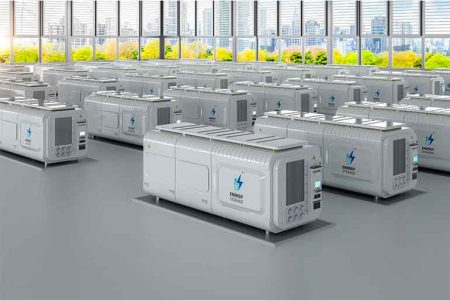
- Why flow batteries matter: The best option for renewable energy storage at the grid-scale; they provide an excellent cycle life and safety benefits.
- The global flow battery market is anticipated to grow from $300M USD in 2022 to $1.2B USD by 2030. (Allied Market Research)
- India-led efforts: NTPC and some state discoms are considering the technology for vanadium redox flow batteries with solar farms.
5. Hydrogen-Based Storage
Significance: Green hydrogen and fuel cells could substitute batteries for heavy-duty transport and storage on the grid.
Investments: Under India’s National Green Hydrogen Mission (2023, ₹19,744 crore budget), funding has been allocated towards hydrogen storage initiatives.
Outlook: still face challenges due to infrastructure and costs.
Global Market Dynamics
According to BloombergNEF’s 2025 Energy Storage Outlook:
- By 2035, non-lithium batteries could capture 25–30% of the market.
- In stationary energy storage sodium-ion batteries are expected to be the predominant technology, and solid-state batteries could lead premium EV sectors.
- Both the US and EU are funding aggressive research into alternatives to Chinese lithium supply chains.
India’s Role in the Battery Wars
India is in a strong position.
- The Production Linked Incentive (PLI) Scheme – ₹18,100 crore – is driving Advanced Chemistry Cell (ACC) manufacturing and will provide manufacturer’s alternatives to making it in China.
- ISRO is researching solid-state or metal-air batteries for use in space and defence applications.
- The private sector is taking steps too. Reliance, Ola Electric and Exide are looking for opportunities around sodium-ion and solid-state.
- If India can accelerate its production of sodium-ion or Li-S at scale, India could leap-frog into a dominant player.
What This Means for the Consumer and the Industries
- EV Consumers: Expect some safer, cheaper, faster charging batteries to come online in the next 3–5 years.
- Energy Companies: Flow batteries and sodium-ion will contribute to greater reliability in renewables.
- Investors: A central thesis of investor diversification into alternative chemistries is to avoid over-exposure that has come with lithium volatility.
Conclusion
The lithium-ion Battery Wars of 2025 will not be about replacing lithium-ion anytime soon, but rather parallelization and resiliency. It will continue to play a dominant role for the foreseeable future. Sodium-ion, solid-state, lithium-sulfur, flow batteries, and hydrogen all have their own advantages.
As the world races toward net-zero, the real victory will belong not to a single technology but to a portfolio of energy storage solutions that balance cost, performance, and sustainability.
The next decade will decide which alternatives become mainstream—and which remain niche. For now, the wars have only just begun.
 Electrify your feed! Click here to join our Whatsapp group and to get the latest updates, expert insights, and innovations driving India’s energy storage revolution.