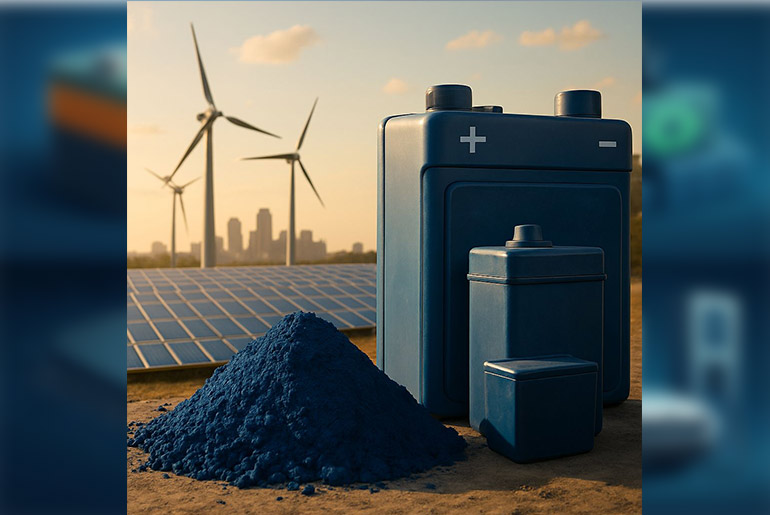
Imagine a world where the power grid is fed by a pigment once used in 18th-century paintings. That future is here—and it’s electric. At the intersection of chemistry, art history, and energy tech lies an unlikely hero: Prussian Blue. While it started as the first synthetic dye discovered by accident in a Berlin lab in the early 1700s, this brilliant blue pigment has re-emerged three centuries later—not as paint, but as a cornerstone of next-generation sodium-ion batteries.
In a world hurtling toward electrification, where lithium prices are volatile and rare earths are geopolitically complex, battery scientists are turning to the periodic table’s more abundant cousin—sodium. And to hold these bulky ions in place? Enters Prussian Blue.
From Pigment to Power
Prussian Blue’s vibrant past is only part of its allure. Its open-framework crystal structure, consisting of iron and cyanide bridged in a cubic lattice, just happens to be perfectly suited for sodium-ion intercalation. Think of it as a molecular sponge—with ample room for sodium ions to move in and out.
This structure enables rapid ion transport, high capacity retention, and safe, low-cost battery cycling. It doesn’t swell or degrade as quickly as other materials do, making it ideal for stationary grid storage and commercial battery applications.
How It Works: A Quick Dive
At the heart of the Prussian Blue cathode lies a cage-like framework that can trap and release sodium ions reversibly. Compared to traditional lithium-ion materials, it offers:
- High voltage (up to 3.8V)
- Long cycle life (10,000+ cycles reported)
- Rapid charge/discharge rates
- Compatibility with aqueous and solid electrolytes
- Most importantly, it’s cheap, non-toxic, and easy to synthesize.
Who’s Driving the Innovation?
1. Natron Energy (USA):
The global leader in Prussian Blue-based sodium-ion batteries. Their systems are already being deployed in industrial UPS, data centers, and telecoms—with charging times under 8 minutes and cycle lives surpassing 50,000.
2. Faradion (UK/India):
Now part of Reliance, Faradion is scaling sodium-ion batteries (some with PB variants) for two-wheelers, grid storage, and even electric buses in India.
3. HiNa Battery (China):
One of the first companies to commercialize PB cathodes for grid-scale energy storage, with large-scale pilot lines already in operation.
Circular Energy: Safe, Scalable, Sustainable
In an era where circular economy and eco-friendly tech are no longer buzzwords but strategic imperatives, PB cathodes check all the right boxes:
- No cobalt, nickel, or lithium = zero conflict materials
- Environmentally benign = safe for large-scale use
- Sodium abundance = cost-effective scaling
And when paired with aqueous electrolytes, these batteries become non-flammable, making them ideal for densely populated areas and high-temperature regions.
Not Just an Alternative — A Disruptor
Prussian Blue isn’t just a workaround to lithium scarcity—it’s a chemistry disruptor. Here’s how:
- Innovation Impact
- PB Cathodes Stable, fast sodium storage
- Aqueous Electrolytes Fire-free battery architecture
- Low-cost Synthesis Localized, scalable production
- No Rare Earths Geopolitically safe supply chains
- Long Life Cycle Ideal for stationary/grid use
It’s not about mimicking lithium-ion anymore—it’s about outperforming it in the right sectors.
“Prussian Blue is to sodium-ion batteries what LFP was to lithium-ion: cheap, durable, scalable. It’s the chemistry that will unlock rural electrification, urban grid stability, and two-wheeler EVs in the Global South.”
What’s Next?
Hybrid Batteries: Creating hybrid batteries with PB and solid-state or dual-ion systems.
Smart BMS for Na-Ion: Development of battery management platforms that will enable the optimal performance of the given battery with PB.
Local Manufacturing: India, China, and Africa are poised to have suitable capabilities for producing PB for battery cathodes regionally.
Policy Push: As countries compete to push lithium alternatives, Prussian Blue will be riding the wave of the federal support of R&D and deployment.
The Bottom Line
While headlines scream about lithium-air, silicon anodes, and solid-state silver bullets. Prussian Blue is quietly building the backbone of the real-world battery revolution—one that’s cheap, local, and circular.
It’s a rare case where history and high-tech collide. The pigment that once adorned aristocratic art is now set to democratize energy storage worldwide.
In the new world of batteries, Blue is the new Green.
 Electrify your feed! Click here to join our Whatsapp group and to get the latest updates, expert insights, and innovations driving India’s energy storage revolution.