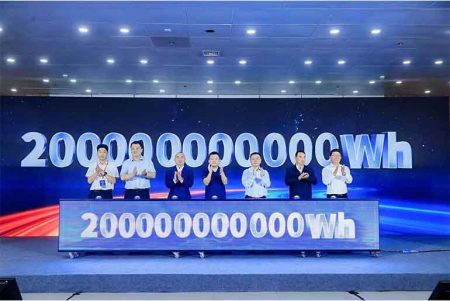
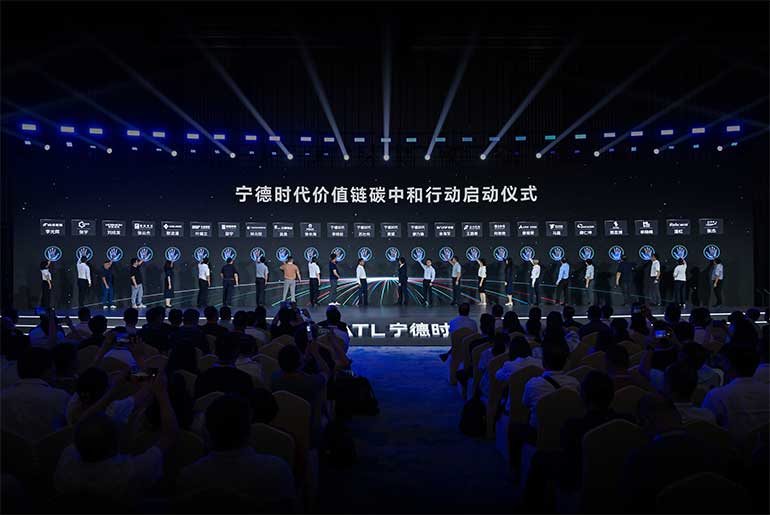
At a launch event held in Ningde on Monday, the company also called on global partners to accelerate decarbonization across the battery value chain. It announced procurement guidelines that require suppliers to provide carbon footprint data from 2027, and offers favorable terms to suppliers with better carbon emission performance.
“Before contributing to global carbon rules and standards, CATL must first prove what is possible through our own industrial practice,” said Robin Zeng, Chairman and CEO of CATL. “As the world ramps up efforts toward net-zero, zero-carbon batteries will not be a choice but a necessity in the near future. We are ready to share our technologies and experience with partners across the industry, helping to shape global carbon standards and advance industry-wide decarbonization.”
2025 Carbon Neutrality Target for Core Operations Delivered as Planned
Since the commissioning of our first battery factory in 2012, CATL has been exploring and validating every aspect of zero-carbon manufacturing. This has become an integral part of CATL.
Jiang Li, Vice President, Board Secretary and Head of Corporate Sustainable Development Management Committee of CATL, said, “Carbon neutrality cannot be built on estimates alone. It requires reliable data, clear boundaries and systematic execution.”
To build this data foundation, CATL independently developed the CATL Carbon Chain Management System (CCMS) in 2022 to monitor and calculate carbon emissions at its plants and production lines. To date, CATL CCMS has covered carbon data across battery production operations and core upstream suppliers, generating more than 1,000 product and raw material models.
Based on this data system, CATL embeds decarbonization efforts across process and equipment optimization, battery design, green energy consumption, raw‑material sourcing and recycling.
In 2025, zero-carbon electricity accounted for 100% of electricity consumption in its core operations, with more than 18 billion kWh of zero-carbon power consumed cumulatively since 2023. Energy consumption per unit of product at its battery manufacturing bases decreased by 28% compared with 2022, below the industry average. Its carbon emission intensity decreased by approximately 77% compared with 2022. From 2023 to 2025, CATL delivered a cumulative carbon reduction of over 10 million tons of CO₂ equivalent, comparable to Brunei’s total national carbon emissions in 2025.
The milestone not only marks CATL’s first fulfilled carbon neutrality commitment, but also sets a new benchmark for carbon neutrality practices in the lithium-ion battery industry.
Advancing Toward Full Value-Chain Carbon Neutrality by 2035
More than 80% of carbon emissions across CATL’s product lifecycle stem from its supply chain, with total value-chain emissions exceeding five times those generated in core operations.
Bryan Huang, Head of Procurement Center at CATL, said: “CATL will advance value-chain decarbonization across key areas including material innovation, material manufacturing, green logistics, and battery recycling. This requires collaboration across the entire battery value chain.”
In terms of data management, baseline carbon data has been established for more than 100 core Tier 1 suppliers, and CATL aims to progressively achieve 100% data coverage across key upstream links.
CATL plans to reduce emissions across four key areas: materials and process innovation, manufacturing, green logistics, and battery recycling. The company is developing lower-carbon materials and production processes, while targeting 100% renewable electricity use across its value chain by 2035. It also aims to promote zero-carbon logistics and expand its global battery recycling network through Brunp Recycling.
To further reduce supply-chain emissions, CATL will introduce Green Procurement Guidelines requiring new suppliers to provide product carbon footprint data. Supplier evaluations will also consider renewable energy use and energy efficiency, with stronger-performing suppliers potentially receiving greater order allocation and long-term partnership opportunities.
CATL will also launch its Zero-Carbon Supply Chain Empowerment Initiative, launching in-depth joint decarbonization initiatives with an initial cohort of 30 core suppliers.
The economics of zero-carbon opens substantial new growth opportunities. CATL is making strong efforts in zero-carbon mobility, zero-carbon power, and the electrification of industries, with several application scenarios already implemented. Together with global partners, CATL aims to expand the zero-carbon economy, accelerate the global clean energy transition, and help create a more sustainable future.
 Electrify your feed! Click here to join our Whatsapp group and to get the latest updates, expert insights, and innovations driving India’s energy storage revolution.