As the world accelerates toward deep electrification, the role of advanced batteries has never been more pivotal. By 2030, global energy systems will rely on technologies that deliver safe, intelligent and zero-carbon power across mobility, industry and the grid. Standing at the center of this global transformation is CATL, whose breakthroughs are continuously reshaping the technological and strategic contours of the bacattery ecosystem.
From next-generation sodium-ion chemistries and solid-state advancements to hybrid systems enabling extended range and ultra-fast charging, CATL is charting a roadmap that will influence markets worldwide. Equally transformative is its leadership in sustainability—through closed-loop circularity, zero-carbon factories, and material-level transparency—and its deep integration of AI across R&D, manufacturing and lifecycle management. These capabilities are redefining performance standards for EVs, grid-scale storage, renewable integration and advanced mobility applications such as aviation and maritime electrification.
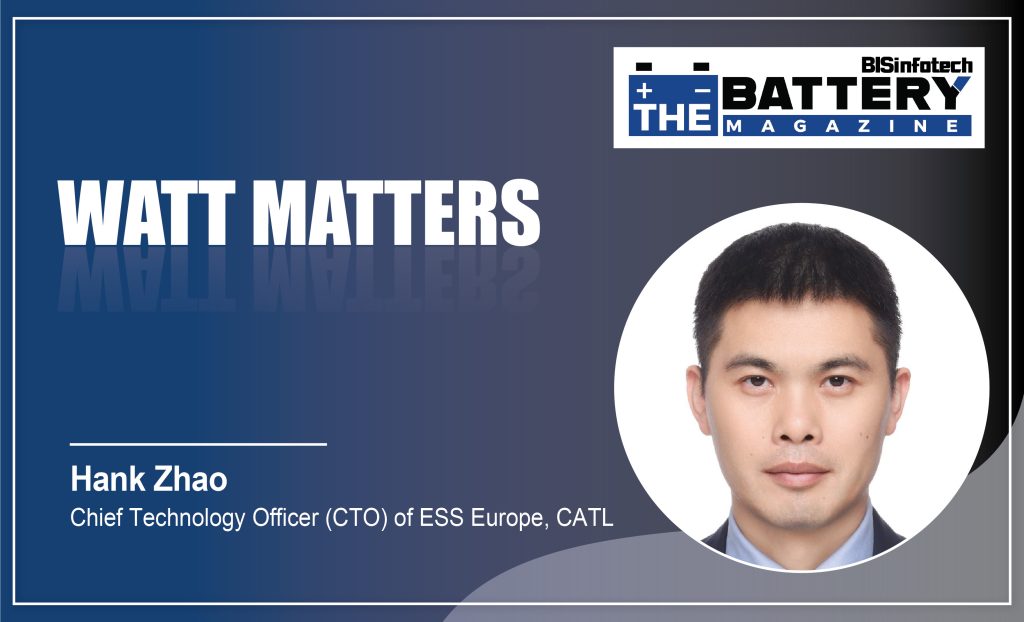
For this special edition, Shweta Kumari engaged in an in-depth conversation with Hank Zhao, Chief Technology Officer (CTO) of ESS Europe at CATL, who offered a comprehensive perspective on CATL’s innovation philosophy, global strategy, and the future of intelligent energy systems.
Let’s delve into the interview to uncover CATL’s vision for the next era of clean energy.
As the world’s energy systems transition towards electrification, how does CATL envision its role in shaping the global battery ecosystem by 2030 — across mobility, energy storage, and renewable integration?
Batteries as the cornerstone of electrification — fundamental components that enable the storage and transformation of energy, thereby playing a pivotal role in the global transition to clean energy.
CATL’s goal is to make high-quality energy technology accessible across the globe, helping to achieve international sustainability goals. CATL is not just a battery component manufacturer; we are a system solution provider and are committed to becoming a zero-carbon technology company.
To realize this vision, we are actively driving progress across three strategic pillars: zero-carbon transportation, zero-carbon power systems, and the industrial decarbonization.
To support the rapid electrification of transportation, we’ve built the world’s most comprehensive portfolio of battery solutions, spanning advanced batteries with diverse chemistries, battery swapping solution, and ultra-fast charging technologies.
In terms of power system, we are pioneering solutions that integrate advanced battery storage with AI-powered energy management, grid-forming capabilities, virtual power plants, and flexible control technologies. Our goal is to build truly intelligent, resilient, and zero-carbon electricity systems that bring clean energy around the world.
For industrial decarbonization, all CATL battery factories will achieve carbon neutrality by the end of this year. More importantly, we are leveraging our technologies and solutions to drive green transition in sectors like steel, cement, and chemicals. We are also working with global partners to build zero-carbon islands, industrial parks, and even entire low-carbon cities through integrated solutions that combine mobility, power, and industrial use.
CATL has consistently led breakthroughs in battery chemistry. Could you share the company’s roadmap for advancing next-generation technologies such as sodium-ion, solid-state, and hybrid systems — and their potential impact on global markets?
In 2021, CATL launched its first-generation sodium-ion battery, achieving the highest energy density in the industry at that time. Building on that momentum, we launched our second-generation Naxtra battery at Auto Shanghai this year, reaching 175 Wh/kg — again the highest globally for sodium-ion. Meanwhile, the Naxtra battery will be first applied in the Choco-Swap vehicle models in 2026. With significantly reduced reliance on lithium resources, sodium-ion offers a compelling alternative for the next wave of EV adoption. Most importantly, it solves the long-standing challenge of poor low-temperature performance, opening up a new path for electrification in colder, high-latitude regions.
CATL is among the global leaders in both the R&D and industrialization of solid-state batteries. We are targeting small-scale production by 2027, with initial applications in premium vehicles, robotics, and aviation. These batteries are the key to enabling the next generation of high-performance electric mobility.
CATL has pioneered hybrid battery systems that push the boundaries of range, safety, performance and reliability. In 2023, we launched the Freevoy Super Hybrid Battery, the first in the world to enable a pure electric range of over 400 km and 4C fast charging. This year, we unveiled the Freevoy Dual-Power Battery, making battery-battery extension possbile by integartging self-forming anode technology in the secondary energy unit. Designed for L3 and L4 autonomous driving scenarios, this hybrid system ensures a more stable and intelligent power supply, supporting longer trips and enabling smarter mobility. In geographically expansive regions like Europe and the U.S., where charging infrastructure is still catching up, hybrid technologies can provide extended range and help alleviate the range anxiety.
Sustainability has become central to CATL’s manufacturing and supply chain strategy. How is CATL reducing lifecycle emissions, promoting recyclability, and ensuring responsible sourcing across its global operations?
At CATL, sustainability is embedded in every link of our manufacturing and supply chain strategy, in 2024 alone, we advanced 310 energy-saving projects, equivalent to reducing the CO2 emissions of 264,600 tons. This is part of our broader commitment to green manufacturing. In fact, our Yibin facility was certified in 2022 as the world’s first zero-carbon battery factory, and as of today, CATL operates 10 zero-carbon factories, setting a new standard for the industry.Our goal is to achieve carbon neutrality in our core operations by 2025 and across the battery value chain by 2035.
CATL is actively building a closed-loop system encompassing battery production, application, cascade utilization, and recycling, supported by our subsidiary Brunp—the global leader in battery recycling. In 2024 alone, we recycled approximately 130,000 tons of end-of-life batteries, recovering 17,000 tons of lithium salts, with a 99.6% recovery rate of nickel, cobalt and manganese. Beyond industrial capacity, Brunp also plays a pivotal role in shaping the regulatory framework—leading or participating in over 80% of China’s lithium battery recycling standards. To further scale impact, we launched the Global Energy Circularity Commitment (GECC) initiative with the Ellen MacArthur Foundation, setting a clear directional goal: within 20 years, 50% of new battery production could be decoupled from virgin raw materials.
CATL independently developed the Carbon Chain Management System (CCMS), and promotes it to upstream suppliers. This system handles carbon emission data collection, modeling, calculation, and analysis, building a database covering carbon footprint data of almost all battery raw materials. It has so far encompassed over 800 products and raw material models, covering more than 130 suppliers and 40 material categories. Through this system, CATL engages suppliers in carbon reduction dialogues and regular performance assessments.
To enhance transparency and accountability across our global supply chain, CATL launched the CREDIT — transparency audit program on sustainable value chain, which consists of sustainable development management mechanism, business ethics code, environmental protection, labor practice, and responsible procurement. Through this program, we aim not only to ensure compliance with international ESG standards, but also to raise awareness and empower our supply chain partners to explore their own sustainability potential.
CATL continues to expand its international footprint through gigafactories and partnerships. What factors guide your global manufacturing decisions — and how do you balance localisation, resilience, and cost efficiency?
We expand our overseas presence by taking into considerations multiple factors including market demand, investment environment, development of local supply chain, availability of skilled labor and level of cost etc.
From intelligent BMS to AI-driven lifecycle analytics, how is CATL integrating digital technologies to enhance performance, safety, and predictive maintenance for global EV and ESS customers?
AI is accelerating the development of disruptive technologies across the battery industries. In battery manufacturing, as we are entering the TWh era, every facet of the value chain must scale exponentially without compromising quality or efficiency. The challenge lies in three areas: ultra-high production speeds, extremely intricate process flows, and unprecedented quality standards. At CATL, we address this by embedding AI across the whole process:
In R&D, we deploy AI-accelerated cross-scale simulation, integrating multi-dimensional materials data to enable intelligent battery design—from particle engineering to full-pack architecture.
In production, we apply precision AI-enabled equipment across key procedures such as coating, laser wielding, high-speed winding and so on, achieving 1 cell per second, 1 module every 20 seconds, and a coating speeds of 100 m/min. In coating, one of the most critical processes in electrode manufacturing, we apply slurry onto 5-micron copper foil with a thickness control of ±1 micron—achieving over 50% improvement in uniformity compared to industry standards. This is made possible by our self-developed intelligent coating system, which models over 1,000 powder-fluid combinations through AI-driven deep learning to optimize coating precision at the micron and milligram levels.
In quality control, we implement a closed-loop AI system with over 7,000 control points and 300+ inspection steps, driving a defect rate of PPB at cell level, which means only one defect part in one billion produced. Three orders of magnitude above the industry average. Our CCD vision inspection system, empowered by advanced algorithms and AI technologies, enables high-speed, high-precision automated inspection, replacing 99.9% of manual visual checks and the equivalent workload of over 3,000 human inspectors—significantly enhancing product quality and process efficiency.
CATL now operates the only three Lighthouse Factories recognized by WEF in the global lithium battery industry. Our Liyang facility stands as a global benchmark in smart manufacturing, leveraging Industry 4.0 technologies to build a fully digitalized and intelligent sustainable operations system. Through the integration of AI-driven management and inspection capabilities, the plant has achieved remarkable performance improvements: a 16% boost in factory energy efficiency, a 47% reduction in per-unit energy consumption, and a 60% increase in inspection efficiency.
Utility-scale energy storage is emerging as the next growth engine worldwide. What differentiates CATL’s energy storage systems in terms of technology design, safety, and total cost of ownership — and where do you see the strongest market traction globally?
For CATL, we view safety as our lifeline and foundational commitment. We believe that a truly sustainable energy future must be built on systems that are not only powerful and efficient, but also safe and stable. For a BESS power plant with a capacity of 1 GWh, it contains over one million cells, which imposes extremely high requirement for consistency and reliability of the whole system.
CATL has implemented multi-dimensional technologies that safeguard our products throughout their entire lifecycles. These technologies include intrinsic safety technology for cells, intelligent module safety control, systematic safety prevention and control, and the continuous iterative upgrading of digital, intelligent station-level safety management.
Drawing on over 20 years of lithium-ion battery design experience and collaboration with institutes, we have developed a comprehensive quality management system specifically for energy storage. This system not only controls battery quality to the PPB level but also incorporates probabilistic safety assessment (PSA) techniques to evaluate system safety levels and quantify safety design standards.
We have developed AI-driven TENER·SEES (Smart Electrical Energy Storage) platform with 99.99% fault prediction to ensure safety across diverse conditions.
To validate the effectiveness of the safety technology, CATL has built a safety validation platform to simulates the safety validation of energy storage systems in different power grid scenarios and reinforce the standards to pass the test. After the project is put into operation, by leveraging AI-powered risk monitoring and intelligent early warning, the platform constantly monitors the operation status and captures massive data for analysis.
The safety laboratory of CATL’s R&D and Verification Center for Energy Storage Technology is fully equipped for the evaluation and verification of thermal runaway propagation of large-sized energy storage products, which is the world’s first laboratory authorized by UL Solutions as UL9540A Witness Test Data Program (WTDP) for Modules and Units. The authorization represents UL Solutions’ recognition of CATL’s rigorous efforts to ensure safety and quality in accordance with international standards.
There is enormous global potential in the integration of AI with energy storage — not just as a technological trend, but as a foundational enabler of the zero-carbon future.
Global power consumption is projected to increase by 75% by 2050, with potential renewable energy investments exceeding USD 10 trillion over the next 25 years. As zero-carbon power systems accelerate worldwide, and more industries begin their decarbonization journeys, energy storage is no longer a one-size-fits-all solution. The market is calling for more intelligent, adaptive, and diversified storage capabilities. To meet these evolving needs, CATL is advancing cross-disciplinary innovation across multiple frontier areas — including AI-driven energy optimization, grid-forming storage systems, flexible dispatch control, and virtual power plants.
These technologies will be essential in creating resilient, intelligent, and cost-effective energy systems that not only store power, but also actively shape grid behavior and support large-scale renewable integration. In our view, this intersection of AI and energy storage will drive the next wave of high-value applications globally — especially in regions aiming to scale up renewables while ensuring grid stability.
Partnerships are key to scaling innovation. How does CATL approach collaborations with automakers, utilities, and technology firms to co-develop new solutions and accelerate the global clean energy transition?
We work closely with our partners to co-develop solutions that meet the evolving needs of different industries and regions. Our advanced battery products are already widely recognized for their safety and performance.
Ultimately, CATL’s goal is to make high-quality energy technology accessible across the globe, helping to achieve international sustainability goals.
Looking beyond 2030, what new frontiers in materials science, battery intelligence, or sustainability excite CATL the most — and how is the company preparing to stay ahead of the next wave of global disruption?
Our company has always regarded innovation as the core competitiveness. CATL maintains continuous innovation in four dimensions including material and electrochemistry system, structure system, green extreme manufacturing and business models. In materials science, we are pushing beyond conventional lithium-ion technologies — continuously improving energy density, safety, and lifecycle performance. At the same time, we are actively exploring next-generation chemistries with disruptive potential. Now, we have abundant technological reserves in frontier areas such as lithium-air batteries. We believe that the breakthrough from quantity to quality is not too far away. And we will continue to explore the boundaries of science by innovation.
Over the past decade, we have invested over 10 billion U.S. dollars in R&D – far more than any other players in the battery industry. Also, we have developed a world-leading R&D team of over 20,000 people, whose creativity and dedication are fueling our breakthroughs. Today, our portfolio of granted and pending patents exceeds 50,000 globally, marking the fastest growth in this industry.
CATL is driving comprehensive growth by continuously expanding into new application scenarios across all domains, from passenger vehicles to commercial vehicles, as well as electric ships, and electric aircraft.
- Commercial Vehicles:The adoption of new energy heavy-duty trucks has reached a record high, with CATL’s Tectrans battery becoming the top choice. For harsh conditions like mining and construction, we’ve developed high-strength versions to ensure durability and performance.
- Electric Ships:Over 900 ships powered by CATL batteries are now in operation across inland and coastal waterways. We also supported China’s first all-electric sea passenger ship and its first cargo ship battery-swapping project.
- Low-Altitude Mobility: Our two-ton eVTOL has successfully completed multiple complex flight tests. On November 22nd, our subsidiary Autoflight launched the world’s first integrated sea-air mobility solution, featuring a zero-carbon water-based vertiport that acts as both a floating hub and intelligent control center, showcasing the collaborative operational capabilties of water-based veriport and eVTOL under this innovatiove “water+low-altitude” model.
In addition to technological innovation, business model innovation is equally crucial. We are promoting the battery-swapping model based on “battery-vehicle separation,” with fully automated swapping process, vehicles can complete a full energy replenishment in just about 99 seconds. Recently, in collaboration with JD.com and GAC Group, we launched the “People’s Great Car,” based on the Choco-Swap system. This year, CATL’s “Choco-Swap Alliance” has expanded to 45 cities across China. By the end of the year, we will have built 1,000 battery swap stations, with a future goal of 30,000 stations globally.
 Electrify your feed! Click here to join our Whatsapp group and to get the latest updates, expert insights, and innovations driving India’s energy storage revolution.